
 Chinese
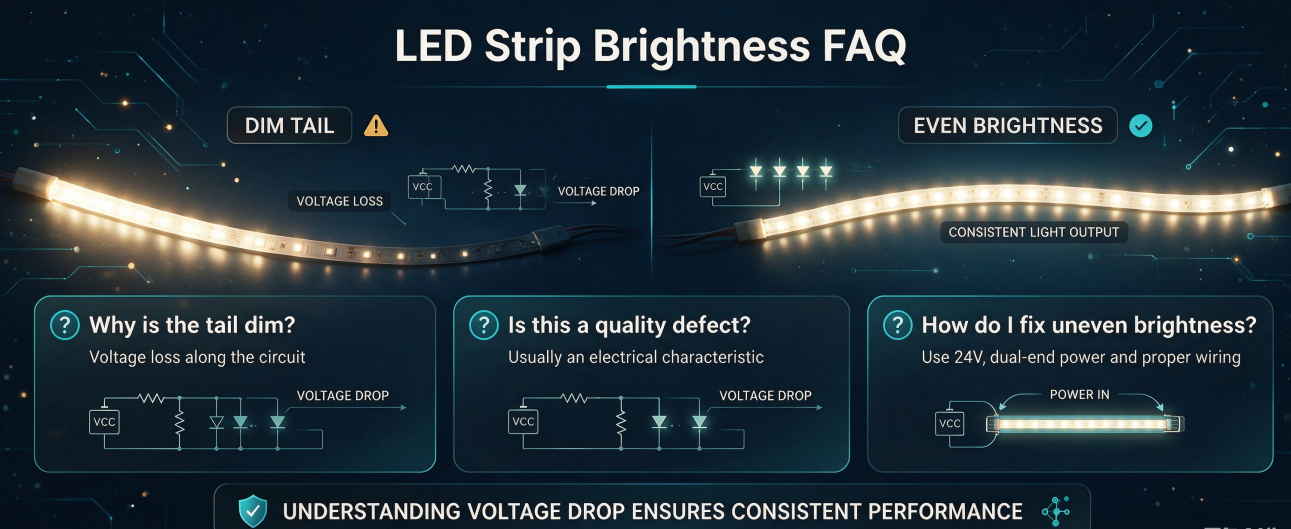
If you are a commercial lighting contractor, project engineer, wholesaler, or facility manager, you have likely encountered a common technical issue: the same LED strip light displays uniform high brightness at the power-input start section but gradually turns dim toward the tail end. This uneven brightness phenomenon frequently occurs in long-distance installation, large-scale commercial lighting projects, industrial decoration, and architectural lighting systems.
Many B2B clients mistake this issue for defective LED strips or product quality problems. In fact, front-bright-back-dim LED strip performance is mainly caused by voltage drop, a physical electrical loss issue in low-voltage LED lighting systems rather than product defects. This professional guide covers core causes of uneven LED strip brightness, key influencing factors, 12V/24V performance comparison, and practical industrial LED strip installation solutions, helping B2B enterprises fix dim LED strip tail issues and achieve consistent, stable, and long-lifespan LED strip lighting effects in engineering and commercial applications.
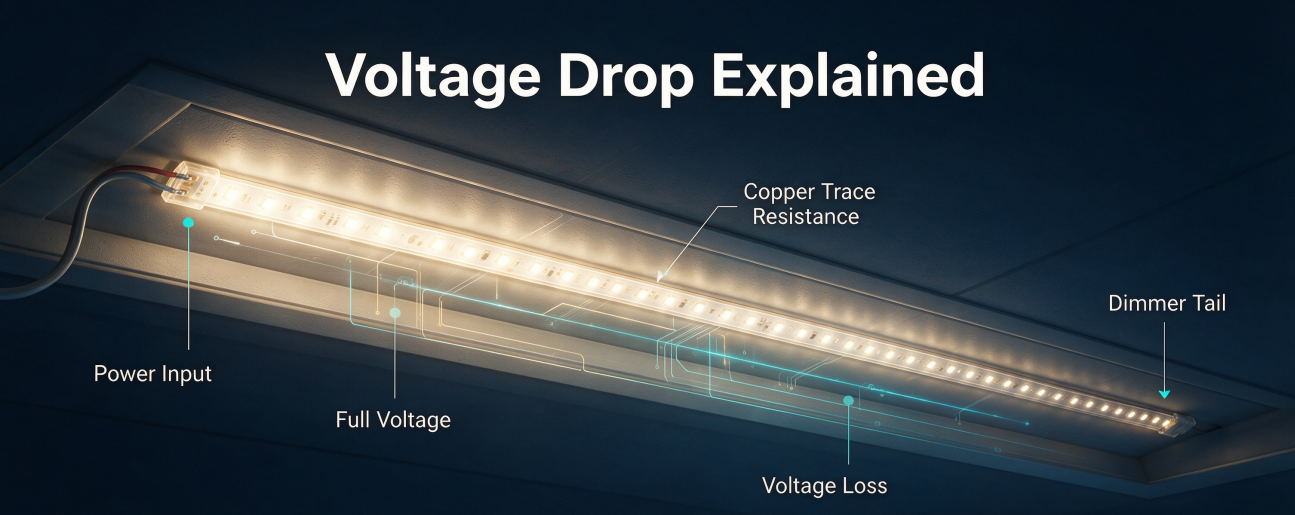
1. Core Cause: Voltage Drop in LED Strip Circuits
Nearly all low-voltage LED strips (12V/24V) adopt flexible PCB boards with thin copper traces. When electric current flows from the power supply end to the tail end of the LED strip, the copper traces and circuit wires generate inherent resistance. As the transmission distance increases, continuous voltage loss occurs, which is defined as LED strip voltage drop.
The front section of the LED strip is close to the power source and obtains the rated working voltage, so the LED beads maintain full-lumen brightness. The tail end suffers from accumulated voltage loss, leading to insufficient working voltage for LED chips. Consequently, the luminous flux decreases visibly, forming the typical front-bright-back-dim condition.
For B2B engineering scenarios, this issue is more prominent in ultra-long single-run installation, high-density LED strips, and high-power commercial lighting systems, which seriously affect the overall aesthetic and professional grade of lighting projects.
2. Main Factors That Aggravate Uneven LED Strip Brightness
Voltage drop is unavoidable in low-voltage LED circuits, but multiple external factors will amplify the brightness difference. The key influencing factors for commercial and industrial applications are summarized below:
- Excessive Single-Run Length: The longer the single installation length of the LED strip, the higher the cumulative circuit resistance and voltage loss. Single-point power supply for overlong strips is the top cause of tail dimming.
- Insufficient PCB Copper Thickness: Low-end LED strips adopt ultra-thin copper traces, which bring higher circuit resistance. Premium industrial-grade LED strips with thickened copper traces effectively reduce voltage drop and ensure long-distance brightness consistency.
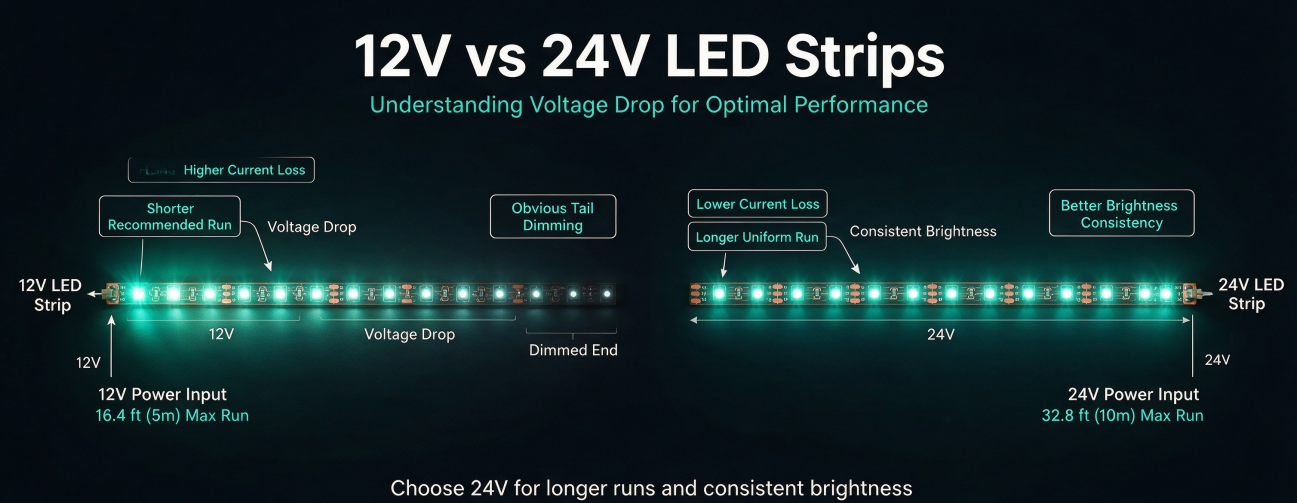
- Unmatched Voltage Specification: 12V LED strips have higher working current and more severe voltage drop than 24V models under the same power and length conditions, making them more prone to uneven brightness.
- Non-Standard Power Matching & Wiring: Undersized power adapters, over-thin connecting wires, and excessive wire distance between the driver and LED strip will increase circuit loss and worsen tail dimming.
- High-Load High-Density LED Strips: High-power, high-lumen, high-bead-density LED strips consume more current, accelerating voltage attenuation along the circuit.
3. Voltage Drop &Brightness Performance Comparison (12V vs 24V LED Strips)
For B2B project selection, voltage specification is the core factor affecting installation effect and construction cost. The following table intuitively compares the practical performance of mainstream 12V and 24V commercial LED strips in long-run installation scenarios:
| Performance Dimension | 12V LED Strip Lights | 24V LED Strip Lights | B2B Project Recommendation |
| Voltage Drop Degree | Severe, obvious tail dimming within 5m single run | Mild, stable brightness within 8-10m single run | Long-distance engineering prefer 24V |
| Max Single-Point Power Run | 3-5 meters (commercial standard) | 8-10 meters (commercial standard) | Long-span lighting uses 24V |
| Current Load | High current, high circuit loss | Low current, low circuit loss | 24V reduces line heating & loss |
| Brightness Consistency | Poor for long runs | Excellent for medium & long runs | Premium projects prioritize 24V |
| Applicable Scenarios | Short-distance indoor decoration, small retail displays | Commercial engineering, architectural lighting, supermarket, hotel, factory lighting | Most B2B bulk projects choose 24V |
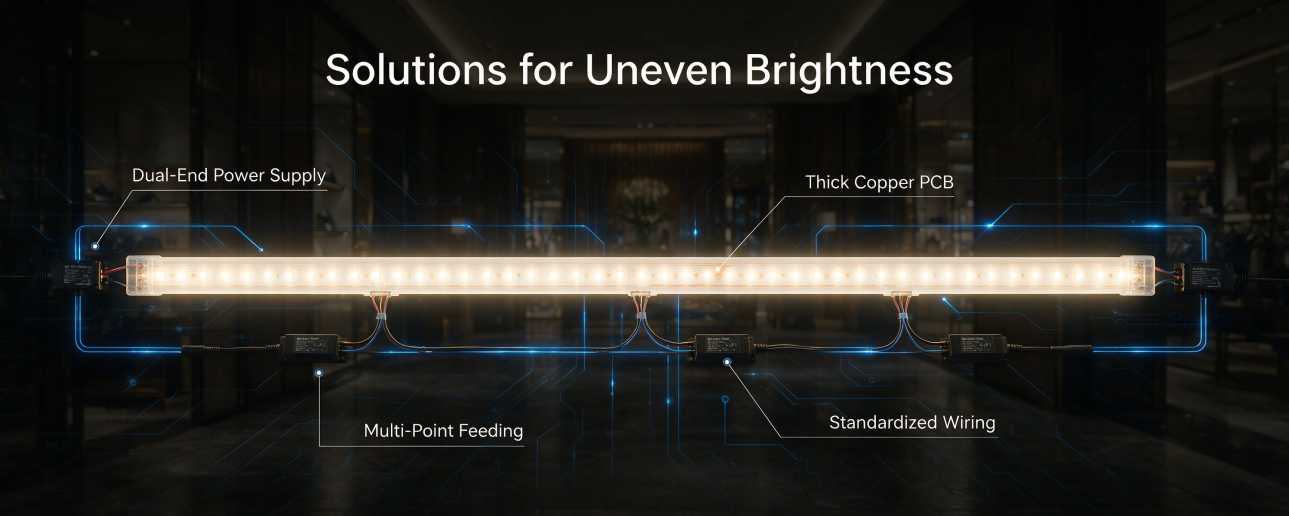
4. Professional B2B Solutions to Fix Front-Bright-Back-Dim Issue
Based on years of industrial LED strip R&D and engineering service experience, we summarize standardized, cost-effective solutions for commercial and industrial projects to completely solve uneven brightness caused by voltage drop:
4.1 Adopt Dual-End or Multi-Point Power Supply
For LED strips with a single run exceeding the standard length, supply power from both ends of the strip to balance circuit voltage. For ultra-long runs over 10 meters, adopt multi-point power feeding to eliminate cumulative voltage loss fundamentally. This is the most widely used solution in large commercial lighting projects.
4.2 Select Premium Thick Copper PCB LED Strips
Our industrial-grade LED strips adopt thickened copper trace PCB design, which effectively reduces internal circuit resistance, minimizes voltage attenuation, and maintains consistent luminous flux in long-distance operation. It improves project stability and reduces subsequent maintenance costs for B2B clients.
4.3 Match Appropriate Voltage &Power Drivers
Replace 12V strips with 24V high-stability LED strips for long-run projects. Equip with constant-voltage professional LED drivers with sufficient power margin to avoid voltage insufficiency caused by overloaded power supplies.
4.4 Optimize On-Site Wiring Construction
Use thick-gauge connecting wires, shorten the distance between the power driver and LED strip, and reduce wiring resistance and loss. Standardize construction to avoid virtual connections and circuit impedance increase.
5. FAQ – Professional Q&A for B2B LED Strip Lighting
We sort out high-frequency questions from engineering contractors, wholesalers, and project managers to solve on-site application doubts efficiently:
Q1: Is the front-bright-back-dim LED strip a quality defect?
A: It is not a product quality defect in most cases. This phenomenon is a natural electrical voltage drop characteristic of low-voltage LED strip circuits. Only extreme dimming within an ultra-short run may be caused by non-standard production or defective materials. Standard LED strips from formal manufacturers all have this physical feature under long single-point power supply conditions.
Q2: How much brightness difference is normal for LED strips?
A: For standard 24V commercial LED strips, the brightness attenuation within 10 meters of single-point power supply is controlled within 5%, which is invisible to the naked eye and meets commercial engineering standards. For 12V strips, slight brightness difference within 5 meters is normal; obvious dimming beyond 5 meters belongs to normal voltage drop performance.
Q3: Can voltage drop cause other failures besides uneven brightness?
A: Yes. Long-term voltage insufficient operation will lead to color temperature drift, flickering lights, reduced LED bead lifespan, and even unstable startup of high-power strips. Standard voltage drop optimization is conducive to long-term stable operation of lighting systems and reduces project after-sales risks.
Q4: What is the most cost-effective solution for bulk B2B projects?
A: For large-scale hotel, supermarket, office, and architectural lighting projects, we recommend 24V thick copper PCB LED strips + dual-end power supply. This solution balances product cost and construction difficulty, ensures overall lighting consistency, and improves project delivery quality.
Q5: How to avoid voltage drop problems in the early project design stage?
A: In the design phase, confirm the single-run installation length in advance, select 24V high-stability LED strips for long-distance layouts, reserve multi-point power supply positions, and match high-quality constant-voltage drivers. Our professional engineering team can provide free customized lighting layout and power matching solutions for B2B bulk orders.
The front-bright-back-dim issue of LED strips is a solvable voltage drop problem rather than a product quality fault. For B2B commercial and industrial lighting projects, standardized product selection, reasonable power supply design, and standardized construction can completely eliminate uneven brightness, realizing long-term stable, consistent, and high-quality LED lighting effects.
As a professional LED strip manufacturer focusing on B2B engineering and wholesale services, we provide high-consistency industrial-grade LED strips, customized lighting solutions, one-stop engineering matching services for global contractors, distributors, and project enterprises. All our products adopt strict quality control standards to ensure stable luminous performance and low voltage drop for long-run installations.
Facebook:https://www.facebook.com/profile.php?id=100089993887545
Instagram:https://www.instagram.com/mingxuelighting.factory/
YouTube:https://www.youtube.com/channel/UCMGxjM8gU0IOchPdYJ9Qt_w
LinkedIn:https://www.linkedin.com/company/mingxue/
Post time: Jul-23-2026