
 Chinese
LED strip lights are a preferred lighting solution for commercial spaces, retail displays, architectural lighting, residential decoration, and industrial accent lighting, thanks to their high energy efficiency, long lifespan, flexible installation, and low maintenance costs. However, LED strip lights flickering is one of the most frequent issues encountered by installers, business contractors, and end-users during post-installation operation. Subtle strobing, random blinking, or consistent low-frequency flicker not only compromises lighting aesthetics and visual comfort but also affects project quality, commercial display effects, and even the service life of your LED strip lighting system. Mastering how to fix flickering LED strips is essential for both household users and commercial lighting project teams.
As a professional B2B LED strip manufacturer serving global distributors, engineering contractors, and lighting solution providers, we have summarized decades of field installation experience. This guide breaks down the core LED strip flicker causes, provides actionable troubleshooting methods, and shares professional prevention strategies to help you achieve stable, long-term flicker-free LED lighting operation for all commercial and residential projects. Our tailored commercial LED strip flickering solutions fit large-scale engineering and bulk procurement scenarios perfectly.
1. Most Common Causes of LED Strip Flickering (Commercial & Residential Scenarios)
LED strip lights flickering rarely stems from a single factor. In most B2B lighting projects, the problem is caused by mismatched system configurations, non-standard installation, incompatible accessories, or low-quality supporting components. We classify and explain the mainstream LED strip flicker causes below with targeted solutions to help users quickly troubleshoot and fix flickering LED strips.
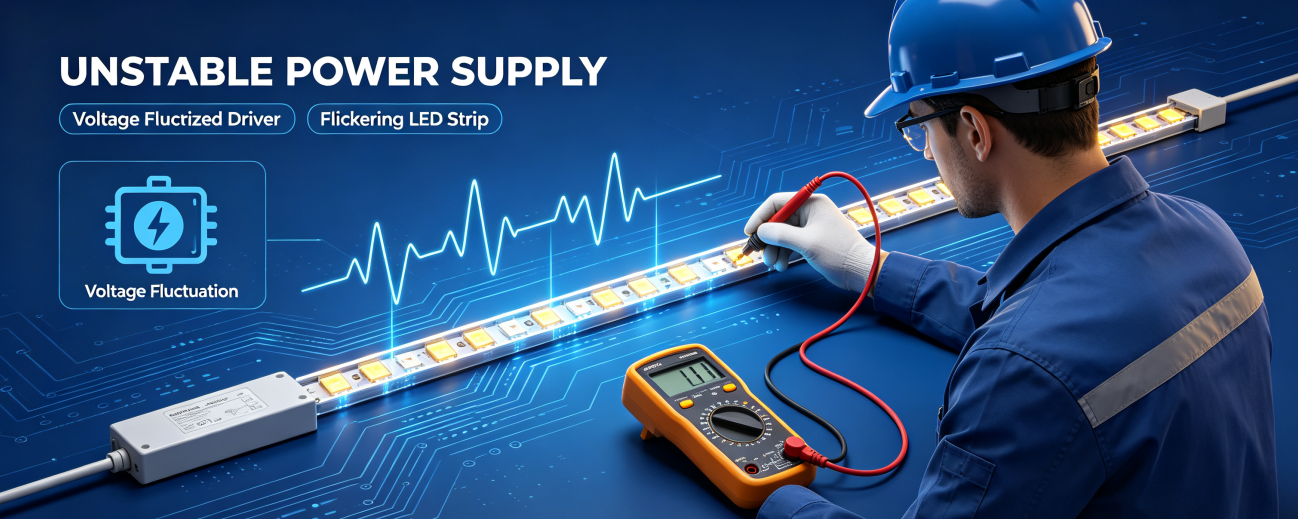
1.1 Unstable or Undersized LED Power Supply (No.1 Cause)
LED strips require a constant and stable voltage/current output to maintain normal operation. Most flickering issues in engineering projects are triggered by unqualified or undersized LED drivers. Many users and junior installers choose generic power adapters without calculating the total load wattage, leading to insufficient power output, voltage fluctuations, and intermittent current supply.
For long-distance LED strip layout (over 5 meters in commercial continuous lighting projects), ordinary power supplies cannot sustain continuous and stable output under full load, resulting in obvious flicker, brightness dimming, or periodic strobing. In addition, unregulated power supplies with poor ripple performance will cause low-frequency flicker invisible to the naked eye but harmful to human eyes and camera shooting scenarios.
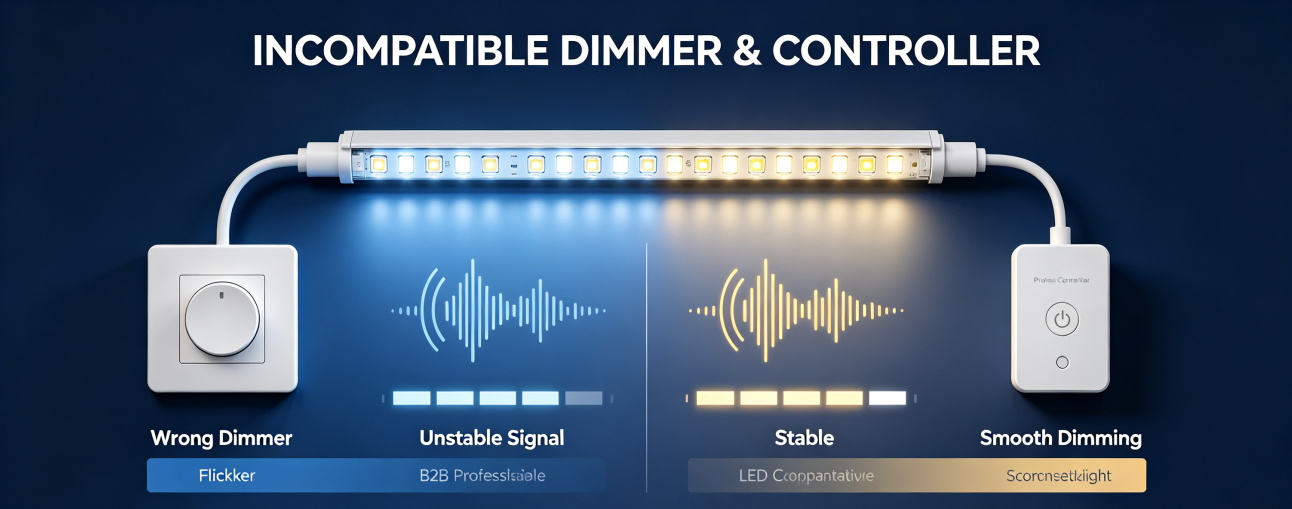
1.2 Incompatible Dimmer & Controller Matching
Dimmable LED strip systems are widely used in hotel lighting, mall display lighting, and smart home scenarios. Mismatched dimming accessories are a key flickering trigger. Traditional TRIAC dimmers designed for incandescent lamps cannot match low-voltage constant-voltage LED strips, causing current oscillation and continuous flicker. Meanwhile, low-quality PWM dimmers with unstable signal output will lead to irregular brightness changes and strobing.
In B2B customized lighting projects, mismatched communication protocols between smart controllers and LED strips will also cause intermittent flickering during brightness adjustment, color switching, or mode conversion.
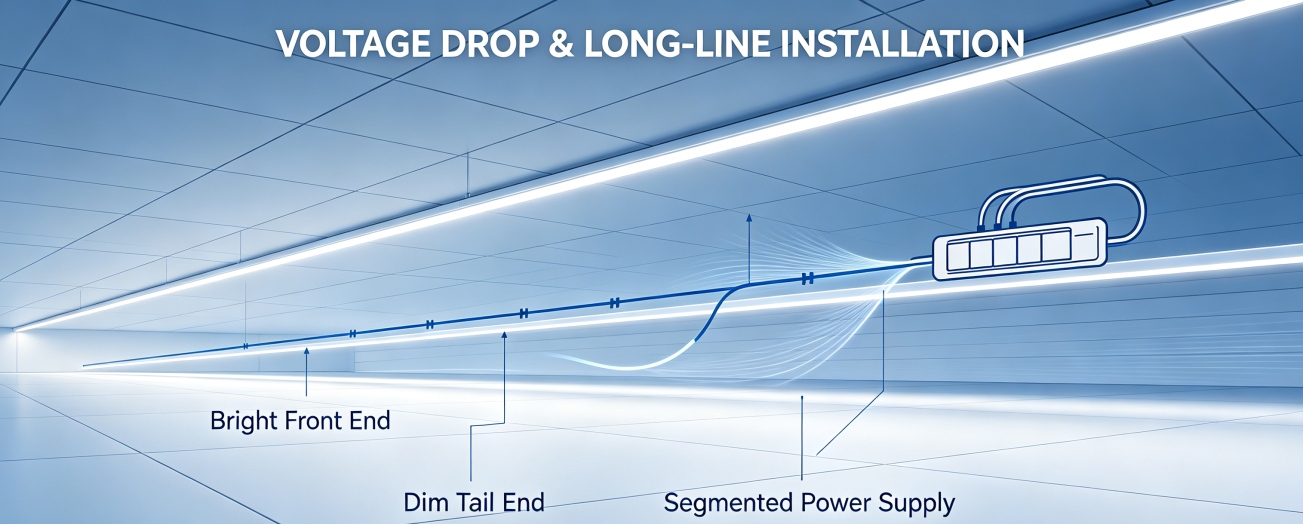
1.3 Voltage Drop & Unstandardized Long-Line Installation
Voltage drop is a common problem in large-scale commercial LED strip projects. When the continuous laying length of LED strips exceeds the standard laying distance, the voltage gradually attenuates from the power input end to the tail end. The front-end strips work normally with sufficient voltage, while the middle and tail sections suffer from insufficient voltage, causing flicker, dimness, or uneven brightness.
Unstandardized wiring, too thin wire gauge, and excessive series connection of multiple LED strip segments without supplementary power supply will further aggravate voltage drop and flickering failure.
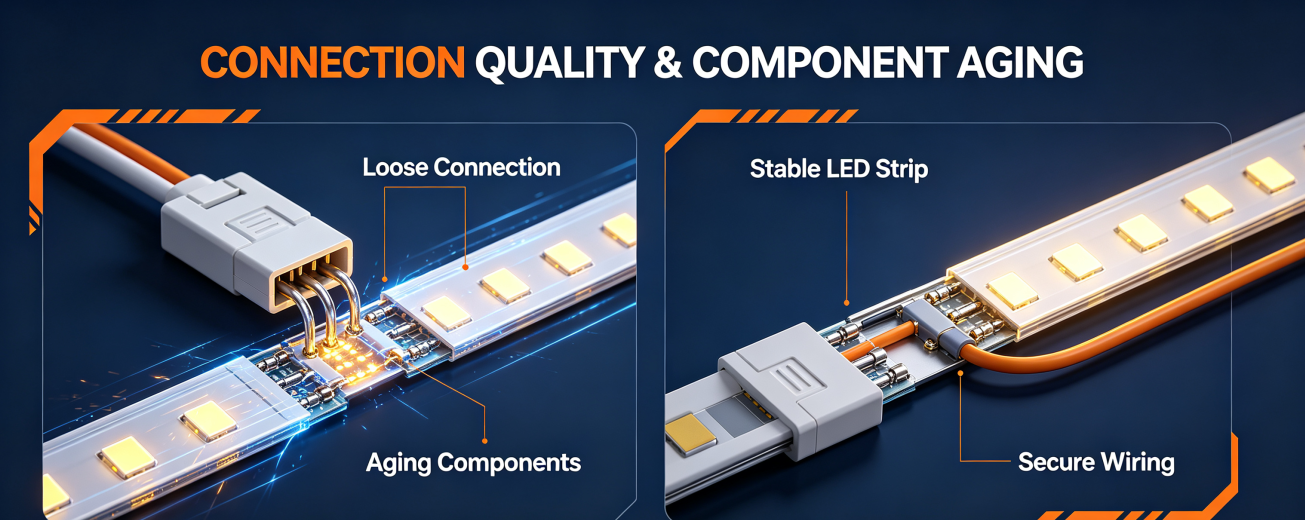
1.4 Loose Connection & Damaged Circuit Structure
LED strip lighting systems rely on closed and stable circuit connections. Loose solder joints, poorly inserted connectors, oxidized wiring terminals, and damaged PCB circuits caused by bending and extrusion during installation will lead to intermittent circuit conduction. This intermittent power on/off directly causes random flickering of LED strips.
This problem is more prominent in corner installation, curved laying, and long-term used engineering projects, where aging connectors and loose wiring gradually trigger frequent flicker faults.
1.5 Defective LED Strip Quality & Aging Components
Low-cost inferior LED strips with unqualified chip packaging, poor solder craftsmanship, and substandard PCB boards have hidden circuit defects in mass production. Such products are prone to flicker failure after a short period of use. In addition, long-term high-load operation, high-temperature working environment, and component aging will cause LED driver IC attenuation and chip performance degradation, resulting in late-stage flickering problems.
2. LED Strip Flickering Causes & Quick Fixes Comparison Table
Use this professional comparison table to quickly identify LED strip flicker causes and implement accurate solutions. It is a practical tool for mastering how to fix flickering LED strips and optimizing flicker-free LED strip installation for all scenarios.
We have sorted out a one-stop troubleshooting table for B2B engineering contractors and commercial users to quickly locate faults and implement efficient solutions, greatly improving project maintenance efficiency.
| Flickering Cause | Typical Phenomenon | Quick Fix Solution | Applicable Scenario |
| Undersized/Unstable Power Supply | Flicker occurs under full load; brightness fluctuates randomly; lights flicker when starting up | Replace with high-quality constant-voltage LED driver; reserve 20%-30% power margin for total load | All commercial & residential full-load lighting projects |
| Incompatible Dimmer/Controller | Flicker during dimming/color changing; abnormal light mode switching | Use dedicated LED PWM/CCR dimmers; match protocol-specific smart controllers | Smart lighting, dimmable commercial display lighting |
| Long-line Voltage Drop | Front-end bright, tail-end dim/flickering; long-distance laying failure | Adopt segmented power supply; increase wire gauge; reduce single-series laying length | Large-area engineering, long-distance architectural lighting |
| Loose Wiring & Poor Connection | Random intermittent flicker; flicker aggravated by slight vibration | Re-solder loose joints; replace aging connectors; fix wiring firmly | Curved installation, long-term operating projects |
| Strip Quality & Component Aging | Flicker appears after months of use; local segment flickering | Replace defective LED strips; upgrade high-temperature resistant components | High-temperature environment, long-time continuous lighting projects |
3. Professional B2B Prevention Tips for Flicker-Free LED Strips
For commercial lighting projects, engineering contractors, and bulk procurement clients, standardized flicker-free LED strip installation and system configuration can fundamentally avoid LED strip lights flickering faults, reducing after-sales maintenance costs and improving project qualification rate. We recommend the following industry-standard practices for stable long-term operation:
For commercial lighting projects, engineering contractors, and bulk procurement clients, one-time standardized configuration and installation can fundamentally avoid post-operation flickering faults, reducing after-sales maintenance costs and improving project qualification rate. We recommend the following industry-standard practices:
3.1 Standardize Power Configuration Calculation
Calculate the total power consumption of all LED strips in the project accurately. Select professional constant-voltage LED drivers with a 20%-30% power surplus margin to ensure stable full-load output and avoid long-term overload operation of power supplies.
3.2 Adopt Matched Supporting Accessories
Support low-voltage LED strips with dedicated LED dimmers and smart controllers, avoid universal incandescent dimmers and low-cost generic accessories. For RGB/RGBW color-changing LED strips, select protocol-matched controllers to ensure stable signal transmission.
3.3 Optimize Long-Distance Installation Layout
For laying lengths exceeding 5 meters, adopt segmented power supply and two-end power supply schemes to eliminate voltage drop. Use standard wire gauge cables and avoid excessive series connection of strip lights.
3.4 Choose High-Quality Industrial-Grade LED Strips
Industrial and commercial lighting projects should prioritize high-quality LED strips with qualified PCB boards, stable IC drive, and precise SMT soldering. High-quality LED strips feature low attenuation, strong anti-interference ability, and stable long-term operation, effectively reducing flickering and failure rates.
4. FAQ About LED Strip Flickering & Troubleshooting
We sort out high-frequency questions from global distributors, engineering clients, and end-users to solve your core doubts quickly.
Q1: Is flickering LED strip dangerous for use?
Moderate flickering will not cause direct safety hazards, but long-term flickering will easily cause visual fatigue and discomfort. Severe continuous flicker indicates unstable system voltage or faulty components, which may lead to light strip burnout and power supply damage in severe cases, affecting the overall safety of the lighting system. It is recommended to troubleshoot and repair in time.
Q2: Why does my LED strip flicker only when dimming?
This is mainly caused by mismatched dimming accessories or unstable dimmer signal output. Ordinary non-LED-specific dimmers cannot adapt to the low-voltage working characteristics of LED strips, resulting in current oscillation during dimming. Replacing with a professional LED dedicated PWM/CCR dimmer can solve the problem completely.
Q3: Can voltage drop cause LED strip flickering?
Yes. Long single-line laying of LED strips leads to gradual voltage attenuation. When the tail-end voltage is lower than the rated working voltage of the strip lights, insufficient power supply will cause dimness and flickering. Segmented power supply is the most effective solution for engineering projects.
Q4: Will low-quality LED strips keep flickering after repair?
Yes. Inferior LED strips have inherent defects such as poor chip stability and unqualified PCB circuits. Even if wiring and power supply problems are repaired, new flickering and strobing faults will still occur in subsequent use. For long-term stable operation of commercial projects, replacing with industrial-grade high-quality LED strips is the most cost-effective solution.
Q5: How to avoid LED strip flickering in large commercial projects?
Standardized power configuration, matched professional accessories, optimized flicker-free LED strip installation, and high-quality LED strip products are the four core elements to solve commercial LED strip flickering issues. As a professional B2B LED strip manufacturer, we can provide one-stop LED lighting solution customization, including project power calculation, layout design, and accessory matching guidance for global engineering projects.
5. Final Words
LED strip lights flickering is almost always a systemic problem caused by mismatched configuration, non-standard installation, or unqualified supporting parts, rather than accidental failure. Clarifying core LED strip flicker causes and mastering how to fix flickering LED strips allows residential users to solve daily faults quickly. For B2B distributors, engineering contractors, and commercial project clients, professional commercial LED strip flickering solutions and standardized product selection are the key to improving project quality and reducing after-sales costs.
Our company focuses on the R&D, production, and customization of high-stability commercial-grade LED strips. All products feature stable drive, low attenuation, strong anti-interference, and zero flicker performance, supporting various architectural lighting, commercial display, hotel engineering, and smart lighting projects. We provide bulk wholesale, OEM/ODM customization, and professional technical support for global business partners.
Facebook:https://www.facebook.com/profile.php?id=100089993887545
Instagram:https://www.instagram.com/mingxuelighting.factory/
YouTube:https://www.youtube.com/channel/UCMGxjM8gU0IOchPdYJ9Qt_w
LinkedIn:https://www.linkedin.com/company/mingxue/
Post time: Jul-10-2026