
 Chinese
When choosing LED light strips, the selection of voltage is one of the key factors. 110V and 220V are common specifications for high-voltage LED light strips, which often cause many users to be in a dilemma when making a choice. These two do not merely differ in voltage values; they also have significant differences in applicable scenarios, installation methods, and usage experience. This is the core difference between 110V and 220V light strips that users are concerned about.
I. Basic positioning of 110V and 220V light strips
1.1 Common features: Both fall under the category of high-voltage LED light strips.
Both 110V and 220V LED light strips are AC high-voltage power supply light strips, belonging to the category of high-voltage LED light strips. They do not require additional low-voltage transformers (in some scenarios, a rectifier may be needed). They can be directly connected to the corresponding voltage of the mains power supply for use. Compared to 12V and 24V low-voltage light strips, they are more suitable for medium and long-distance, large-area lighting scenarios. They are widely used in commercial lighting, outdoor decoration, large-space lighting and other fields, featuring stable brightness and high power supply efficiency. They are common high-voltage specifications in the selection of LED light strips.
1.2 Key Differences Core: Different distribution grids lead to differences in the derived series.
The most fundamental difference between the two lies in the different specifications of the mains power grid they are adapted to. This is the core distinction between 110V and 220V light strips, and this disparity directly determines their applicable regions, product designs, and usage details.
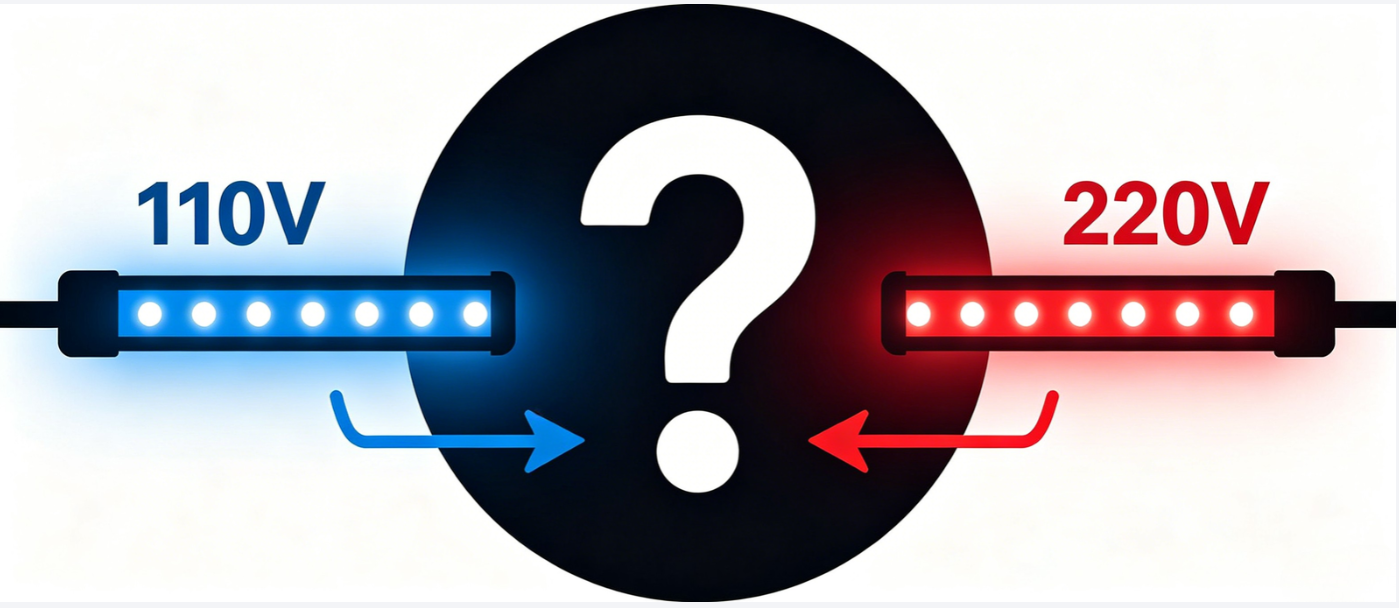
II. The Core Difference Between 110V and 220V Light Strips
2.1 Voltage Specifications and Grid Compatibility
2.1.1 110V Light Strip: Compatible with 110V – 120V mains power grid
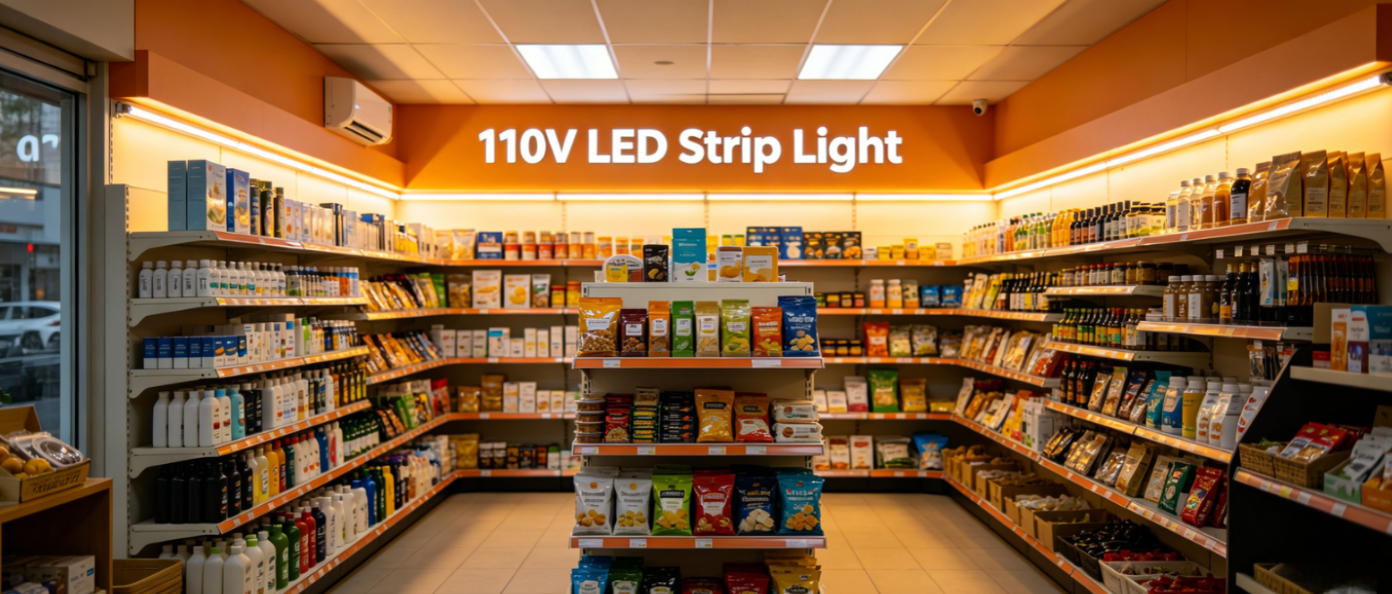
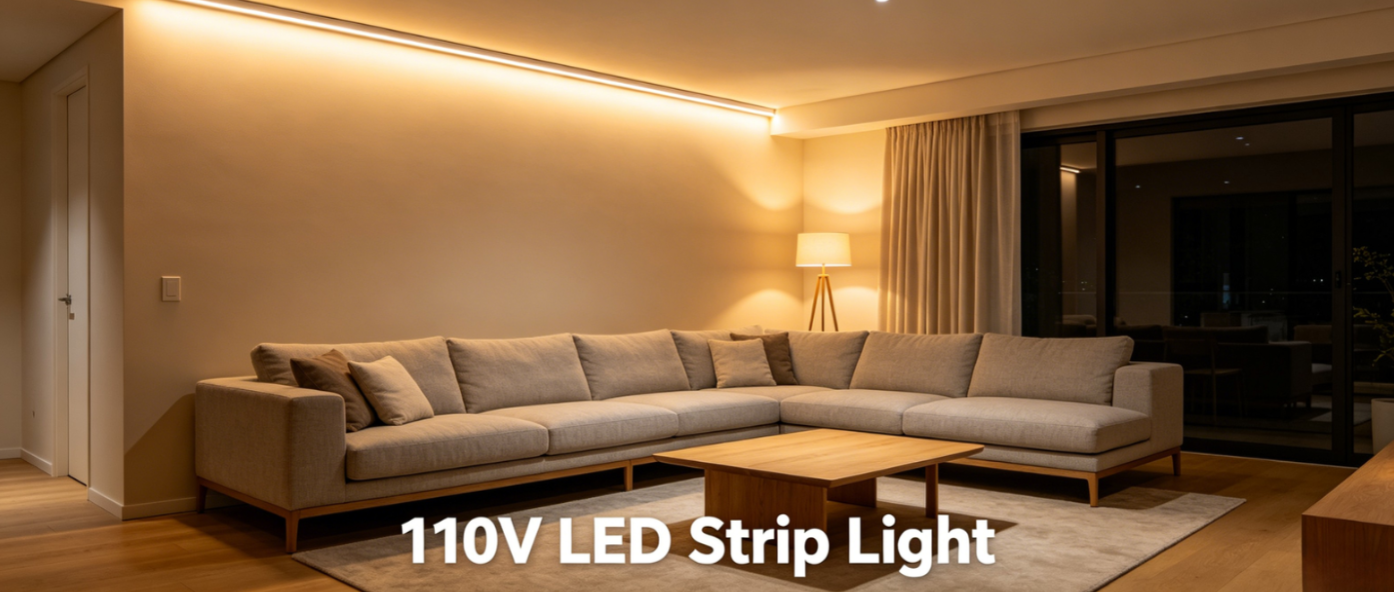
The 110V light strip is an important specification of high-voltage LED light strips. Its design standard is in line with the 110V – 120V power supply specifications. It is mainly suitable for countries and regions with a 110V power grid, such as the United States, Canada, Japan, etc. The internal circuit design and connection terminals are all made according to the 110V voltage standard to ensure stable operation after connecting to the local power supply and avoid damage caused by voltage mismatch. It is the core choice for voltage selection of LED light strips for 110V power grid areas.
2.1.2 220V Light Strip: Compatible with 220V – 240V mains power grid.
The 220V light strip is the most popular specification among high-voltage LED light strips. It is compatible with the 220V-240V mains voltage standards in most regions around the world, including China, Europe, Australia, etc. It is currently the most mainstream high-voltage light strip specification in the domestic market. Its circuit design complies with the 220V mains voltage standard and can be directly connected to the regular sockets or power supply lines in households and commercial venues, without the need for additional voltage conversion equipment (except for special waterproof and dimming scenarios). It is the preferred choice for voltage selection of LED light strips in China.
2.2 Power Supply Distance and Voltage Drop
2.2.1 110V light strip: The power supply range is moderate, and the voltage drop is relatively significant.
Under the same power and wiring conditions, the single continuous power supply distance of 110V light strips is usually 20-30 meters. Due to the relatively low voltage, the current is relatively large. When the power supply distance exceeds 30 meters, voltage drop occurs easily, manifested as inconsistent brightness at the beginning and end of the light strip, with the end brightness being slightly lower than the front end. If longer distance power supply is required, additional power injection points need to be added.
2.2.2 220V light strips: Longer power supply distance and less voltage drop
The 220V light strip has a higher voltage, resulting in a relatively smaller current. During the process of power transmission, there is less loss. The continuous power supply distance for a single use can reach 50 to 100 meters. In long-distance installation scenarios, the voltage drop phenomenon is not obvious, ensuring uniform brightness across the entire light strip. There is no need to frequently add power injection points, making it more suitable for large spaces and long-distance lighting requirements.
2.3 Power and Heat Generation Situation
2.3.1 110V Light Strip: At the same power level, the current is higher and the heat generation is slightly greater.
Under the same power output, the working current of the 110V light strip will be greater than that of the 220V light strip. The higher the current, the more obvious the heat generation of the light strip circuit will be. When operating continuously for a long time, it is necessary to pay attention to the heat dissipation of the installation environment to avoid the accumulation of heat in a sealed space, which may affect the service life of the light strip.
2.3.2 220V light strip: At the same power level, the current is lower and the heat generation is less intense.
When the 220V light strip operates at the same power output, its working current is smaller, resulting in less electrical energy loss and less heat generation. The heat issue is also less severe. Even when running continuously for a long time, it can maintain a relatively low operating temperature. It has lower requirements for the heat dissipation of the installation environment and a more stable service life. It is particularly suitable for scenarios requiring long-term uninterrupted lighting (such as shopping malls, hotel corridors, etc.).
III. Clarification of Common Misconceptions
1: The higher the voltage, the brighter the light.
Error: Many users believe that 220V light strips are brighter than 110V light strips. In fact, the brightness of LED light strips mainly depends on the specifications, density and power of the light bulbs, and has no direct correlation with the voltage level. For the same power and the same specifications of light bulbs, the brightness of 110V and 220V light strips is basically the same.
2: 220V light strips are more dangerous than 110V light strips.
Error: Both are high-voltage light strips. As long as they meet the safety standards of the corresponding region and are installed and used in accordance with regulations, they can ensure the safety of use. Although the 220V light strips have a higher voltage, through reasonable insulation protection design, they can effectively avoid safety hazards such as leakage, and in domestic common scenarios, there is no need to worry about safety issues.
3: The two can be used interchangeably at will
Error: If a 110V light strip is connected to a 220V power supply, it will immediately burn out the light strip; if a 220V light strip is connected to a 110V power supply, it will experience insufficient brightness, failure to start normally, and even damage to the internal circuitry. These two types cannot be replaced randomly; they must be selected based on the grid voltage.
The primary distinction between 110V and 220V LED light strips is which grid specifications they work with. This is what sets 110V and 220V light strips apart, and it causes a number of variations in power supply distance, heat production, installation, and situations in which LED light strips can be used. The two are neither better nor worse than the other. The secret is to choose the right LED light strip voltage according to your needs and the voltage of your local grid. This is the fundamental reasoning behind the selection guide for LED light strips.
110V light strips are a good option if you need small-scale, medium-distance lighting in a 110V grid area; 220V light strips have more benefits if you need long-distance, large-scale lighting in a 220V grid area because they are more versatile and useful.
We can offer specialized 110V and 220V high-voltage LED light strip solutions based on your usage area and scene requirements because we are a skilled manufacturer of LED light strips. We guarantee the product’s compatibility and user experience by combining voltage selection techniques for LED light strips, assisting you in avoiding typical errors when buying LED light strips. Please do not hesitate to contact us at any time if you would like more information about the product details or pertinent recommendations for choosing LED light strips.
Facebook:https://www.facebook.com/profile.php?id=100089993887545
Instagram:https://www.instagram.com/mingxuelighting.factory/
YouTube:https://www.youtube.com/channel/UCMGxjM8gU0IOchPdYJ9Qt_w
LinkedIn:https://www.linkedin.com/company/mingxue/
Post time: May-13-2026