
 Chinese
We have been making LED strip products for 21 years now. The question people ask Mingxue Optoelectronics the most is one short sentence: what LED strip to use for shadowless lighting design? A lot of people think the answer is only about brightness. You take a roll, stick it on, done. It almost never works that way. One customer showed us a render that looked nice. The moment the light went on, he said the room felt like a nightclub. The color temperature was wrong, the colors looked gray, and the wiring was a mess. One press of the switch, and the whole room lost its character.
So we built a small habit that has lasted many years. Before you look at any spec sheet, run the job through five things: space, psychology, physiology, task, and system. This is not classroom theory. It is the method we have used on one lighting engineering project after another since the company started in 2005. Call it a strip, a tape, or a ribbon, the idea stays the same. Below we explain how to choose LED strip lights without regret, and how to layout LED strip for shadowless lighting and match the run with the right driver.
 1、Which LED strip fits a low ceiling? Start with the room
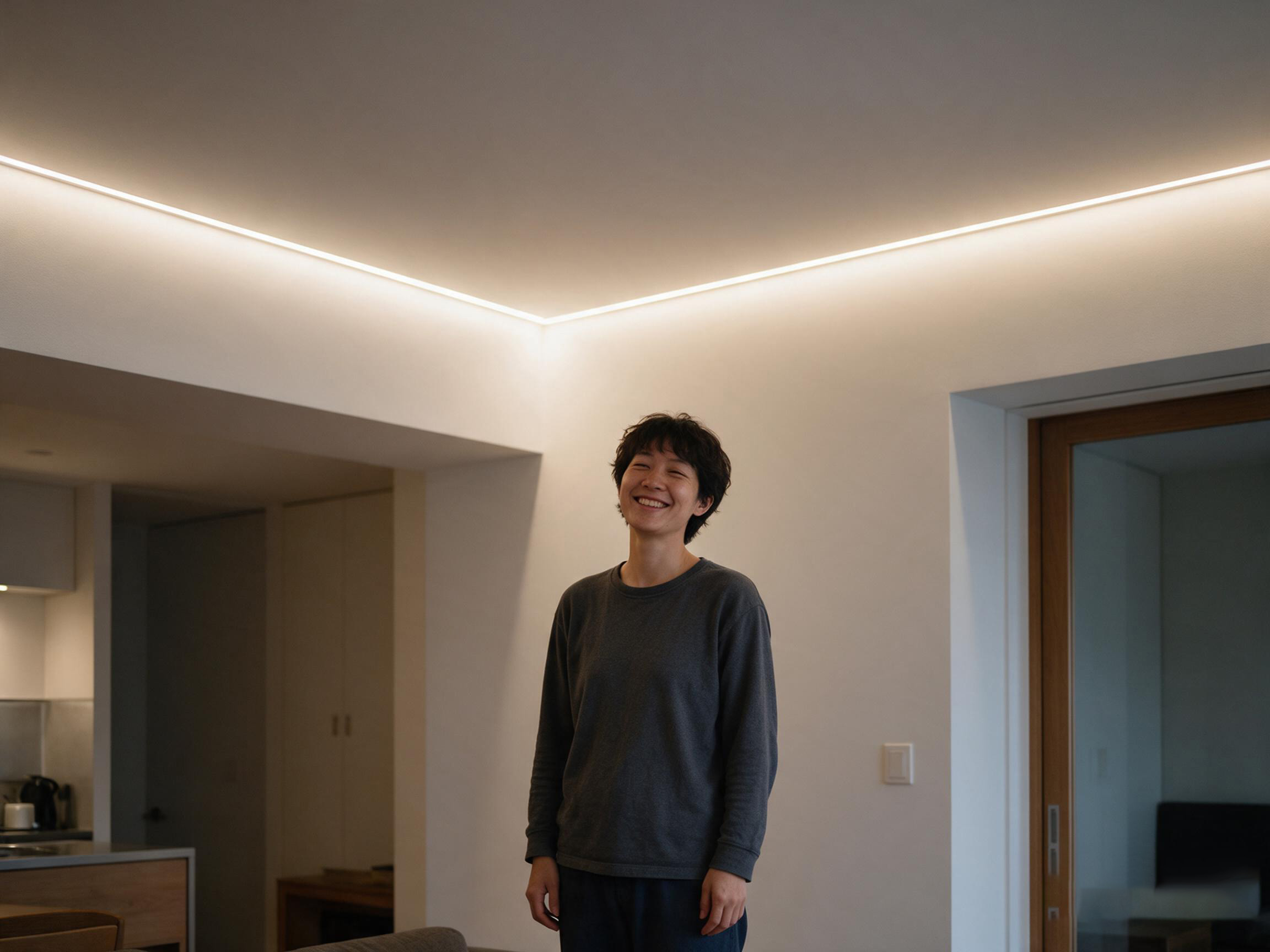
Get the space wrong, and everything after it is wasted. The LED strip has to follow the building, not fight it. We have seen a lot of jobs go wrong this way: the ceiling is already low, and someone still puts in a big light. After that, the room feels tight. With a low ceiling, keep the LED strip small and tuck it into a cove or corner, so it doesn’t eat the headroom. In a small room, point the light at the walls, and the eye reads the space as bigger. When the living room and the dining room run together, use two LED strips at different color temperatures to draw the line. People know where to sit the moment they walk in.
|
Space problem |
LED strip approach |
| Low ceiling | Small-profile LED strip mounted along the edge so it does not press down the height |
| Small room | Wall-wash light to stretch the room’s perceived depth |
| Blurred zones | Different color temperature or brightness contrast to guide the path |
Brightness ratio matters more than people think. At 3:1 you get a focal point. At 10:1 it becomes the star. At 100:1 it turns into noise and steals the show. Before you mount anything, decide what should stand out. More LED strip is not always better. What you want is layers, not a blanket of light. The common mistake is to run every LED strip at full power. In most rooms, two or three dim lines in the right place beat a dozen bright ones.
2、What color temperature should your LED strip light be? It sets the mood
Light carries emotion. This is not an exaggeration. Take the same roll, change only the color temperature and the layout, and the whole room changes mood. When someone asks about the best color temperature for LED strip, they are really asking what feeling the room should give. Comfort usually comes from perimeter light that is a little uneven and not too bright. Make it dim and uneven, and the same room feels private. Keep the edges soft when people need to relax, and only push the ceiling and desk bright when a space needs real work light.
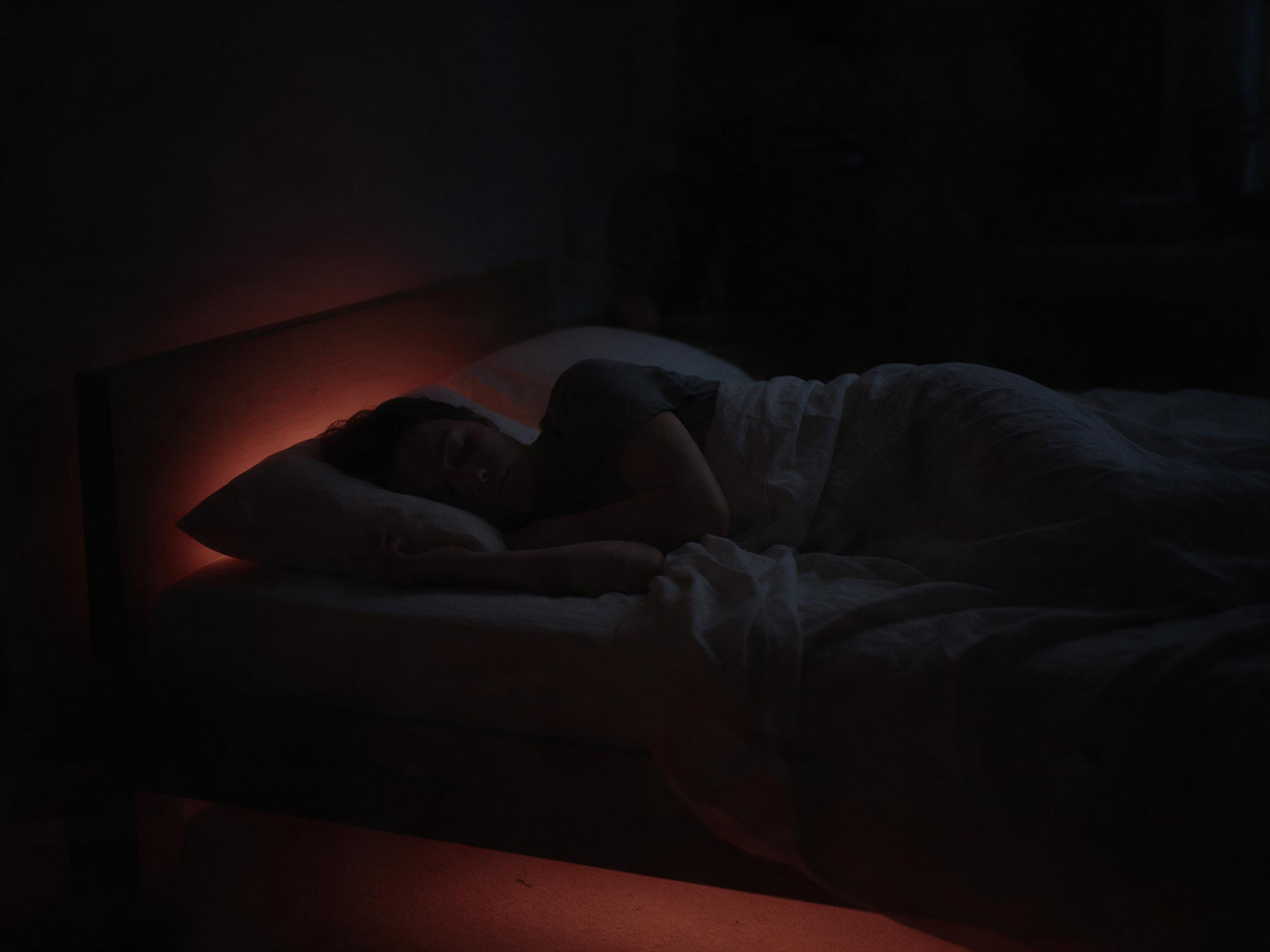
On the 3000K vs 4000K LED strip light question, this is what we tell clients. Rooms for rest go toward 3000K warm white. Rooms for work go up to 4000K. A few hundred kelvin is the difference between falling asleep the moment you get home and staying wired all night. When a client can’t decide, we tell them to sit in a mall restaurant for ten minutes and just feel it. That teaches more than any spec sheet. The same logic works in reverse. A bedroom that feels cold and clinical almost always has an LED strip that leans too blue. A warmer temperature fixes the mood faster than changing the furniture.
3、Physiology matters before you lock in a shadowless lighting design
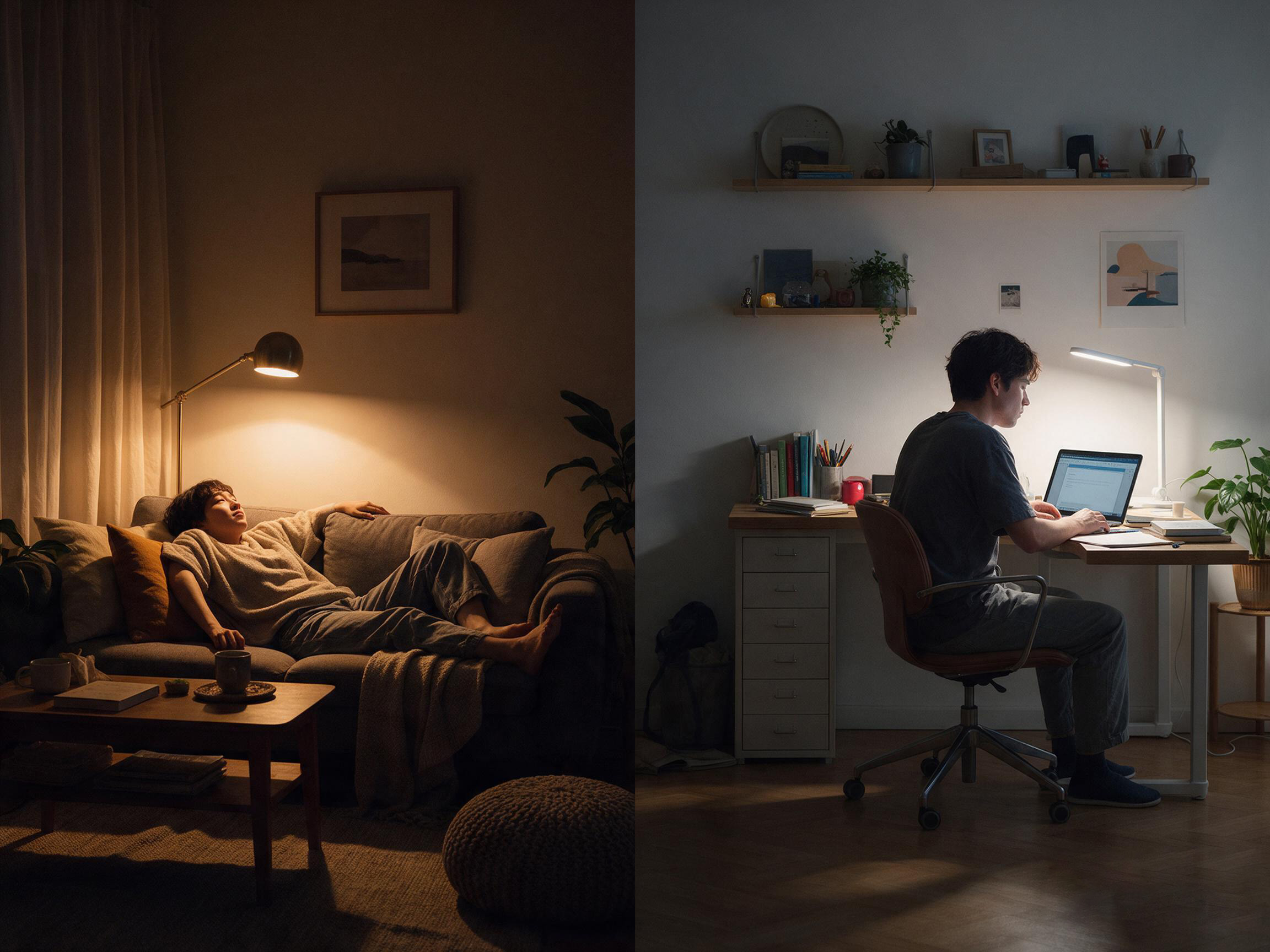
In a shadowless lighting ceiling, linear lighting is basically the standard. Looking good is not enough. The light also has to sit easy on the body. You can’t skip the circadian angle when you decide where the LED strip goes in a shadowless lighting plan. During the day you want bright, bluish light to wake people up. After dark, the blue has to come down, or melatonin never kicks in and sleep suffers. For night use we suggest the 600 to 620 nm warm-red band, kept dim so it doesn’t glare. Homes with older people need extra care. Past 65, the eye needs about four times the light it needed at 20, so the illuminance has to go up. Seasonal low mood is another matter. A daylight lamp only helps a little, and real symptoms need a doctor. None of this is to scare anyone. It is what we learned doing shadowless lighting design over the years, and your body is not the place to run tests. One trick we use in a bedroom shadowless lighting design: keep the LED strip bright in the morning, then dim it to a warm low level after dark, so the space helps the body clock instead of fighting it. The hardware stays the same. Only the schedule changes.
4、What CRI does your LED strip light actually need? Task comes first
A room that looks good is still a failure if you can’t read a page or the colors look gray. When clients ask what CRI is good enough for LED strip lights, we say reading and makeup areas should run CRI 90 or higher. The closer to natural light, the more honest the color. For shadowless lighting design we usually go with a COB LED strip or CSP LED strip, because the CRI>97 output and SDCM<3 binning keep the color steady from one roll to the next. The task area should be bright, and the background should stay back. Keep the brightness ratio at 3:1 or lower, or your eyes keep adjusting and tire out fast.
|
Task metric |
Suggested value |
| Brightness ratio (task vs. background) | No more than 3:1 |
| Illuminance uniformity | No less than 0.6 |
| CRI | Indoor 90+, makeup and reading 95+ |
Control glare with UGR, and don’t let the LED strip point straight at a screen or into someone’s eyes. On the desk you judge horizontal illuminance. On faces and walls you judge vertical illuminance. Watch both. When we design a study, we fix the desk position first, then work backward to decide where the LED strip goes and how far it reaches. That order saves a rework pass more often than it should. One last note on rendering. Two rolls can both claim a high CRI and still look different side by side. That’s why we bin for color consistency at SDCM<3 instead of trusting one number on a spec sheet.
5、How to build a commercial lighting or outdoor lighting project that lasts
Looking good is only a passing grade. A system has to hold up for years. What LED strip for commercial lighting is not the same question as what LED strip for outdoor lighting projects, but the logic underneath is the same: selection, control, and maintenance. You can’t skip any of them. Selection means locking down the size, light distribution, CRI, and mounting in one pass. For a linear light or wall washer in a commercial lighting fit-out, decide it all at once. On control, daylight sensors dim by themselves during the day, occupancy sensors turn off when a room empties, timers run on a schedule, and scene presets switch between meeting and projection with one tap. Outdoor work adds a waterproofing and weather layer on top. This is the part people forget the most. Maintenance can’t be an afterthought either. Whether the driver can be swapped on its own, and whether a fault shows up remotely, decide if the project still lights up three years later. We have seen cheap jobs where the wiring was buried for good. Shiny in year one. Then one dead section means pulling the whole run. For a larger outdoor lighting project we also run a voltage-drop calculation before quoting, so the LED strip doesn’t turn dim at the far end of a long facade. That one check has saved installers from a second site visit more often than almost anything else on the spec.
6、FAQ: LED Strip Light Questions
Q1: Can LED strip lights be installed in a bathroom?
A: You can, but only with an LED strip light rated IP65 or higher, and you have to seal the connections so moisture can’t reach the circuit. An IP20 roll has no place in a wet room.
Q2: Do LED strip lights need a transformer?
A: Yes. A low-voltage LED strip needs a transformer to bring 220V down to 12V or 24V, and you should leave a 30% power margin so the driver doesn’t run hot and fail early.
Q3: 4000K or 3000K LED strip light, which is better?
A: It depends on the room. 3000K warm white relaxes in bedrooms and dining rooms, while 4000K neutral white keeps you sharp in a study or office. Match the temperature to the purpose, not the trend.
Q4: How much power does a LED strip light use per day?
A: At 8W per meter and six hours a day, one meter of LED strip light draws about 0.05 kWh daily. That’s a little over one kWh a month, so it stays one of the cheapest light sources to keep running.
Choosing an LED strip is not a matter of grabbing a single roll. Run the space, mood, health, task, and system angles once, and the decision finally takes shape. That’s why Mingxue Optoelectronics keeps telling clients not to order in a hurry. Talk the requirements through first. The company has been making LED strip products since 2005. Its 24,000 sqm footprint pairs a Shenzhen R&D and sales center with a Foshan manufacturing base. Foshan Mingxue
Optoelectronics Co., Ltd. operates as a wholly-owned subsidiary of Mingxue Optoelectronics Holding Co., Ltd. The facility is ISO 9001 certified and turns out as much as 6 million meters of strip a month, with IKEA, Walmart, and BYD among its long-standing customers and IATF16949, UL, CE, and SAA certifications in place. If you have a shadowless lighting design or an outdoor lighting project you’re not sure about, send the project background over and we’ll work out the parameters and voltage drop first. If you’d like to learn more about our LED strip light products or get a quote, feel free to leave your contact details on our official website, or call us at +86 137 1903 7641 (same number on WeChat).
Published by Mingxue Lighting | Founded 2005 | Shenzhen R&D Center + Foshan Manufacturing Base | 24,000 sqm | ISO 9001 Certified
Facebook:https://www.facebook.com/profile.php?id=100089993887545
Instagram:https://www.instagram.com/mingxuelighting.factory/
YouTube:https://www.youtube.com/channel/UCMGxjM8gU0IOchPdYJ9Qt_w
LinkedIn:https://www.linkedin.com/company/mingxue/
Post time: Oct-09-2026