
 Chinese

If your B2B business imports flexible LED tape lights into the United States, outdated tariff assumptions can quickly erode gross margins, trigger port detention, or create unexpected compliance exposure. Many lighting procurement teams still rely on duty calculations created shortly after Section 301 tariffs were first implemented, without updating for evolving CBP enforcement and ongoing aluminum AD/CVD scope activity.
1. Why B2B Importers Must Re‑Evaluate LED Strip Tariffs in 2026
For years, many B2B lighting importers treated Section301 additional tariffs as a temporary trade measure that would expire under a future trade negotiation. This expectation has not materialized.
Since 2018, the 25% Section301 surcharge for China‑origin lighting has survived every formal administrative review cycle and remains fully active in 2026. Beyond static tariff rates, U.S. Customs and Border Protection (CBP) has strengthened origin‑verification practices. Customs officers now regularly review assembly records and production evidence instead of only accepting stamped shipping documentation.
If your landed‑cost model, duty estimate or Bill‑of‑Material (BOM) allocation has not been refreshed recently, your pricing forecasts are likely inaccurate. For B2B distributors and contract lighting suppliers operating on thin margins, unplanned duty expenses can turn a profitable project into a loss‑making shipment before goods clear the port.
This guide focuses on practical procurement‑oriented insights rather than abstract trade‑law theory. It is designed to help cross‑functional B2B teams calculate realistic landed cost and identify legal opportunities to manage import risk.
2. Breakdown of Stacked Duty Layers for LED Strip Shipments
A single container of LED lighting can trigger multiple overlapping duty layers. Missing one component of the duty stack can derail quotations, delay release of goods and generate unbudgeted import costs.
2.1 Base MFN Duty Rate (HTS Classification Floor)
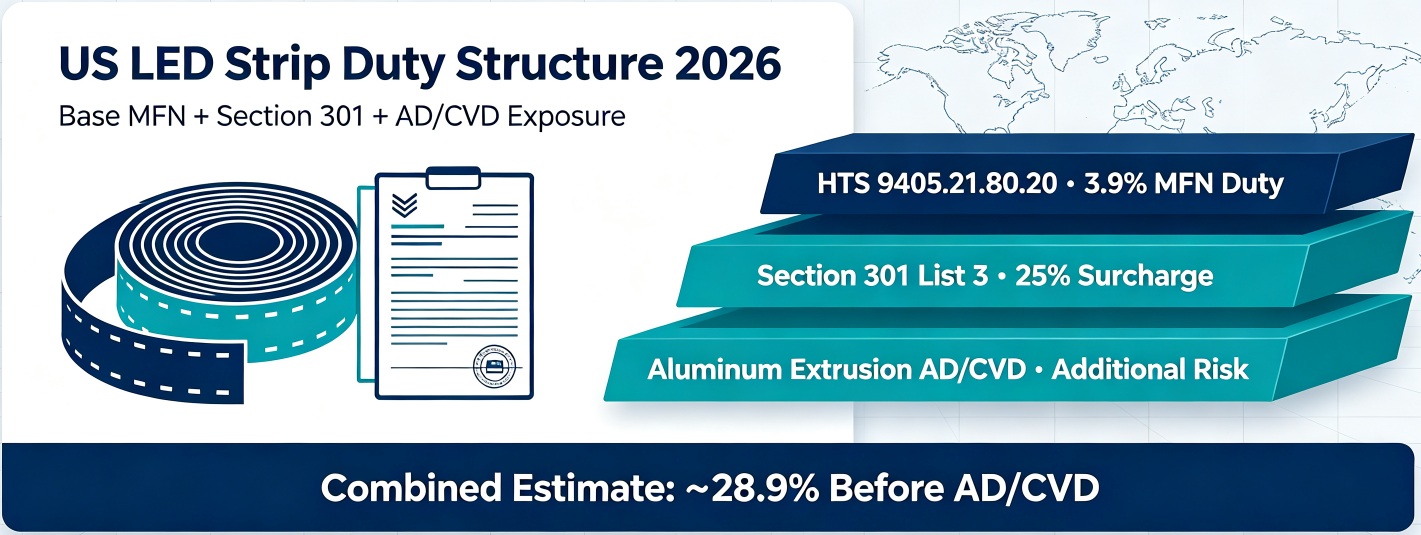
Flexible LED strip lights, including COB LED tape products, are commonly classified under HTS subheading 9405.21.80.20, for LED lamps and lighting fittings. The Most‑Favored‑Nation (MFN) base duty rate for this code sits at approximately 3.9% of customs value.
The base rate itself is moderate; the majority of import‑cost pressure comes from secondary tariff layers stacked onto this baseline classification. Always confirm the 10‑digit HTS code with your licensed customs broker, as product design changes may shift classification eligibility.
2.2 Section 301 List3 25% Surcharge
USTR placed China‑origin lighting goods onto Section301 List3 back in 2018. After an initial 10% rate, the surcharge increased to 25% in 2019 and remains enforced in 2026.
Simple arithmetic illustrates the financial impact:
3.9% base MFN duty + 25% Section301 surcharge = 28.9% combined duty against customs value
As a real‑world B2B example: a $10000 FOB shipment of bare LED tape generates roughly $2890 in duty, calculated before ocean freight, port handling or broker fees. For wholesale distributors working on tight margin structures, this single cost line item can completely reverse project profitability.
2.3 The Aluminum Extrusion AD/CVD Compliance Trap for Bundled Kits
This is the highest‑risk blind spot for B2B buyers ordering all‑in‑one LED strip‑plus‑channel kits as a single SKU.
The United States maintains active anti‑dumping and countervailing duty orders targeting Chinese aluminum extrusions (investigations A‑570‑967 and C‑570‑968). Anodized aluminum profiles, recessed mounting channels and diffuser housings generally fall inside this order scope.
When LED tape reels ship together with aluminum channel hardware inside the same shipment container, CBP may apply separate AD/CVD margins on top of the existing ~29% LED‑strip duty burden. This pushes the effective duty rate far above standard budget figures for lighting products. As of 2026, ongoing scope reviews are evaluating whether pre‑bundled LED‑strip‑and‑extrusion systems qualify under the aluminum‑extrusion AD/CVD scope, so regulatory interpretation continues to evolve.
AD/CVD cash‑deposit margins update annually during administrative reviews. B2B procurement teams should never quote static margin values found online. Confirm current published rates via your customs broker prior to finalizing supplier contracts or customer quotations.
3. Sourcing Path Comparison: Duty, Cost and Origin‑Risk Overview
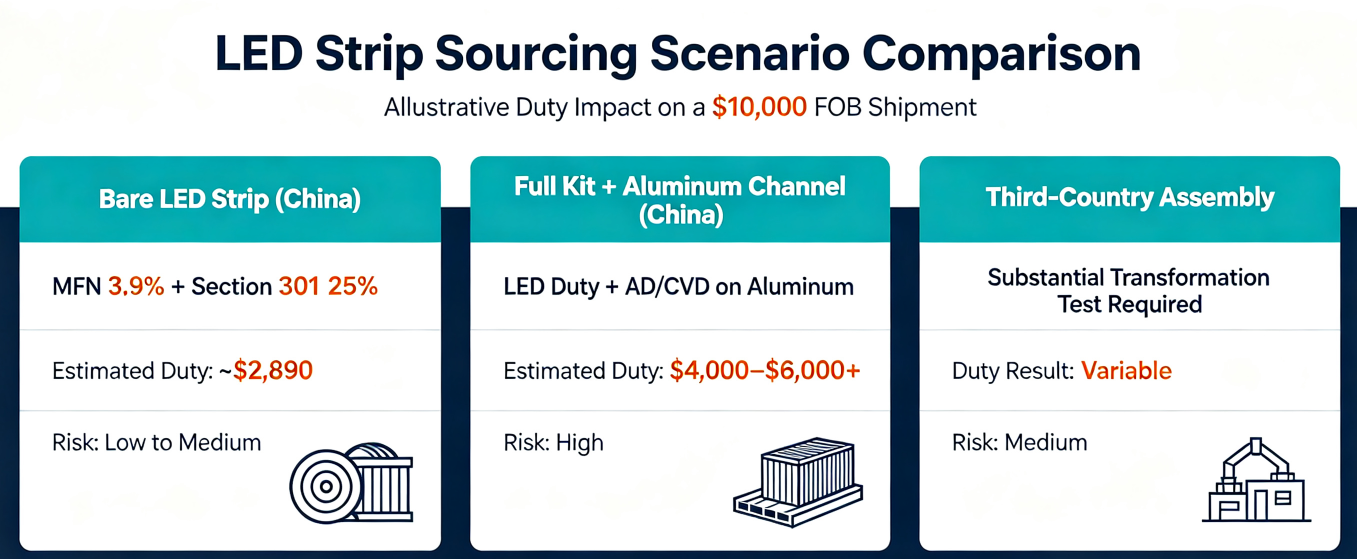
Below is an illustrative comparison for a baseline $10000 FOB order, showing expected duty exposure across three common B2B sourcing models. All figures are for planning reference only; actual results depend on product build, documentation and broker classification outcomes.
| Sourcing Scenario | Estimated Duty Profile | Illustrative Duty on $10 000 FOB Shipment | Origin & Compliance Risk | B2B Procurement Note |
|---|---|---|---|---|
| Bare LED strip manufactured in China | 3.9% MFN +25% Section 301 | ~$2 890 | Low‑to‑Medium | Clean classification; Section 301 creates the primary cost pressure |
| LED strip + anodized aluminum channel, full kit from China | 3.9% + 25% + applicable AD/CVD on aluminum hardware | $4 000 – $6 000+ | High risk | Aluminum components trigger separate AD/CVD liability; avoid combined‑SKU budgeting without separate BOM duty modelling |
| LED components manufactured in China, assembled in Vietnam / Mexico | Determined by substantial‑transformation test; potentially only MFN base rate | Variable | Medium risk | Requires genuine manufacturing transformation; simple repackaging or relabeling does not change country‑of‑origin status |
Key B2B sourcing take‑away: You are not required to stop purchasing Chinese aluminum extrusions. However, bundling tape and channel inside one single kit shipment amplifies compliance and cost exposure. Split line‑items on your bill‑of‑material to separate LED tape sourcing from aluminum‑profile procurement, so you can adjust channel suppliers independently without renegotiating your entire lighting kit supply chain.
4. Pre‑Purchase‑Order Compliance Checklist for B2B Procurement
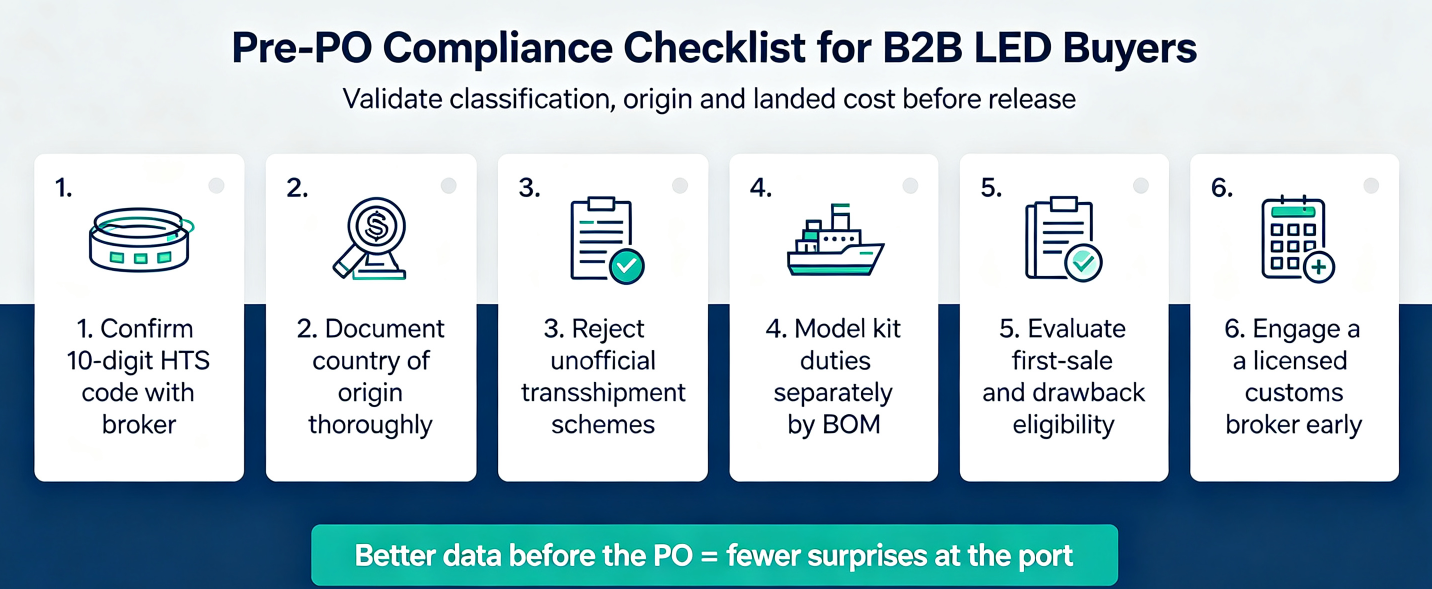
You do not need on‑demand trade‑counsel retainers to avoid predictable import pitfalls. Run through this checklist before releasing your next production PO:
1. Validate HTS classification: Confirm your 10‑digit HTS code with a licensed customs broker. Prior‑year codes may no longer match updated product specifications.
2. Document country‑of‑origin thoroughly: Retain assembly records and production evidence demonstrating where substantial transformation occurs. “Shipped from” location does not equal “Made‑in” origin status.
3. Reject transshipment schemes: Routing China‑origin merchandise through third‑country ports purely to erase origin marking represents customs penalty exposure, not a valid tariff‑avoidance loophole.
4. Model kit‑based duty separately: If you procure bundled LED‑strip‑and‑extrusion kits, explicitly build projected AD/CVD cost lines into your landed‑cost model.
5. Evaluate First‑Sale valuation and duty drawback: Where supply‑chain conditions qualify, First‑Sale rules can reduce declared customs value; drawback enables recovery of duties paid on goods later re‑exported out of the USA. Consult your broker for eligibility.
6. Engage a qualified customs broker upfront: Broker service fees are far lower than financial losses caused by container detention, forced re‑classification, or post‑entry duty liquidation bills.
5. Actionable Sourcing & Compliance Moves for 2026
Three high‑impact adjustments help B2B lighting importers build resilient import operations amid current US trade rules:
1. Rebase line your duty calculations: Discard duty models created before 2019. Plan business cases assuming Section301 tariffs remain active long‑term; adjust forecasts only when official Washington policy changes occur.
2. Segment your bill‑of‑material: Separate LED tape procurement from aluminum‑extrusion sourcing. This gives procurement flexibility to shift channel vendors without renegotiating LED strip pricing or MOQ terms.
3. Maintain audit‑ready production records: CBP origin audits have become less permissive. Keep organized assembly documentation that can withstand formal customs verification requests.
These recommendations do not mean businesses must stop buying Chinese‑manufactured LED lighting. Treat tariff and compliance requirements as core product specifications, on par with lumens output or CRI performance, rather than treating import duties as a minor invoice footnote.
6. Frequently Asked Questions
Q1:Do replacement LED strip reels and spare parts attract these same tariffs?
Yes in most scenarios. Replacement tape reels of Chinese origin fall under the same HTS classification and remain subject to Section301 tariffs. Replacement aluminum channels can also trigger aluminum‑extrusion AD/CVD orders.
Q2:Will the 25% Section 301 rate be repealed soon?
The surcharge has been reaffirmed through every official review cycle and remains fully enforceable for 2026. Build sourcing and pricing models on the assumption rates stay in force; adjust strategy only following formal USTR regulatory updates.
Q3:Can I avoid Section 301 duties by assembling products in a third‑country market?
Only if your supply chain achieves genuine substantial‑transformation, creating a change in tariff character. Simple repackaging, labelling or bagging of pre‑manufactured Chinese components does not reset country‑of‑origin. CBP actively audits these assembly‑process claims, and fake transformation leads to significant penalties.
Q4:What strategies reduce AD/CVD exposure for aluminum mounting channels?
Source aluminum extrusions from manufacturers outside the scope of the China aluminum‑extrusion AD/CVD orders, or procure complete kits with independently verified, fully‑documented non‑Chinese origin for the aluminum hardware. Verifiable origin documentation outweighs low‑cost supplier invoices.
Q5:Are product exemptions available for LED strip lighting?
Section301 product‑exclusion windows have opened and closed on variable timelines. Work with your customs broker to assess eligibility for your exact product configuration; never rely on previously‑expired exemption determinations.
7. Important Disclaimer
This article is written for general B2B procurement educational purposes only. It does not constitute legal advice, customs compliance advice or tariff‑quotation support. Duty rates, AD/CVD margins, scope rulings and HTS interpretations change via administrative reviews and court decisions. Always validate classification, origin‑rules and current applicable rates with U.S. Customs and Border Protection and a fully‑licensed customs broker before issuing supplier POs or providing customer quotations.
MINGXUE is the brand name of Shenzhen Mingxue Optoelectronics Co., Ltd. For international markets, the company operates under the brand name MINGXUE Lighting. Our official international website is mingxueled.com.
Published by Mingxue Lighting | Founded 2005 | Shenzhen R&D Center + Foshan Manufacturing Base | 24,000 sqm | ISO 9001 Certified
Facebook:https://www.facebook.com/profile.php?id=100089993887545
Instagram:https://www.instagram.com/mingxuelighting.factory/
YouTube:https://www.youtube.com/channel/UCMGxjM8gU0IOchPdYJ9Qt_w
LinkedIn:https://www.linkedin.com/company/mingxue/
Post time: Sep-22-2026