
 Chinese
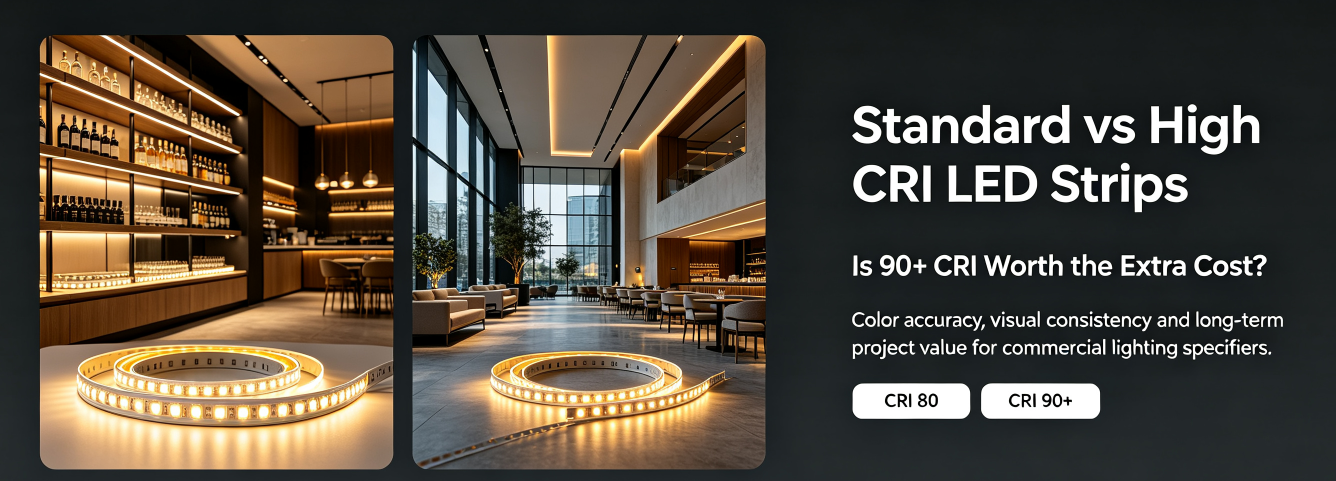
B2B buyers frequently have to decide between normal CRI LED strips (CRI 80) and high CRI LED strips (90+ CRI) when buying LED strip lights for commercial, architectural, retail, and hospitality applications. Standard CRI 80 units are less expensive to buy up front, but 90+ CRI LED strips are a popular option for high-end commercial LED lighting projects because of their higher color accuracy, visual uniformity, and long-term project value.
The fundamental concern for facility managers, wholesale distributors, lighting designers, and project contractors is still whether or not professional lighting installations justify the higher cost of 90+ CRI LED strips.
This expert B2B guide helps distributors, contractors, and designers make data-driven purchasing decisions for a variety of LED strip lighting projects by breaking down the main distinctions between standard CRI 80 and 90+ high CRI LED strips and comparing their performance, cost, and application scenarios.
What Is CRI in LED Strip Lighting?
CRI (Color Rendering Index) is a universal lighting metric that measures a light source’s ability to reproduce the true, natural colors of objects compared with natural sunlight, scored on a scale of 0–100. A higher CRI rating means more accurate color rendering, fewer color distortions, and better visual comfort.
In professional B2B lighting specifications, two CRI tiers dominate mainstream LED strip markets:
- Standard CRI (CRI 80): The industry baseline for general-purpose lighting, suitable for non-color-critical environments with basic illumination needs.
- High CRI (90+ CRI): A premium professional-grade rating that meets high-standard architectural and commercial lighting requirements, with excellent restoration of red, green, and neutral tone details.
Beyond basic CRI scores, professional lighting projects also prioritize the R9 value (red color rendering capability). Most standard CRI 80 LED strips have low R9 scores, resulting in dull, faded red tones, while 90+ CRI LED strips maintain stable high R9 performance for vivid, lifelike color presentation.
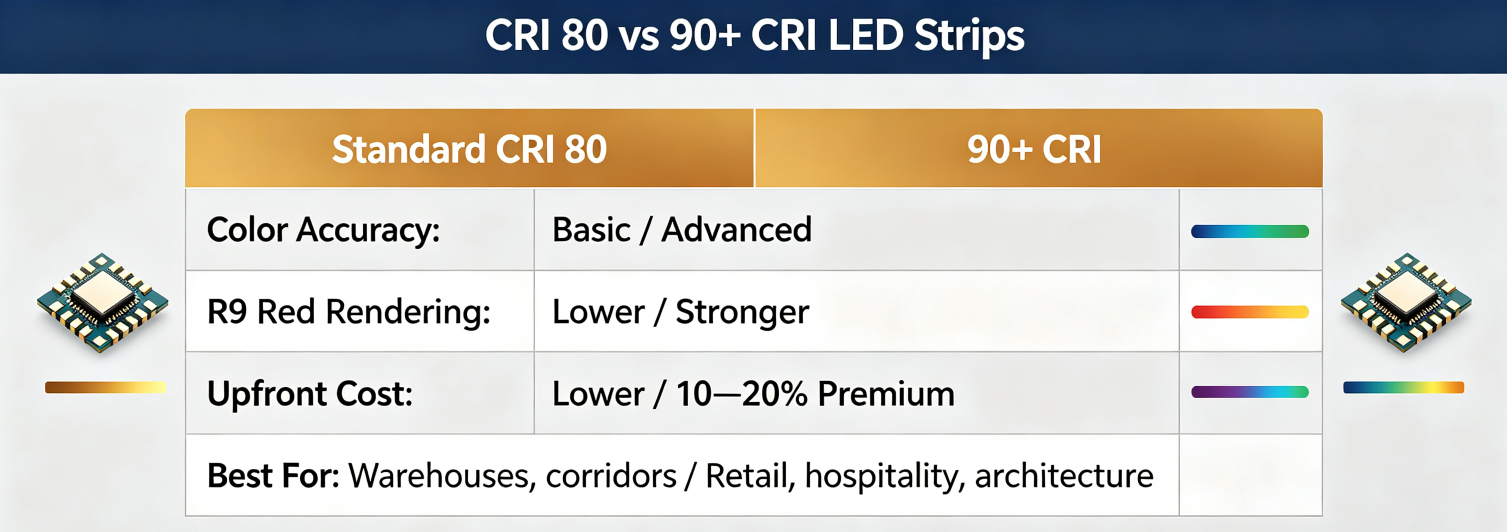
Standard CRI 80 vs 90+ High CRI LED Strips: Core Comparison Table
This side-by-side comparison table highlights the critical differences in performance, cost, application, and project value to support B2B bulk procurement and project specification decisions.
|
Comparison Dimension
|
Standard CRI 80 LED Strips
|
90+ High CRI LED Strips
|
|---|---|---|
|
Color Accuracy
|
Basic color rendering; obvious color deviation for saturated colors (red, wood tone, skin tone); muted visual effect
|
Ultra-high color fidelity; restores natural object colors; consistent tone across dimming and long-term operation
|
|
R9 Red Rendering
|
Low R9 value, poor red color restoration
|
High R9 value, vivid and natural red tones, ideal for retail and catering scenarios
|
|
Upfront Cost
|
Low procurement cost, cost-effective for large-scale basic lighting projects
|
10–20% higher upfront cost than CRI 80 models (industry standard premium)
|
|
Lumen Output
|
Higher initial lumen output, high brightness for auxiliary lighting
|
Slightly lower lumen density (10% average reduction) but higher perceived visual quality
|
|
Service Life Stability
|
Gradual color shift after long-term use, inconsistent batch color temperature
|
Strict phosphor formula control, minimal color drift, excellent batch consistency for engineering projects
|
|
Best Application Scenarios
|
Warehouses, corridors, storage rooms, industrial lighting, low-budget auxiliary lighting
|
Retail displays, hotel lobbies, restaurant lighting, luxury residential, architectural decoration, museum and studio lighting
|
|
B2B Project Value
|
Satisfies basic illumination standards, no premium visual upgrade
|
Enhances project grade, reduces after-sales complaints, improves project bidding competitiveness
|
Key Benefits of 90+ CRI LED Strips for B2B Projects
1. Elevated Space Aesthetics and Commercial Display Effect
90+ CRI LED strips precisely recreate the actual colors of goods, furniture, fabrics, and food in commercial settings where product display and space texture are important. High CRI lighting increases the appeal of products and indirectly raises consumer conversion rates in retail establishments. Standard CRI strips cannot match the quality, cozy spatial experience that natural skin tones and material textures provide for upscale residential and hospitality applications.
2. Consistent Engineering Quality and Low Maintenance Cost
Professional 90+ CRI LED strips adopt high-purity phosphor materials and strict color binning standards, ensuring uniform color temperature and zero noticeable color difference in large-area laying. For B2B engineering and bulk order clients, this greatly reduces the risk of rework caused by color inconsistency. Meanwhile, stable light decay performance extends the service life of the lighting system, lowering long-term maintenance and replacement costs for commercial facilities.
3. Compliance with High-End Lighting Specification Standards
Most international high-end architectural lighting design specifications, hotel star-rated standards, and commercial space lighting guidelines take 90+ CRI as the minimum professional lighting threshold. Adopting 90+ CRI LED strips helps contractors and distributors meet high-standard project requirements, qualify for high-end bidding projects, and optimize brand professional image.
When to Choose Standard CRI 80 vs 90+ High CRI LED Strips
Choose Standard CRI 80 LED Strips If:
- Your project only requires basic functional illumination without color display requirements
- You are sourcing for industrial spaces, warehouses, passageways, and utility area lighting
- The project budget is limited, and visual quality upgrade is not a core demand
- Large-area low-brightness auxiliary lighting is needed with no strict color consistency standards
Choose 90+ High CRI LED Strips If:
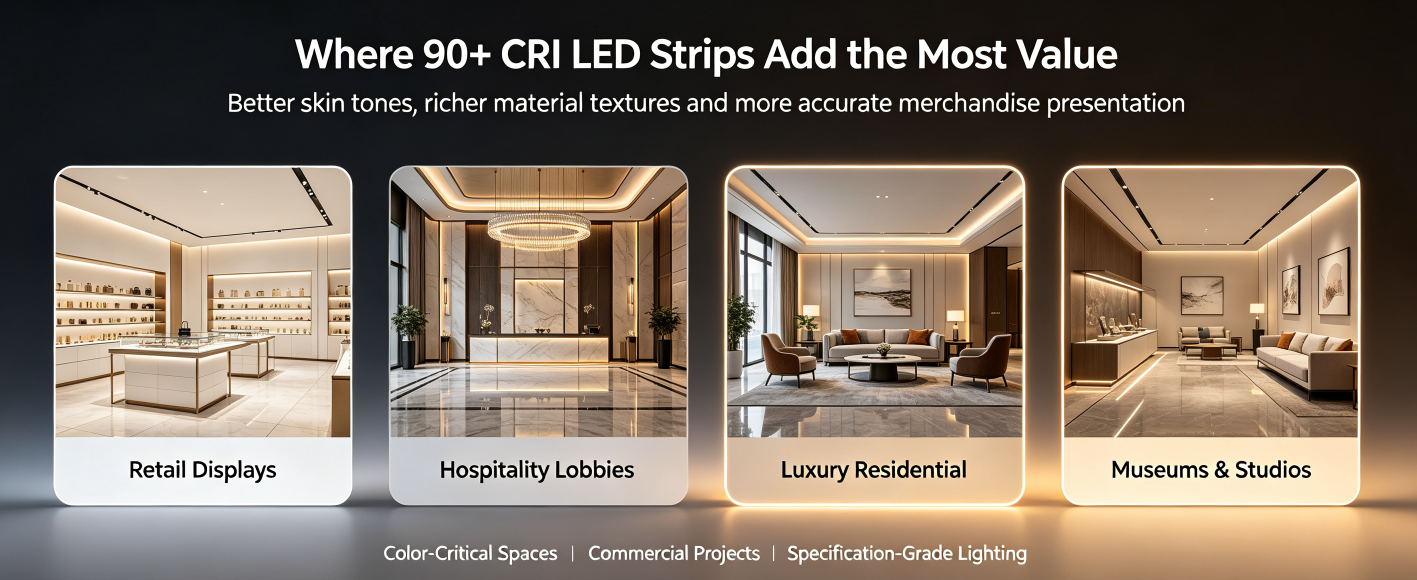
- The project involves commercial display, hospitality, high-end residential, or architectural decorative lighting
- Color accuracy, spatial grade, and customer experience are core project evaluation indicators
- You need long-term stable lighting performance and low after-sales maintenance pressure
- You are bidding for high-standard engineering projects with clear CRI specification requirements
Is 90+ CRI LED Strip Worth the Extra Cost? Final Verdict
From a pure upfront cost perspective, 90+ CRI LED strips are 10–20% more expensive than standard CRI 80 models. However, for all professional commercial and high-end residential B2B projects, the premium is fully worthwhile and delivers higher comprehensive return on investment.
The marginal cost increase is negligible compared to the total project budget, but the value improvement is substantial: better display effects, higher project qualification, lower rework and maintenance costs, and stronger client satisfaction. Only for purely functional industrial and basic auxiliary lighting scenarios can standard CRI 80 strips maintain cost-performance advantages.
For B2B distributors and engineering contractors, matching 90+ CRI products to high-value projects and standard CRI products to basic projects is the optimal cost-performance procurement strategy.
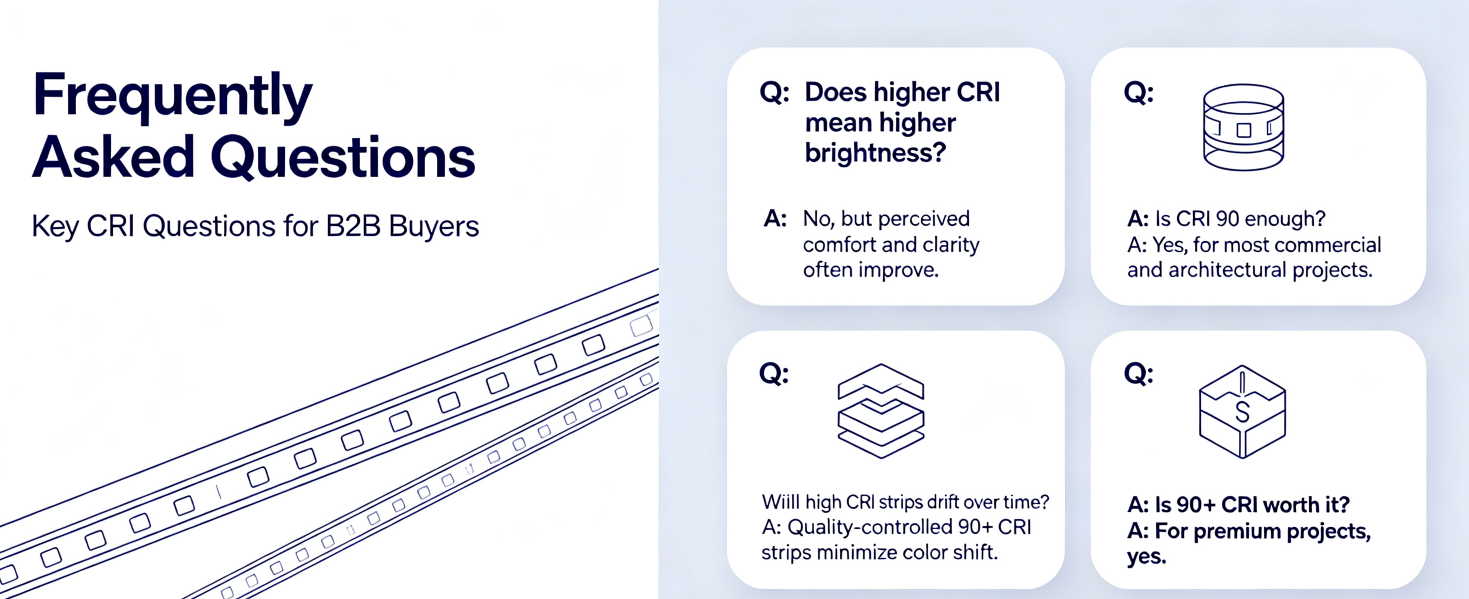
FAQ About Standard and 90+ High CRI LED Strips
Q1: Does higher CRI mean higher brightness for LED strips?
No. Due to enhanced phosphor formulations for color rendering, 90+ CRI LED strips often have somewhat lower lumen output than normal CRI 80 strips under the same power. However, compared to low CRI high-lumen lighting, high CRI lighting produces crisper, more layered visual effects, which improves perceived brightness and comfort.
Q2: Is there a big quality gap between CRI 90 and CRI 95 LED strips?
For 90% of commercial and architectural lighting installations, CRI 90 is the most economical professional grade. CRI 95 ultrahigh CRI strips are mostly utilized in color-critical settings like professional photography studios, museums, and art galleries. CRI 90 strikes the ideal combination between cost and quality for the majority of B2B applications.
Q3: Will high CRI LED strips have obvious color drift after long-term use?
Formal manufacturer-grade 90+ CRI LED strips adopt high-quality LED chips and stable phosphor formulas, with strict aging and color binning tests. The long-term color drift is extremely low, and the batch consistency is far better than standard CRI products, meeting the long-term stable operation requirements of commercial projects.
Q4: Can 90+ CRI LED strips replace standard CRI strips for all scenarios?
Technically yes, but economically unreasonable. For basic functional lighting scenarios such as warehouses, corridors, and equipment auxiliary lighting, standard CRI 80 strips fully meet the demand. Using 90+ CRI strips will cause cost waste without bringing practical value improvement.
Q5: What core parameters should be checked when purchasing high CRI LED strips in bulk?
B2B bulk procurement should focus on four core indicators: CRI ≥90, stable R9 red rendering value, consistent color temperature tolerance (≤±300K), and certified light decay stability. Our factory’s 90+ CRI LED strips pass strict quality testing, supporting customized specifications, bulk wholesale, and engineering project customization.
Conclusion
The decision between standard and 90+ high CRI LED strips ultimately comes down to application scenarios, project placement, and quality standards. While 90+ CRI LED strips are the recommended option for upscale commercial, architectural, and hospitality lighting, standard CRI 80 LED strips are perfect for budget-conscious basic lighting applications.
The additional cost of 90+ CRI LED strips is a worthwhile investment rather than a needless expense for B2B purchasers seeking project quality, long-term stability, and market competitiveness. Please get in touch with our knowledgeable staff if you require engineering technical assistance, bulk wholesale quotes, or bespoke high CRI LED strip solutions.
*Published by Shenzhen Mingxue Optoelectronics Co., Ltd. | Founded 2005 | Shenzhen R&D Center + Foshan Manufacturing Base | 24,000 sqm | ISO 9001 Certified*
Facebook:https://www.facebook.com/profile.php?id=100089993887545
Instagram:https://www.instagram.com/mingxuelighting.factory/
YouTube:https://www.youtube.com/channel/UCMGxjM8gU0IOchPdYJ9Qt_w
LinkedIn:https://www.linkedin.com/company/mingxue/
Post time: Aug-28-2026