
 Chinese
In the field of LED decorative lighting, RGB LED strips and RGBIC strips are the two most popular products. They can be seen in various applications, including creating a home atmosphere, decorating commercial spaces, and setting up outdoor scenes. However, many users often get confused when making a purchase: Both are color LED strips. What are the differences between RGB and RGBIC? Which one is more suitable for their needs?
Currently, RGB light strips have dominated the basic decoration market due to their high cost-effectiveness. Meanwhile, RGBIC light strips have emerged as the new favorite in smart home and high-end commercial decoration due to their more diverse dynamic effects. These two are not in a substitutive relationship; rather, they are complementary products tailored to different needs. Understanding their differences is also key to grasping the core purchasing logic for LED light strips.
The working core of the RGB light strip is the “additive color mixing model”. Through pulse width modulation (PWM) technology, it can mix out a rainbow-like rich color. Its key feature is “synchronous control” – all the light bulbs in the entire light strip can only present the same color and the same brightness simultaneously, and it is impossible to achieve independent control of each individual light bulb.

The RGBIC light strip is also based on the RGB three-color light-emitting principle. However, since each light bulb has an independent IC chip, the controller can send instructions to each light bulb individually, enabling “independent color control and brightness control for each individual light bulb.”
| Comparison dimension | RGB LED light strip | RGBIC LED light strip |
|
Control method
|
Synchronous control, without independent LED control | Independent control, precise regulation |
| Lighting effects | Static monochrome, simple switching, no complex dynamic effects | Rich dynamic effects such as multi-color synchronization, flowing water, running horse, breathing, and music synchronization |
| Structural Process | The structure is simple, without an IC chip, and can be freely cut (specify the cutting point) | The structure is highly precise and contains an IC chip. It cannot be cut randomly (some parts can be cut in groups). |
| Price cost | High cost-effectiveness and low overall investment | Mid-to-high-end positioning, with a relatively high overall investment. |
| Applicable scenarios | Basic color decoration, large-scale flooring, budget-limited scenario | Personalized atmosphere, intelligent interconnection, high-end decoration, creative scenes |
| Power consumption | Moderate power consumption and excellent energy efficiency | The power consumption is slightly higher, and there is not much difference in energy efficiency compared to RGB. |
| Control method | Basic remote control, simple controller | Mobile APP, voice, intelligent controller, all support interconnection. |
How to quickly choose the right light strips that suit you?
①Depends on budget:
If the budget is limited and only a basic color atmosphere is needed without complex dynamic effects, choosing RGB LED light strips is sufficient and offers better cost-effectiveness, making it suitable for large-scale installation. If the budget is ample, if you desire personalized and dynamic atmospheres and require intelligent control, then choosing RGBIC LED light strips is the way to go, as it can provide a richer user experience and enhance the spatial atmosphere.
②Depends on the situation
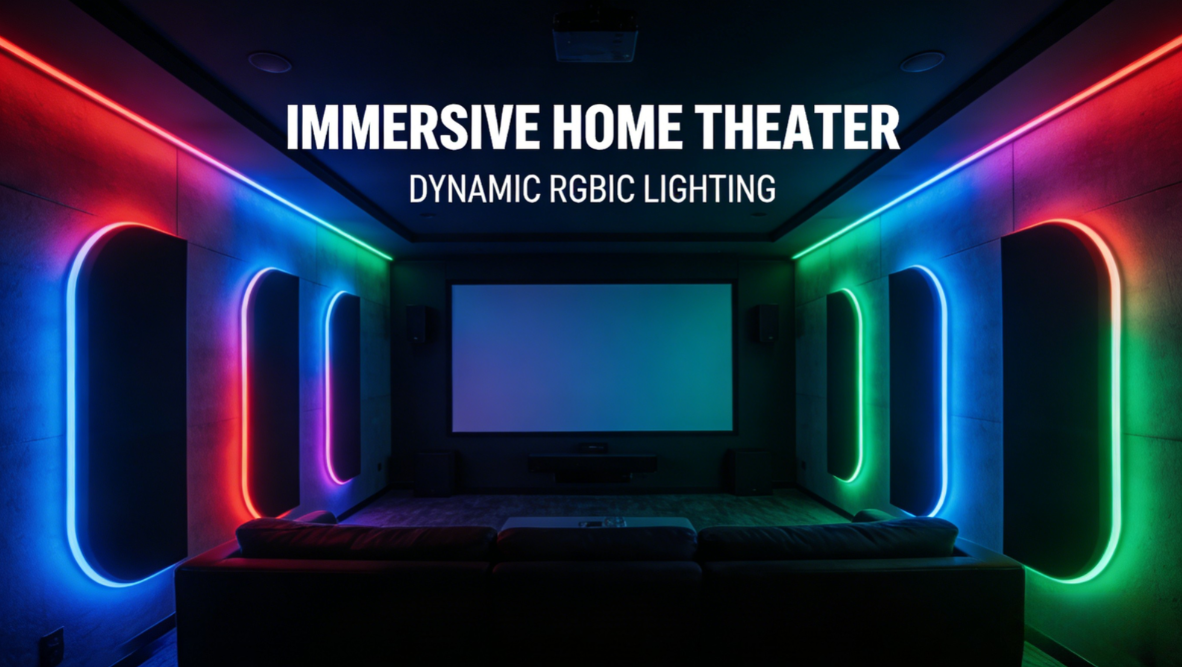
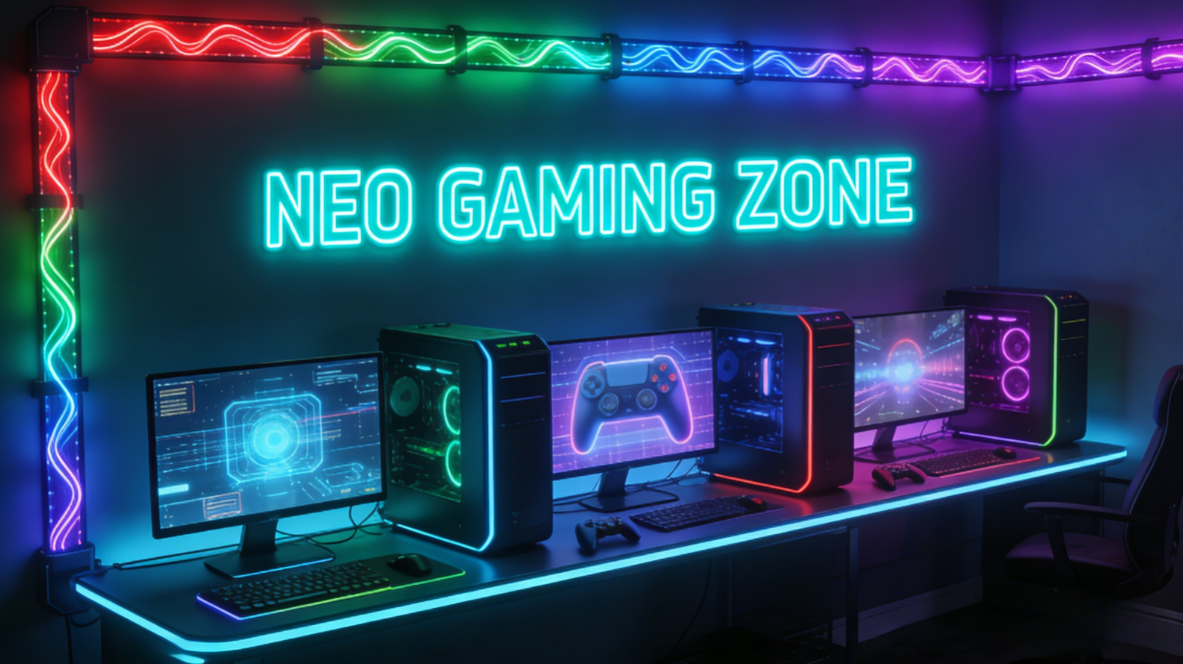
For home basic decoration, ordinary commercial lighting, and outdoor basic lighting enhancement, choosing RGB light strips can meet your needs. For home cinemas, game rooms, popular photo spots, high-end shops, and smart home interlinked scenarios, RGBIC light strips should be the first choice, as they can better create an atmosphere and enhance the space’s grade.
③Depends on individual needs
If you only need fixed-color ambient lights without any dynamic effects, RGB light strips are sufficient. However, if you want to achieve dynamic effects such as flowing water, running horses, synchronization with music, or need voice control and scene interactivity, then you must choose RGBIC light strips.
④Depends on the installation
If the installation scenario requires flexible adjustment of the length of the light strips (such as for irregular spaces or personalized sizes), then the RGB light strips should be chosen as they are easy to cut without affecting the usage; if the length is fixed, no cutting is necessary. The dynamic effect of the RGBIC light strips can better demonstrate their advantages.
It is necessary to avoid these common pitfalls when making a purchase.
1.RGBIC is brighter than RGB.
Brightness is determined by the power, quantity and luminous efficiency of the light bulbs, and is independent of whether it is RGB or RGBIC. For the same specifications (light bulb density and power), RGB and RGBIC light strips have basically the same brightness. The advantage of RGBIC lies in its dynamic effect rather than brightness.
2.RGBIC can be freely cropped.
Most RGBIC light strips cannot be cut randomly because the IC chips are arranged in groups or individually. Cutting them would disrupt the control logic and cause the light strips to malfunction. Some of the cuttable RGBIC light strips can only be cut at the designated IC group positions. When purchasing, it is necessary to pay attention to checking the product instructions.
3.RGBIC is definitely better than RGB.
There is no such thing as “absolutely better”, only “more suitable”. RGB is suitable for basic needs and cost-effective scenarios, while RGBIC is suitable for high-end needs and dynamic atmosphere scenarios. If you don’t need complex dynamic effects, choosing RGB is more cost-effective and you won’t have to pay for the unnecessary IC functions.
4.RGB cannot achieve the effect of gradient transformation.
The RGB light strip can achieve simple gradient effects such as single-color gradient and dual-color gradient. However, it cannot achieve complex dynamic effects like multi-color simultaneous gradient or flowing patterns. Do not mistakenly think that RGB can only display a fixed single color.
The core difference between RGB LED light strips and RGBIC LED light strips lies in “control method” and “lighting effect”: RGB is “synchronous control”, focusing on basic colors and high cost-effectiveness, suitable for basic decoration scenarios; RGBIC is “independent control”, emphasizing dynamic and rich effects, as well as intelligent interconnection, suitable for high-end personalized scenarios.
There is no superiority or inferiority between the two. The key lies in matching your own needs, budget and scene. If you are still unsure which one to choose, based on your usage scenario and budget, contact our professional consultant to provide you with precise selection suggestions, so that every investment can achieve the maximum value.
As a professional LED light strip manufacturer, we have a full range of RGB and RGBIC LED light strip products, supporting customized length, waterproof grade and control method. Whether for home or commercial use, we can provide you with high-quality and cost-effective lighting solutions.
Facebook:https://www.facebook.com/profile.php?id=100089993887545
Instagram:https://www.instagram.com/mx.lighting.factory/
YouTube:https://www.youtube.com/channel/UCMGxjM8gU0IOchPdYJ9Qt_w/featured
LinkedIn:https://www.linkedin.com/company/mingxue/
Post time: Apr-01-2026