
 Chinese
If you’ve ever spent an afternoon studying LED strip specifications from five different providers, you’ll understand how complex it can be. Everyone gives a different figure, employs a different measurement, and their “1200 lumens per meter” does not like the last one you checked.
After years of assisting builders, facility managers, and design companies in specifying LED strips for everything from hotel lobbies to warehouse aisles, I can assure you that knowing lumens is not as simple as memorizing a formula. It’s about determining which metrics are truly important and which are simply marketing noise.
Allow me to walk you through what we’ve learnt.
First, What Exactly Is a Lumen?
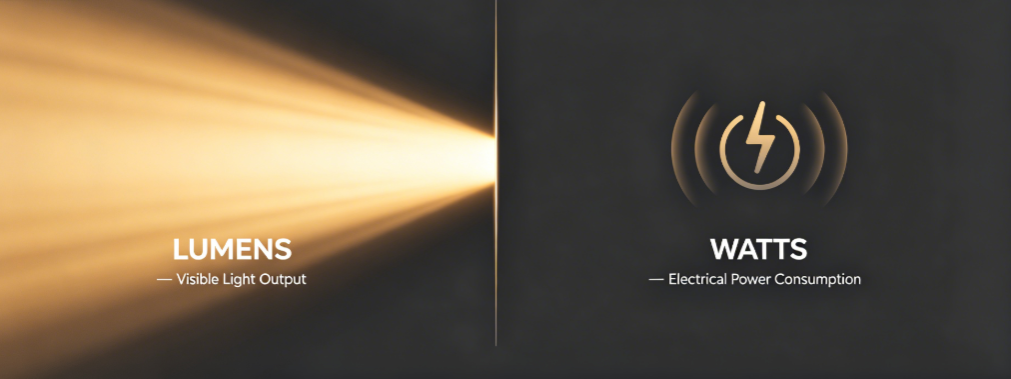
Put simply, a lumen is how we measure the total amount of visible light something produces. The more lumens, the brighter the light — at least in theory.
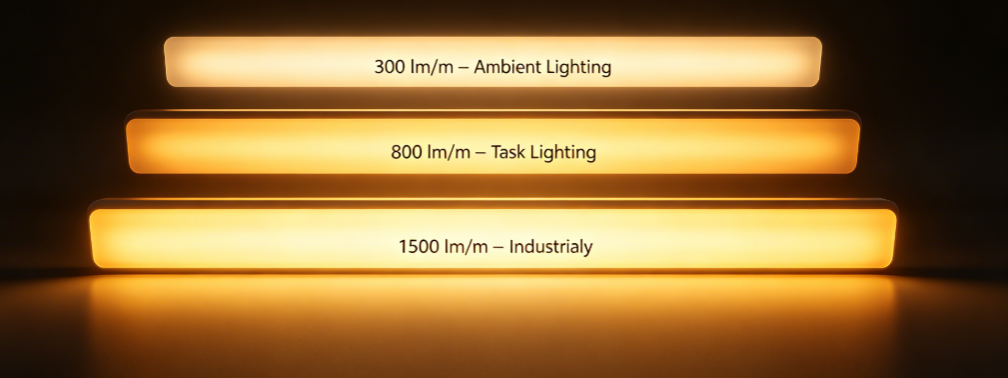
For LED strips, the number you’ll see on every datasheet is **lumens per meter (lm/m)**. This tells you how much light each linear meter of strip puts out, and it’s the most useful comparison tool you have. A 5-meter reel rated at 1000 lm/m gives you 5000 total lumens, but what matters for your lighting design is that per-meter density — because that’s what determines how bright your light line actually looks when it’s installed.
Here’s the thing most people miss: not all lumen numbers are created equal.
Raw Lumens vs. Effective Lumens — The Number That Actually Matters
This is where a lot of buyers get tripped up, and honestly, where some suppliers aren’t as transparent as they should be.
- Raw lumensare what the LED chips are theoretically capable of in a perfect lab setting.
- Effective lumens are what you actually get after losses from the PCB, resistors, solder joints, and any diffuser or housing you put the strip in.
Effective lumens are always lower — usually by 10% to 25%. If a supplier only quotes you raw lumen numbers, you’re not getting the full picture. For project planning, always work with effective lumens. If they won’t provide them, apply a conservative derate yourself and plan accordingly.
Lumens vs. Watts: Why the Old Rule Doesn’t Work Anymore
Back when everything was incandescent or halogen, you could roughly guess brightness from wattage. A 60W bulb was brighter than a 40W bulb. Simple.
LEDs changed all of that.
What counts today is efficacy(lumens per watt). Two strips with the same wattage can emit vastly varying quantities of light depending on LED quality, bin grade, and thermal design.
| Strip Type | Typical Efficacy | Lumen Range (per meter) |
|---|---|---|
| SMD 3528 | 80–100 lm/W | 300–700 lm/m |
| SMD 2835 | 90–120 lm/W | 500–1500 lm/m |
| COB (Chip-On-Board) | 100–150 lm/W | 800–2000+ lm/m |
| SMD 5050 RGB | 70–90 lm/W | 400–800 lm/m |
I’ve seen clients compare a 14.4W/m strip from one provider to a 20W/m strip from another and conclude the latter is brighter. Sometimes it true, but typically the higher-wattage strip is just less efficient, resulting in you paying more in electricity for the same or less light. Over a 50,000-hour lifespan in a commercial facility, the difference quickly adds up.
Always compare lumens and efficacy, not just wattages.
The Real-World Factors That Kill Your Brightness
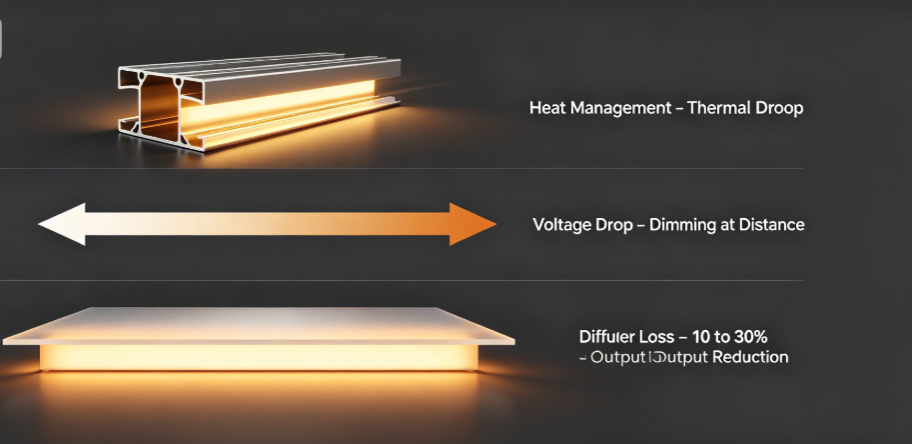
Spec sheets tell you what a strip can do in ideal conditions. Real installations are rarely ideal. Here are the three things that most often cause a strip to underperform once it’s actually mounted:
1. Voltage Drop
LED strips run on low voltage — usually 12V or 24V DC. Push that power through a long copper trace and you get resistance, which means less voltage reaching the far end, which means dimmer light.
With 12V strips, we generally don’t recommend runs longer than 5 meters without power injection. 24V doubles that to about 10 meters. If your project calls for longer continuous runs, either plan for power injection at regular intervals or consider a high-voltage AC strip — though those come with their own efficiency and safety trade-offs.
2. Heat
LEDs don’t like heat. The hotter the junction temperature, the less efficient the LED becomes (it’s called thermal droop, and it’s very real), and the faster the lumen output degrades over time.
This is why we almost always recommend aluminum channels for commercial installations. They act as heat sinks, dropping operating temperature by 10–20 degrees, which makes a meaningful difference in both immediate brightness and long-term lifespan. If you’re enclosing strips in a tight space with no airflow, you need to account for that — either by derating the drive current or specifying a strip rated for higher operating temperatures.
3. Diffusers
Most commercial projects don’t install bare strip — they put it in an aluminum channel with a polycarbonate diffuser to create that clean, dot-free light line. Diffusers look great, but they cost you lumens. A frosted diffuser typically transmits 75–85% of the light; an opaque milk diffuser might only pass 60–75%.
If your lighting calculation calls for 800 effective lumens per meter at the surface and you’re using a frosted diffuser with 80% transmission, you’ll need a strip rated at 1000 lm/m. It’s a basic calculation, but you’d be shocked how many people forget to account for it, resulting in a substantially darker installation.
What to Ask For When You’re Getting Quotes
If you’re sourcing LED strips for a commercial project, here’s what I’d recommend asking every supplier:
1. Effective lumens per meter — not raw. If they can’t or won’t provide this, that’s a red flag.
2. Efficacy in lumens per watt — this tells you how efficient the strip really is.
3. Lumen maintenance rating — L70, L80, or L90, with TM-21 projected lifespan data. For 24/7 operations, L80 or L90 is worth paying for.
4. LM-79 test reports— independent photometric testing in an integrating sphere. Marketing numbers are fine; test data is better.
5. LED binning specification— look for 3-step MacAdam ellipse (SDCM ≤3) to ensure color consistency across batches.
6. Physical samples — always. Numbers on a page tell you part of the story. Seeing the strip mounted in your actual application, with your chosen diffuser, tells you the rest.
Wrapping Up
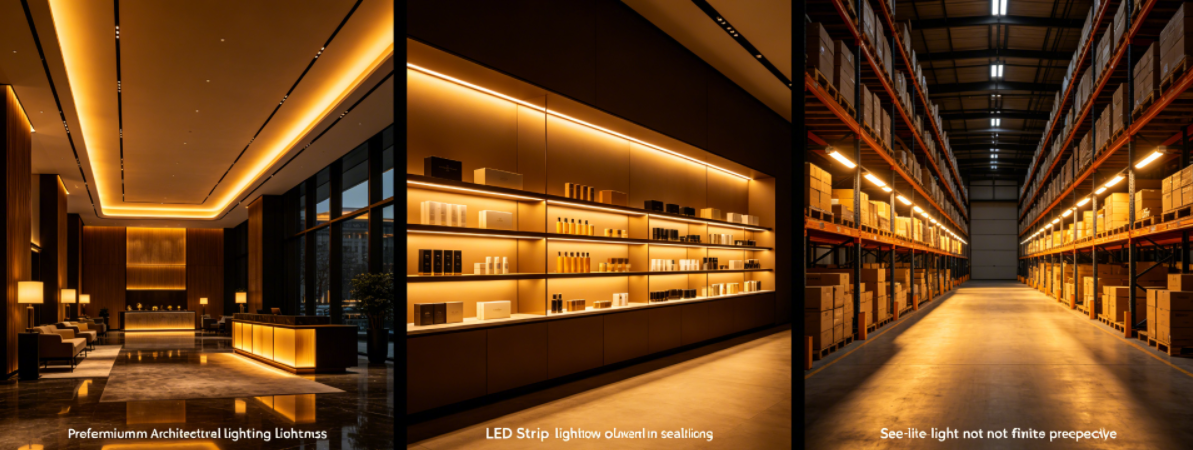
At the end of the day, getting the brightness right on an LED strip project comes down to one thing: working with numbers that reflect reality, not marketing. Understand the difference between raw and effective lumens, account for the real-world losses that happen once a strip is actually installed, and always — always — test physical samples before you commit to a large order.
If you’re working on a project and aren’t sure where to start with the brightness specification, contact a supplier who is willing to go over your requirements in depth. A reputable one will inquire about your space, mounting method, diffuser selection, and goal light levels before quoting you on a product. And that is the type of partner you want for a commercial endeavor.
Facebook:https://www.facebook.com/profile.php?id=100089993887545
Instagram:https://www.instagram.com/mingxuelighting.factory/
YouTube:https://www.youtube.com/channel/UCMGxjM8gU0IOchPdYJ9Qt_w
LinkedIn:https://www.linkedin.com/company/mingxue/
Post time: Aug-18-2026