
 Chinese
For the procurement of LED light strips at the B-end, whether it is for engineering companies, furniture factories, distributors or smart hardware manufacturers, the purchased light strips not only affect the quality of the end products and the delivery effect of the project, but also directly influence the brand reputation and the stability of cooperation. Unlike the scattered demands in the C-end retail sector, B-end procurement involves large quantities and complex application scenarios (covering outdoor lighting, commercial spaces, home furnishings, etc.), and has more stringent requirements for the stability, compliance and consistency of the light strips.
To avoid procurement risks and reduce after-sales costs, when choosing light strips, the following 5 core quality inspection steps are indispensable.
5 key quality inspections for wholesale business
Quality Inspection 1: Electrical Safety Quality Inspection
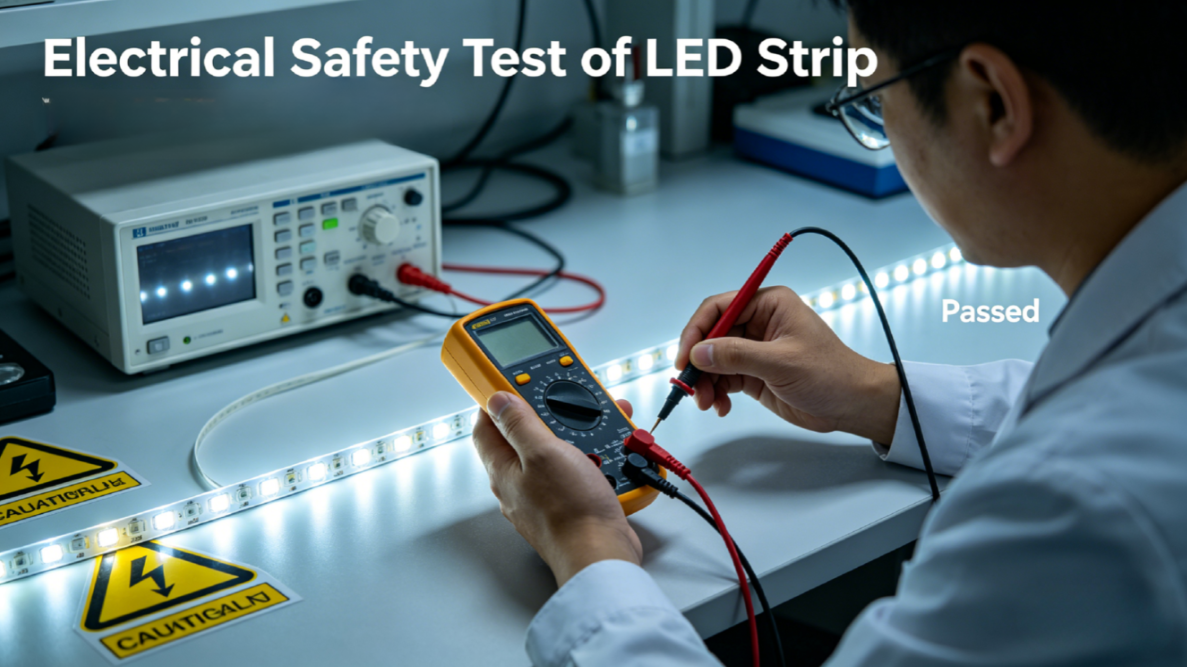
Electrical safety is the primary prerequisite for B2B LED strip procurement, especially for scenarios such as engineering lighting and public spaces. Electrical hazards can not only cause economic losses but also potentially lead to safety accidents. This quality inspection focuses on three core objectives: “no leakage, no breakdown, and stable parameters,” strictly adhering to national standards such as GB 7000.1.
Insulation performance testing uses a 500V megohmmeter to ensure that the insulation resistance is not less than 2MΩ, and for waterproof LED strips, this must be increased to above 10MΩ to avoid the risk of leakage due to insulation damage, making them suitable for outdoor and humid environments. Withstand voltage testing applies a 1500V AC voltage between the input and output terminals for one minute without breakdown or arcing, ensuring safe operation of the LED strip under abnormal voltage conditions and eliminating the risk of short circuits.
At the same time, it is necessary to check the deviation between the actual power of the light strip and the nominal value to ensure that it is controlled within ±5% to avoid excessive power leading to increased energy consumption and serious heat generation, or excessive power affecting the lighting effect; strictly check the positive and negative polarity of the power lead wire to prevent reverse polarity from causing burnout when powered on, especially suitable for B-end batch installation scenarios, reducing installation losses and after-sales costs.
Quality Inspection 2: Optical Performance Quality Inspection
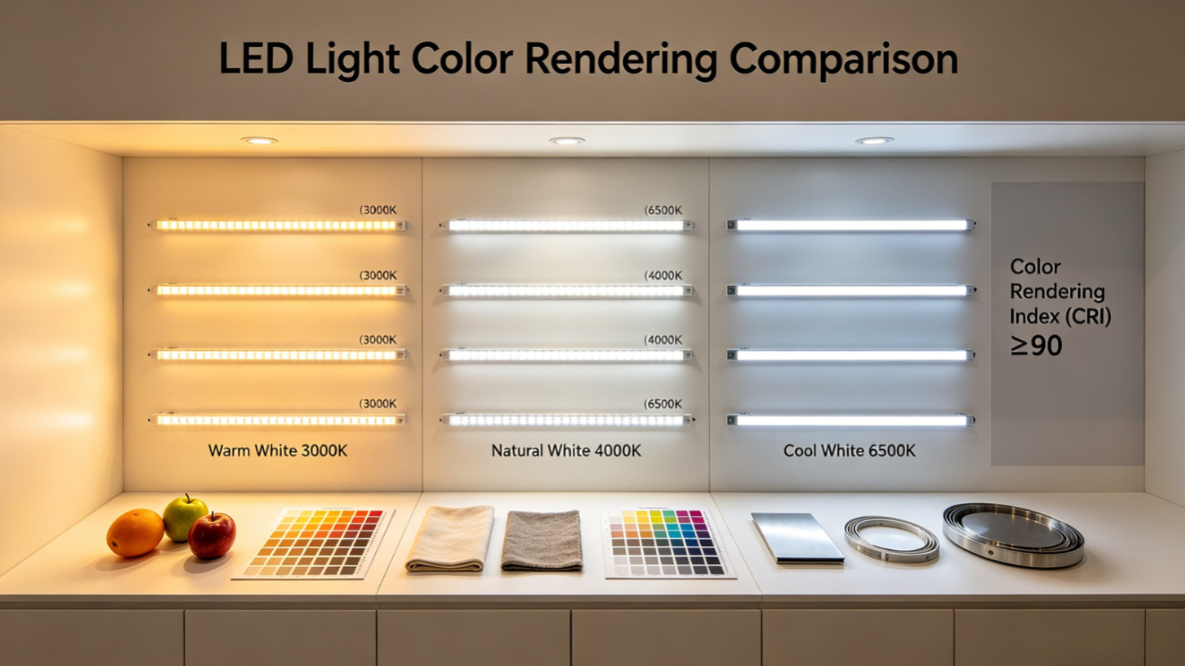
The application scenarios for B2B LED strips cover commercial lighting, home furnishings, and landscape lighting. Different scenarios have significantly different requirements for optical performance—furniture manufacturers prioritize soft light effects, commercial spaces emphasize color reproduction, and engineering lighting focuses on brightness stability. The core of this quality inspection is to ensure that the optical parameters of the LED strips meet standards and are consistent, avoiding issues such as color differences and uneven brightness between batches or within individual strips.
In color temperature testing, the color temperature deviation must be controlled within ±300K, and for high-quality engineering-grade LED strips, it can be controlled within ±200K. LED strips within the same batch must have a consistent color temperature to avoid inconsistent brightness and color mixing during large-scale installations, which would affect the overall decorative effect. Color rendering index (CRI) testing varies depending on the scenario requirements: Ra≥80 for ordinary scenarios, and Ra≥90 for high-end commercial displays, museums, and other scenarios, ensuring that the light can accurately reproduce the colors of objects and enhance the quality of the final product or project.
Luminous flux testing ensures that the light output per meter of light strip meets the nominal standard and satisfies the brightness requirements of different scenarios; light decay testing ensures that the brightness decay is ≤5% through continuous 24-hour lighting test, and that the lighting effect can still be maintained after long-term use, avoiding frequent replacement due to excessive light decay, reducing maintenance costs for business customers, and meeting the requirements of industry standards such as GB/T 24921.
Quality Inspection 3: Environmental Adaptability Test
Business LED strips are commonly used in complex environments such as outdoor landscapes, underground parking garages, kitchens, and bathrooms, requiring strong environmental adaptability; otherwise, damage and failure are likely to occur, increasing after-sales costs. This quality inspection simulates extreme environments in different application scenarios to comprehensively test the durability of the LED strips, strictly adhering to relevant industry standards and internationally accepted standards.
Waterproof performance testing is categorized according to IP protection rating. IP65 LED strips must pass a spray test with no water ingress after 5 minutes; IP67 LED strips must pass an immersion test to ensure no water ingress or short circuits in the internal circuitry, suitable for outdoor rain and humid environments; IP20 LED strips used in dry indoor environments must ensure no exposed wiring to prevent dust accumulation and malfunctions. It should be noted that PU epoxy resin LED strips may yellow with prolonged use, while silicone extrusion LED strips are more heat-resistant and corrosion-resistant, making them more suitable for long-term outdoor use.
In the high and low temperature tolerance test, the light strip must operate continuously for 48 hours each in a -20℃ low temperature environment and a 70℃ high temperature environment without extinguishing, damaging, or exhibiting abnormal brightness, adapting to different climatic conditions in the north and south, and especially meeting the usage needs of special scenarios such as outdoor projects and cold storage. The mechanical performance test focuses on testing the bending performance of the light strip, with a bending radius ≥ 3 times the width of the light strip, and no solder joint breakage or circuit damage after 10 cyclic bending cycles, adapting to common B-end installation scenarios such as curved installation and concealed installation. At the same time, it passes drop and vibration tests to ensure no damage during transportation.
Quality Inspection 4: Process and Material Quality Inspection
The manufacturing process and materials of LED strips directly determine their lifespan and long-term stability. For B2B clients, a longer lifespan translates to lower maintenance costs and a higher cost-effectiveness. This quality inspection focuses on identifying issues such as inferior materials and rough workmanship, ensuring product quality from the source and preventing batch failures due to manufacturing defects.
In PCB circuit board inspection, high-quality rolled copper with a thickness of at least 2 ounces (70um) is prioritized. Compared to 1-ounce ordinary copper plates, it offers better conductivity and faster heat dissipation, effectively preventing circuit aging and breakage caused by excessive heat over long-term use. This is especially suitable for long-distance installations, reducing the impact of voltage drops. The circuit board surface is also checked for bubbles, dirt, and deformation, and the circuitry is free of damage and breaks to ensure stable current transmission.
In the inspection of LED chips and solder joints, LED chips must be free of damage and scratches, neatly mounted, and without misalignment or open solder joints. Solder joints must be smooth and full, without issues such as cold solder joints, bridging, or solder spikes, avoiding dead LEDs and poor contact. The dead LED rate must be controlled below 0.1%. For RGB LED strips, the soldering quality of the IC chips needs to be checked to avoid issues such as failure to change colors or garbled codes. During the testing of packaging and protective materials, the dispensing process must be uniform, free of bubbles and excess adhesive, and the silicone sleeve must be undamaged and undeformed to ensure protective effectiveness. At the same time, issues such as material odors and excessive levels of harmful substances should be avoided.
Quality Inspection 5: Compliance and Consistency Inspection
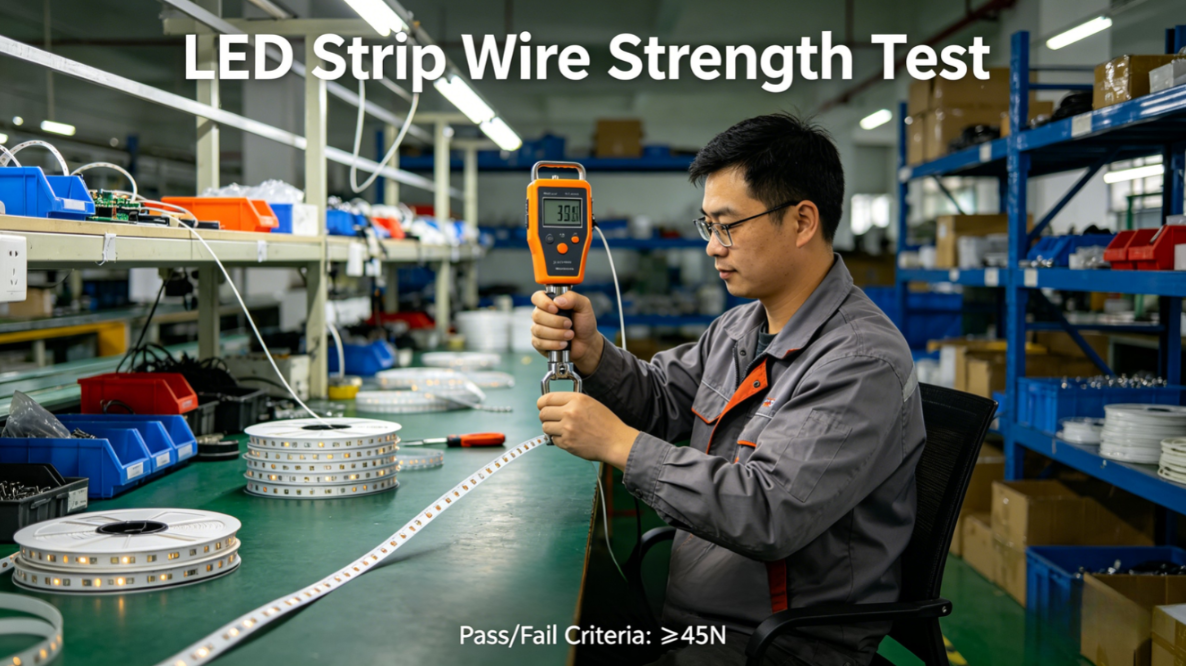
B2B procurement is primarily bulk purchasing, and some clients are involved in export and project acceptance scenarios, placing extremely high demands on product compliance and batch consistency. Any compliance issues or batch discrepancies could render the entire batch unusable, resulting in significant losses. This quality inspection focuses on ensuring products meet relevant standards and that parameters remain stable and consistent throughout mass production, while providing complete compliance documentation.
For product compliance testing, LED strips must comply with national standards such as GB 7000.1 and GB/T 24921, while exported products must meet international certification requirements such as CE, RoHS, and FCC. Testing for heavy metals and hazardous substances ensures compliance with environmental standards, preventing compliance issues from hindering customs or project acceptance. Simultaneously, energy efficiency indicators must meet standards, with a power factor ≥ 0.9, complying with national energy efficiency requirements to reduce energy costs for B2B clients.
In batch consistency testing, products from different batches and production periods are randomly selected to test their electrical parameters, optical performance, and appearance, ensuring no significant differences between batches and avoiding situations where “samples are qualified, but bulk orders are not.” This is particularly suitable for B2B clients such as furniture factories and distributors that require bulk orders. Simultaneously, complete quality inspection reports, certificates of conformity, specifications, and other documentation must be provided to ensure that B2B clients can provide valid qualification certificates during project acceptance and product sales, reducing cooperation risks.
For B2B clients, the quality of LED light strips not only affects the competitiveness of end products and the quality of project delivery, but also their brand reputation and cooperative credibility. The above five quality inspections are not just extra “bonus points,” but rather “essential” for B2B light strip procurement. They are the core guarantee for mitigating procurement risks, reducing after-sales costs, and achieving long-term stable cooperation.
We always prioritize the needs of our B2B clients, integrating these five quality inspections into every stage of production, testing, and delivery. We strictly adhere to industry standards and advertising laws, avoiding exaggeration and false advertising. With compliant, stable, and high-quality light strip products, we provide reliable product support for B2B clients such as contractors, furniture manufacturers, distributors, and smart hardware manufacturers, helping them enhance their core competitiveness and achieve mutual benefit.
Facebook:https://www.facebook.com/profile.php?id=100089993887545
Instagram:https://www.instagram.com/mx.lighting.factory/
YouTube:https://www.youtube.com/channel/UCMGxjM8gU0IOchPdYJ9Qt_w/featured
LinkedIn:https://www.linkedin.com/company/mingxue/
Post time: Apr-29-2026