
 Chinese
Custom LED strip lights sourced from Chinese OEM/ODM manufacturers provide unequaled unit cost savings to worldwide distributors, wholesalers, retail brand owners, and commercial lighting contractors. However, variable factory quality control produces irrevocable B2B operational risks such as product rejection fees, ocean freight backlogs, end-client warranty claims, tarnished brand name, and dwindling gross margins.
According to 2025 cross-border LED industry market research, 34% of first-time B2B LED strip importers experienced severe quality defects within their first three bulk shipments, resulting in average financial losses of $8,400 per defective batch, which included scrapped inventory, return logistics, and compensation to downstream business partners.
The silver lining for B2B procurement teams is that almost all recurring LED strip faults may be detected using standardized pre-shipment third-party QC prior to container loading. This actionable 12-point inspection checklist is designed for in-factory audits, third-party inspection organizations (SGS, Intertek, TÜV, Bureau Veritas), and in-house quality control engineers. It adheres to ANSI/ASQ Z1.4 AQL sampling requirements and aligns with worldwide lighting compliance benchmarks to close confusing supplier tolerance gaps.
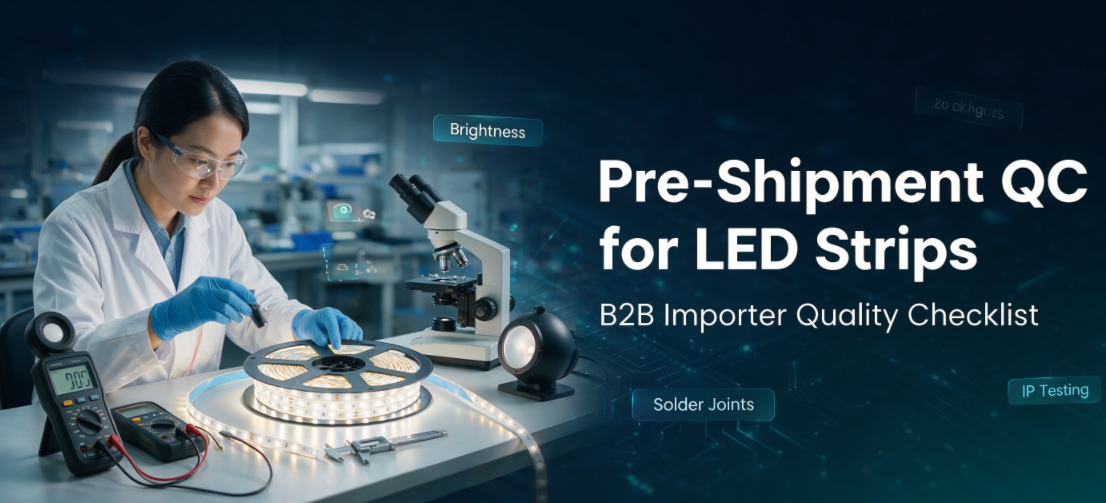
Pre-Inspection Toolkit for On-Site Factory QC Audits
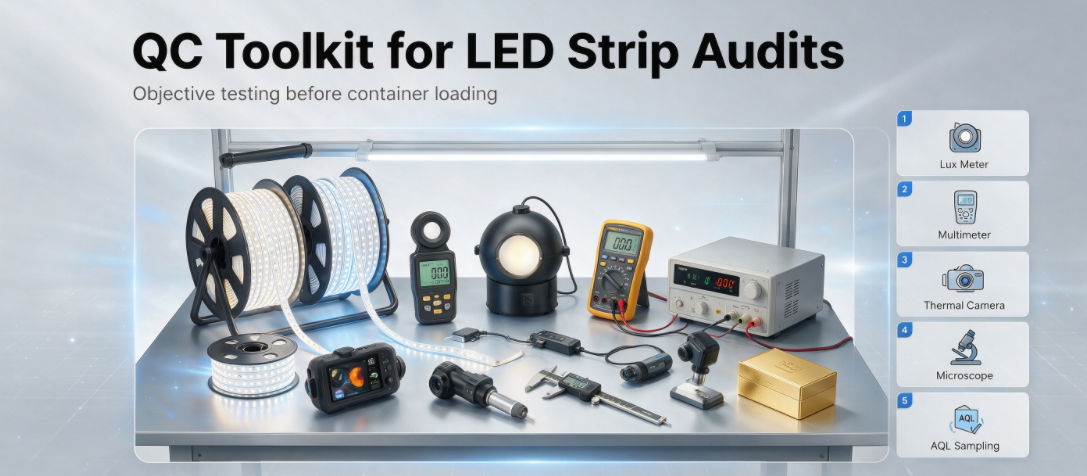
Before launching any bulk batch inspection at the LED manufacturing facility, B2B QC inspectors must prepare a full set of precision testing instruments for objective, quantifiable quality verification.
| Testing Tool | Core B2B Inspection Application |
|---|---|
| Digital Lux Meter & Portable Integrating Sphere / Spectrophotometer | Quantify luminous flux, CCT, CRI, SDCM color consistency for batch benchmarking against golden samples |
| Digital Multimeter & Variable 12V/24V DC Stabilized Power Supply | Measure operational voltage, current, wattage and voltage drop across full-length LED reels |
| Infrared Thermal Camera & Digital Caliper | Thermal dissipation testing + dimensional audit for PCB width, LED pitch and cut-point sizing |
| 10x–50x USB Microscope & 0–5kg Pull-Force Gauge | Micro solder joint defect screening and FPC solder pad adhesion load testing |
| Certified Golden Sample, AQL Z1.4 Sampling Manual & Digital Camera | Side-by-side visual comparison, statistical sampling execution and defect photo documentation for supplier dispute resolution |
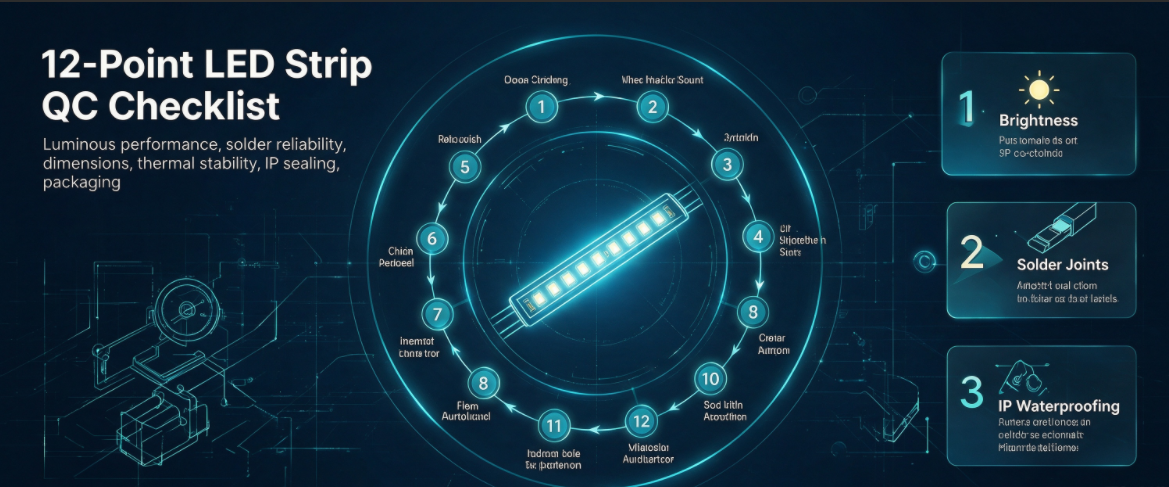
The 12 Standardized Inspection Criteria for B2B LED Strip Bulk Shipments
1. Powered Visual Cosmetic Inspection
Extract 3–5 continuous meters from randomly sampled reels and power strips at rated input voltage under neutral ambient lighting. Inspect the full length for phosphor yellowing, dark chip spots, PCB scratches, uneven solder mask coating and misaligned surface-mounted components.
Acceptance Rule: Zero critical cosmetic flaws on illuminated surfaces; classify visible blemishes as Major Defects with AQL 2.5 threshold for B2B bulk orders.
2. Solder Joint Reliability Testing (Top Root Cause of Post-Delivery Failures)
Use magnification equipment to scan solder pads at multiple reel segments, screening cold solder joints, insufficient tin coverage, solder short bridges and tombstoned LED chips. Complete 1.5kg pull-force adhesion testing on FPC pads to avoid post-installation flickering after thermal cycling. For B2B long-term supply partnerships, mandate SPI (Solder Paste Inspection) and AOI process reports from manufacturers to mitigate hidden solder risks.
3. Dimensional Tolerance Verification
Take 10 random measurement points across 3 sampled reels to audit dimensional compliance against signed technical specifications. Under-length reels and out-of-tolerance PCB dimensions are common supplier cost-cutting tactics that reduce B2B client satisfaction.
| Dimensional Parameter | Allowed Production Tolerance for B2B Orders |
|---|---|
| PCB Width | ±0.2mm vs approved golden sample spec |
| PCB Thickness | ±0.05mm vs approved golden sample spec |
| LED Spacing (Pitch) | ±0.3mm vs approved golden sample spec |
| Cut Point Interval | ±0.5mm vs approved golden sample spec |
| Total Reel Length | +1% / -0% (No negative length deviation permitted) |
4. Luminous Brightness & Lumen Output Calibration
Cut a precise 1-meter test segment, stabilize power output for 30 minutes, then measure luminous flux via integrating sphere. Permitted lumen tolerance range: -5% ~ +10% of manufacturer’s datasheet declaration. Batches below -5% lumen output qualify for batch rejection or commercial price renegotiation with suppliers—this defect usually arises from unauthorized downgrade of LED chip bins post sample confirmation. All B2B purchase contracts must lock fixed LED bin grades to avoid brightness downgrades.
5. CCT Uniformity & MacAdam Ellipse SDCM Consistency
Test color temperature at reel start, midpoint and end. Enforce ±150K single-reel CCT deviation limit. Tiered SDCM standards apply to different B2B end-use verticals: ≤3 SDCM for premium commercial & hospitality lighting, ≤5 SDCM for general residential wholesale orders. Uneven color rendering across reels is a top complaint from B2B commercial lighting contractors.
6. CRI & R9 Deep Red Rendering Audit
Measure Ra general color rendering index plus critical R9 deep red value, the key metric distinguishing premium and low-grade LED strips. Match testing benchmarks to client application verticals as specified in B2B sales contracts.
7. Electrical Parameter Compliance
Calculate real-time wattage via voltage × current readings on 1m powered samples, with ±5% wattage tolerance. Audit voltage drop over full 5m reels; for 12V LED strips, end voltage drop exceeding 0.5V signals underweight PCB copper traces, a common cost-reduction shortcut by unregulated factories.
8. Thermal Performance Long-Stability Test
After 60 minutes of powered thermal stabilization at 25°C ambient temperature, capture component and PCB surface temperatures via thermal camera. Excess heat accelerates LED light decay and shortens product lifespan, a critical failure risk for B2B commercial long-life lighting projects.
9. Back Adhesive Tape Authenticity & Peel Strength Test
Verify branded adhesive (3M VHB / 300LSE) full coverage without bubbles or gaps. Complete a 24-hour peel strength test on aluminum, glass and wooden substrates; counterfeit adhesive tape causes mass product returns for B2B wholesalers within months of installation. Request manufacturer-provided tape authenticity certification for high-volume orders.
10. IP Waterproof Performance Submersion Test
Conform testing protocols to stated IP ratings (IP65, IP67, IP68): submerge 1m sealed strip samples for 30 minutes at rated depth while powered on, checking for air bubbles indicating seal leakage. Differentiate nano-coating splash-proof strips from submersible silicone tube extrusion products and clearly label IP limitations for downstream B2B clients.
11. Cut-Point Soldering & Reconnection Functionality
Cut strips at designated cut marks, attach solderless connectors or hand-solder leads, then power test the joint. No flickering or brightness drop is acceptable. Mandate minimum 3mm × 2mm cut-point pad dimensions for easy field installation by B2B trade customers.
12. Final Packaging, Batch Labeling & Logistics QC
Cross-check reel quantities against packing lists; confirm anti-static moisture-proof packaging with desiccant packs. Validate all mandatory label markings: product SKU, input voltage, wattage, CCT, CRI, reel length, batch trace code, production date and international certification logos. Outer cartons must display country-of-origin marks, weight data and safe handling symbols with zero crushing, water staining or puncture damage.
AQL Statistical Sampling Standard for B2B Bulk LED Strip Shipments
All large-volume B2B container shipments must adopt ANSI/ASQ Z1.4 Level II general inspection sampling to balance audit efficiency and quality risk control. For orders ranging from 1,000 to 3,200 reels:
1. Sample size 125: Accept up to 7 Major Defects; reject the full batch at 8 Major Defects
2. Sample size 200: Accept up to 10 Major Defects; reject the full batch at 11 Major Defects
3. Critical safety non-compliance defects (exposed live circuits, substandard insulation): Zero acceptance (c=0 rule) – one single critical flaw triggers full batch rejection
Core Golden Rule for All B2B LED Strip QC Audits
Always conduct side-by-side comparison with your signed, sealed golden sample. Datasheet specifications alone leave room for supplier tolerance drift across production runs. Store golden samples in light-blocking, temperature-controlled storage, archive full defect comparison photos and bring the physical sample to every pre-shipment factory audit to eliminate contractual disputes with OEM manufacturers.
Root Cause & Mitigation Matrix for Frequent B2B LED Strip Defects
| Common Bulk Defect | Primary Manufacturing Root Cause | B2B Sourcing Risk Prevention Strategy |
|---|---|---|
| Intra-reel inconsistent CCT | Mixed LED chip bins during assembly | Lock single-bin LED requirements in PO; audit component reel bin labels pre-production |
| Early-stage flickering after installation | Unqualified cold solder joints | Mandate SPI/AOI in-process QC; specify solder paste alloy standards in manufacturing agreement |
| Phosphor yellowing within 6 months | Low-grade phosphor or insufficient thermal design | Request LM-80 light decay test reports; enforce junction temperature design limits |
| Adhesive tape delamination | Counterfeit tape raw materials | Require official brand authenticity certificates with batch traceability for adhesive rolls |
| Severe voltage drop on long reels | Thin PCB copper traces below 1oz | Mandate minimum 2oz copper thickness for all 5m+ 24V LED strip bulk orders |
B2B FAQ: LED Strip Pre-Shipment Quality Inspection for Global Importers
Q1: Is third-party inspection mandatory for importing LED strips from Chinese factories?
A1: It is not a legal requirement, yet strongly recommended for all B2B bulk importers. Independent third-party auditors deliver unbiased, standardized QC reports that serve as legal evidence for dispute resolution with suppliers if defective batches are discovered post-shipping. Reputable manufacturers such as Mingxue Optoelectronics fully accommodate SGS, TÜV and Intertek on-site audits without extra surcharges.
Q2: What compliance certifications should I verify during factory QC?
A2: Key mandatory and voluntary certifications for cross-border B2B sales include CE, RoHS, FCC, UL and LM-80 light lifespan test documents. During inspection, cross-check certification mark printing on reel labels and request original test reports from the manufacturer to avoid counterfeit compliance labeling, which can trigger customs seizure of full containers.
Q3: How do I avoid suppliers downgrading LED chip quality mid-production?
A3: Three actionable B2B procurement controls: 1) Lock fixed LED bin codes, brand and model numbers within formal purchase contracts; 2) Complete incoming material inspection on all LED chip reels before mass production launch; 3) Retain a sealed golden sample signed by both parties as the official quality benchmark for every production batch.
Q4: What if the factory refuses to rework defective batches identified during pre-shipment QC?
A4: Formalize penalty clauses in your OEM cooperation agreement, including provisions for free rework, partial order refunds or full batch replacement at the manufacturer’s logistics cost. Reliable B2B LED strip manufacturers implement full batch traceability, enabling fast root-cause correction and rework coordination to avoid supply chain delays.
Conclusion: Build Stable B2B LED Supply Chains via Standardized 12-Point QC
For cross-border wholesalers, commercial lighting contractors and private-label brand importers, standardized pre-shipment LED strip inspection is not an optional add-on cost—it is a core supply chain risk management investment. This 12-point checklist unifies objective testing metrics, AQL sampling rules and B2B commercial dispute prevention measures to align factory production quality with your downstream client expectations.
Partner with certified manufacturers that embed full-cycle QC: incoming material testing, in-line AOI/SPI monitoring, 2-hour full burn-in testing for all finished strips and transparent batch traceability. Consistent pre-shipment quality verification reduces after-sales overhead, stabilizes long-term B2B client retention and maximizes sustainable profit margins for your LED lighting import business.
Contact professional LED strip manufacturers to schedule on-site pre-shipment factory audits, request certified quality test documentation and order golden samples for your bulk import QC standards.
Facebook:https://www.facebook.com/profile.php?id=100089993887545
Instagram:https://www.instagram.com/mingxuelighting.factory/
YouTube:https://www.youtube.com/channel/UCMGxjM8gU0IOchPdYJ9Qt_w
LinkedIn:https://www.linkedin.com/company/mingxue/
Post time: Aug-12-2026