
 Chinese
For B2B specifiers, procurement teams, lighting contractors and system integrators, selecting waterproof LED strip lights should be driven by actual site exposure rather than budget‑driven guesswork or blindly picking the highest IP number. When evaluating IP65 IP67 IP68 LED strip lights, always reference the IEC 60529 standard to avoid mis‑specifying your commercial LED strip lighting project.
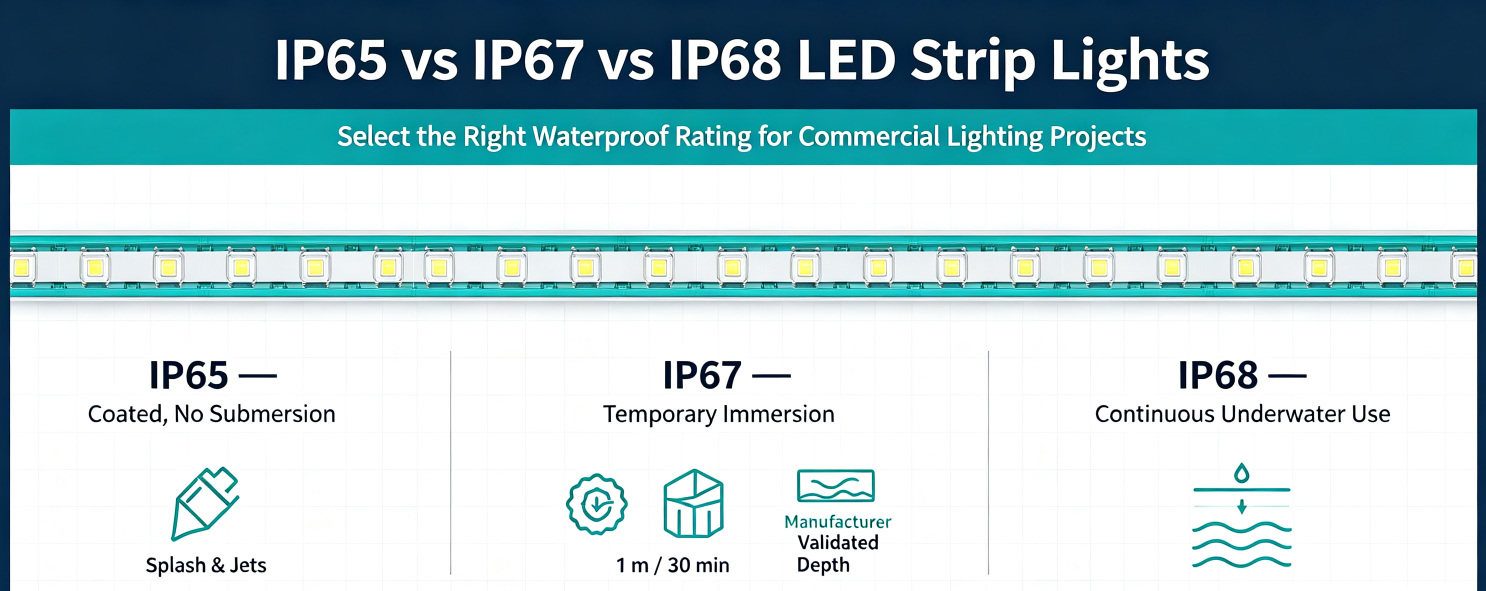
- IP65: Handles splashes and directed water jets; not designed for submersion. Works well for covered outdoor and damp‑indoor environments.
- IP67: Survives temporary immersion up to 1‑metre depth for 30‑minutes under standard lab testing. Suitable for weather‑exposed installations with occasional flooding or water spill‑over.
- IP68: Validated for continuous underwater operation. Exact depth and duration are defined by each manufacturer’s test protocols, not fixed by the IEC 60529 standard. Use for pools, ponds, fountains and marine underwater LED strip applications.
Many covered signage and outdoor facade projects can operate reliably with IP65 or IP67. Unnecessarily specifying IP68 for dry cove lighting increases material cost and reduces on‑site flexibility due to stiffer encapsulation. Conversely, deploying IP65 where direct standing water occurs often results in premature field failure, rework costs and warranty disputes.
Understanding IEC 60529 IP Code for LED Strips
The IP rating system follows the IEC 60529 international standard, with two‑digit notation:
1. First digit: protection level against solid particles (dust, debris)
2. Second digit: protection level against liquid ingress (water)
For LED strip light projects, the second digit is the primary decision factor.
A widespread misconception among B2B buyers is equating higher IP numbers with superior overall product quality. An IP rating reflects defined laboratory test conditions — it is not a universal quality ranking. An IP65‑rated strip can deliver multi‑year reliable service under a protected soffit, while an IP68 unit may fail quickly if field connectors or cut ends remain improperly sealed.
Breakdown: IP65, IP67, IP68 LED Strip Lights
IP65 LED Strip Lights: Water Jet Protection, No Submersion
IP65 provides dust‑tight performance and resistance against water projected by a nozzle (12.5 L/min, any direction, for three‑minute test duration).
Typical construction: PCB and electronic components coated with silicone or epoxy, without a full outer protective jacket. This design preserves high flexibility for tight profile mounting.
Recommended B2B applications:
- Kitchen under‑cabinet and toe‑kick lighting
- Bathroom damp‑zone cove lighting
- Covered eaves, soffits and recessed architectural cove lighting
- Retail display cabinets with occasional wiping or water splashes
- Building facades equipped with canopy or recessed shelter
Conditions to avoid: Open gutter mounting, un‑backed exposed signage, any location with standing or pooled water. Direct driving rain without overhead cover presents elevated risk of water ingress.
IP67 LED Strip Lights: Tolerates Short‑Term Dunking
Under IEC 60529 testing, IP67 permits temporary immersion: up to 1‑metre depth for 30‑minutes. Most IP67 strips are housed inside a clear silicone sleeve or feature full‑length injected silicone encapsulation.
Recommended B2B applications:
- Pool coping lighting with occasional water overflow
- Garden edging subject to storm‑time temporary flooding
- Exposed wall‑mount channel‑letter commercial signage
- Deck step lighting subject to regular hose‑down cleaning
IP67 is intended for accidental, short‑duration water submersion. It is not engineered for permanent underwater service. Specifying IP67 for continuously submerged installations typically generates higher total‑project cost due to site callbacks and replacement work.
IP68 LED Strip Lights: Engineered for Continuous Underwater Deployment
IP68 covers continuous immersion beyond one‑meter depth. One critical detail often omitted from datasheets: the exact test depth and time thresholds are set by each manufacturer, not fixed within the IEC 60529 standard. One vendor’s IP68 may validate 1.5m for 12‑months; another supplier may test to 3m depth. Always request documented test parameters during your LED strip RFQ process.
Typical construction: Fully injected silicone material, resin‑potted end caps and factory‑molded sealed connectors. Extra raw material and labor result in higher per‑meter unit cost compared with IP67 and IP65 variants.
Recommended B2B applications:
- Submerged swimming‑pool perimeter lighting
- Pond and fountain water‑feature illumination
- Marina and marine accent lighting
- Architectural features permanently positioned below the waterline
Even IP68 performance depends entirely on sealing integrity. Factory testing covers original un‑cut reels. Every field cut, splice and added connector creates new sealing points for which the installation team holds responsibility.
Side‑by‑Side Technical Comparison Table
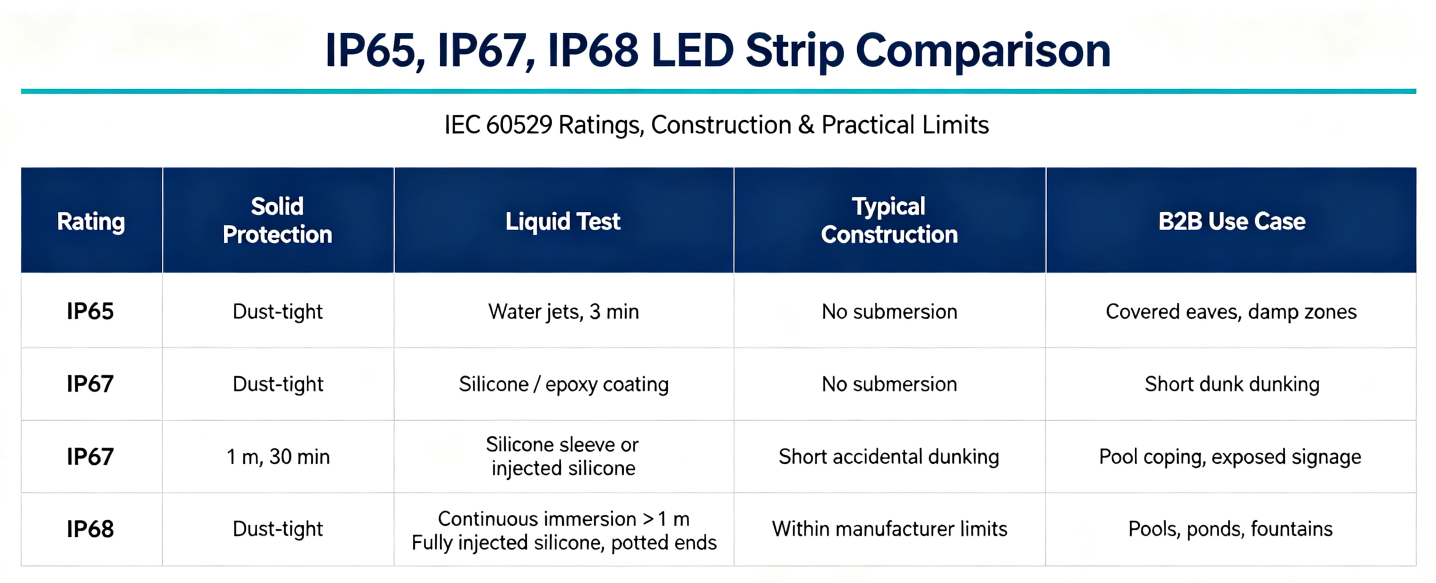
| Rating | Solid Particle Protection | Liquid Test (IEC 60529) | Typical Construction | Practical Operational Limits | Common B2B Project Uses |
|---|---|---|---|---|---|
| IP65 | Dust‑tight (6) | Water jets, all directions for 3 min | Silicone / epoxy coating, no full outer jacket | Zero submersion; prevent standing water accumulation | Damp indoor spaces, covered eaves, cabinet accent lighting |
| IP67 | Dust‑tight (6) | Temporary immersion: 1 m, 30 min | Silicone sleeve or injected silicone body | Short‑term accidental dunking only; not for continuous underwater use | Pool coping, garden edging, rain‑exposed commercial signage |
| IP68 | Dust‑tight (6) | Continuous immersion > 1 m; depth & duration supplier‑defined | Fully injected silicone, resin‑potted end caps | Valid strictly within manufacturer‑published depth and time limits | Submerged pool lighting, ponds, fountains, marine installations |
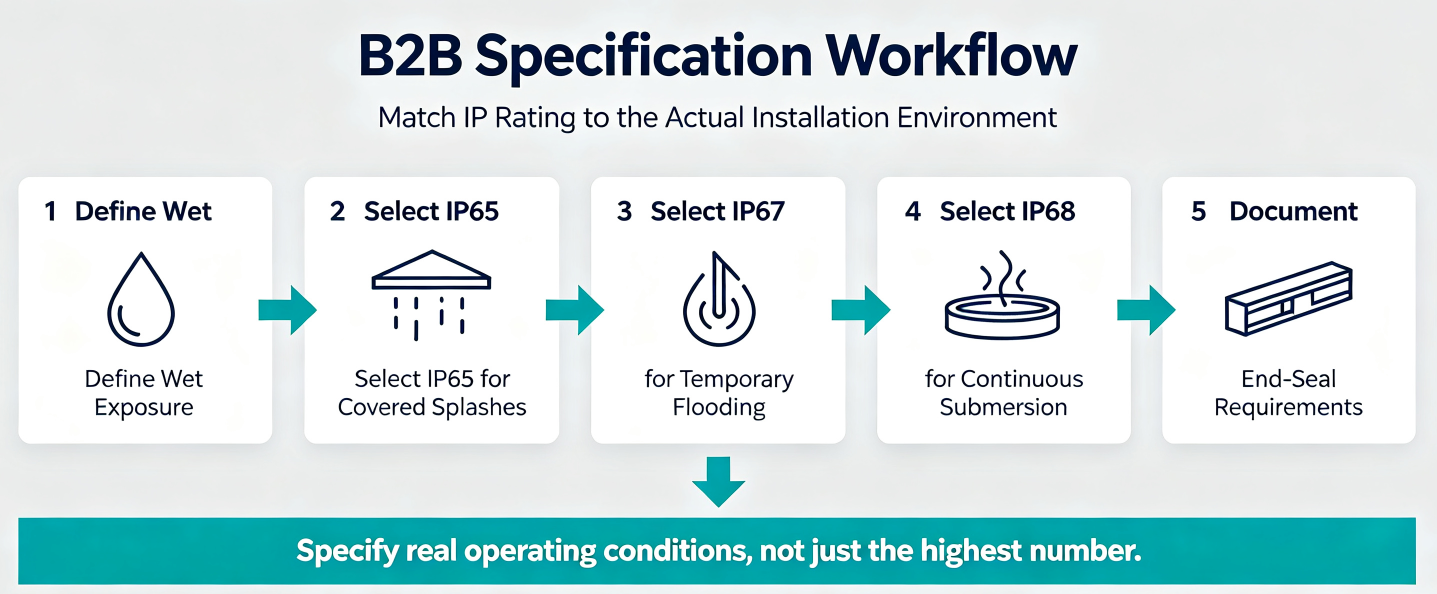
B2B Specification Workflow: Match Rating to Installation Environment
B2B specifiers can follow this step‑by‑step framework to produce clean, unambiguous project requirements for tender and RFQ documentation:
1. Define the normal‑service maximum wet exposure condition of the installation location. Base your specification on typical operating conditions rather than extreme one‑in‑decade storm events.
2. If exposure consists only of splashes, hose spray or rain under protective cover: select IP65.
3. If hardware faces fully‑exposed weather or occasional short‑term flooding: specify IP67.
4. If strip lighting will sit continuously below the waterline as part of design intent: select IP68, and write the validated depth plus duration parameters into your technical specification.
5. Select coating material appropriately: silicone maintains flexibility and delivers better UV stability than many PVC formulations. PVC offers cost advantages for indoor projects yet tends to yellow and stiffen under prolonged outdoor UV exposure.
6. Document required end‑sealing methodology within bill‑of‑materials documentation. A strip’s IP rating delivers limited value when field‑cut ends remain unsealed.
In commercial procurement workflows, buyers purchase a complete lighting system: LED strip, mounting profile, connectors and sealing accessories. The overall ingress‑protection performance is determined by the weakest component in this system.
Critical Failure Point: Field Cuts, Connectors and End Seals
Most field‑diagnosed water‑ingress failures originate not from the LED strip main body but from splice joints and field‑cut ends. Factory‑supplied reel lengths complete with factory sealing undergo formal IP testing; every on‑site cut voids that factory seal.
Three practical sealing solutions ranked by real‑world field reliability for B2B projects:
1. Factory‑supplied resin‑potted end caps with integrated molded connectors: most consistent performance, minimizes installer error risk.
2. Adhesive‑lined heat‑shrink tubing supplemented with neutral‑cure silicone bead: solid performance when installed carefully; higher failure risk under rushed site execution.
3. IP‑rated junction boxes with cable glands for splice points: more labor-intensive installation, but creates inspectable electrical connections for project acceptance.
Sealing performance falls under installer scope of work. During supplier evaluation, explicitly ask vendors to document recommended end‑seal kits and installation procedures before order placement, not after site failures occur.
Key Items to Include in Your RFQ Document
This checklist supports procurement teams to obtain comparable quotations across multiple lighting vendors:
- Required IP rating plus reference to IEC 60529 test standard
- For IP68 products: documented validated immersion depth and time parameters
- Encapsulation / coating material specification (silicone, PVC or epoxy), plus UV‑resistance requirements for outdoor deployments
- CCT binning tolerance to avoid inconsistent color rendering across long strip runs
- Target‑market compliance certifications: CE & RoHS for EU markets; UL / ETL listings for North‑American projects
- Mandatory pre‑production sample approval, including physical demonstration of end‑sealing hardware
- MOQ, production lead‑time, clarification whether cut‑length processing and end‑seals are factory‑supplied or site‑executed
- Warranty terms explicitly aligned to documented on‑site environmental conditions
Two items frequently omitted from RFQs are IP68 immersion test parameters and end‑seal methodology; these two factors strongly influence long‑term project reliability.
Industry‑Wide Common Myths
1. Myth: IP68 means safe for unlimited underwater operation.
- Reality: Protection is valid only within the depth and duration limits from the manufacturer’s lab testing. Conditions beyond those parameters remain unvalidated.
2. Myth: Higher‑number IP ratings are always the better technical choice.
- Reality: Higher IP encapsulation adds material thickness and mechanical stiffness, complicating tight‑profile installation and potentially affecting thermal dissipation. Specify for site environment rather than chasing higher numerical ratings.
3. Myth: If the LED strip carries IP67 rating, the whole installation automatically meets IP67.
- Reality: Added connectors and field‑cut ends must receive matching sealing treatment. Total system ingress protection equals the weakest joint.
4. Myth: Waterproof rating eliminates all maintenance needs.
- Reality: Seals degrade over time under UV radiation, thermal cycling and mechanical movement. Periodic annual inspection of joints reduces unexpected downtime risk for long‑term installations.
Frequently Asked Questions
Q1: Can I cut IP67 or IP68 LED strips and retain the published IP rating?
A1: Only the original un‑cut factory segments keep the certified rating. Any field cut breaks the factory seal. To restore equivalent ingress‑protection performance you must apply the supplier‑approved end‑seal kit (resin potting or adhesive‑lined heat‑shrink). During design phase plan cut points so resealed end locations avoid continuous water submersion.
Q2: Is IP65 suitable for outdoor LED strip installations?
A2: IP65 works reliably for covered outdoor locations such as soffits, canopies and recessed cove lighting. For locations exposed to open direct rain or pooling water, upgrade to IP67. “Outdoor” covers many distinct exposure conditions; always match rating to exact local site conditions.
Q3: Practically, what differentiates IP67 versus IP68 for commercial projects?
A3: IP67 addresses accidental short‑duration dunking. IP68 is intended for lighting hardware designed to remain continuously underwater (pool perimeter, fountains, ponds). For permanently submerged applications specify IP68 and embed depth‑time test constraints into your purchasing documentation. Use IP67 where water exposure happens only occasionally during storms or over‑flow events.
Q4: Do outdoor LED strip projects for North America require UL listing?
A4: UL or ETL certification represents widely‑accepted industry expectation for electrical lighting products deployed in North‑American commercial builds; local inspectors may request proof of compliance. CE and RoHS apply for European markets. Include regional certification requirements in your RFQ to prevent mid‑project sourcing delays.
Q5: How should I verify a supplier’s IP‑rating marketing claims?
A5: Request formal IEC60529 test reports instead of relying only on reel‑label printing. Reputable B2B lighting suppliers share full test documentation, including depth and duration data for IP68‑classified products. Reluctance to provide lab reports represents a risk flag during vendor qualification.
Q6: Which IP rating carries the highest unit cost? What drives pricing variance?
A6: IP68 generally has the highest per‑meter cost due to injected‑silicone encapsulation and potted‑end manufacturing processes; IP67 sits above IP65 for similar reasons. However, total‑project cost is frequently impacted more by profile hardware, connector assemblies and sealing accessories than the base LED strip reel itself. B2B buyers should evaluate the full lighting system instead of focusing solely on strip unit price.
Select LED strip ingress‑protection ratings according to real‑world site wet conditions instead of price‑point or arbitrary preference for higher‑number specifications.
- Deploy IP65 for splash‑prone and covered‑location installations
- Deploy IP67 for fully‑exposed outdoor locations with temporary water exposure
- Deploy IP68 for continuously submerged lighting applications and always capture manufacturer‑validated depth and time test limits in procurement documents
Never overlook end‑cut and connector sealing protocols. Many project failures trace back to poorly‑executed site sealing rather than the LED strip itself. When project scoping creates uncertainty around required IP grade, share installation drawings and site‑exposure notes with your technical supplier for pre‑order review; proactive technical consultation helps avoid premature product degradation and costly post‑installation disputes.
MINGXUE is the brand name of Shenzhen Mingxue Optoelectronics Co., Ltd. For international markets, the company operates under the brand name MINGXUE Lighting. Our official international website is mingxueled.com.
Published by Mingxue Lighting | Founded 2005 | Shenzhen R&D Center + Foshan Manufacturing Base | 24,000 sqm | ISO 9001 Certified
Facebook:https://www.facebook.com/profile.php?id=100089993887545
Instagram:https://www.instagram.com/mingxuelighting.factory/
YouTube:https://www.youtube.com/channel/UCMGxjM8gU0IOchPdYJ9Qt_w
LinkedIn:https://www.linkedin.com/company/mingxue/
Post time: Sep-16-2026