
 Chinese
Most people shopping for LED strip lights open with the color reel. The RGB demo — red, blue, and green cycling through, a strip syncing to the beat — is the part that gets shared and saved, and it is genuinely fun to watch. Then the roll goes up at home, and within a couple of weeks the color show is off and the soft white glow is what actually stays on every night.
That gap between the demo and the daily is where LED strip buying usually goes wrong. Mingxue Optoelectronics has been manufacturing LED strip lights since 2005, a 21-year run in this one product, and the question our team hears most from customers is the same every week: how to choose LED strip lights without getting it backwards. Some version of “what is the best LED strip light brand” or “how much does LED strip light cost per meter” lands in our inbox almost daily, and our answer has not changed in two decades. Before you count how many color modes a roll offers, look at how good its white light is.
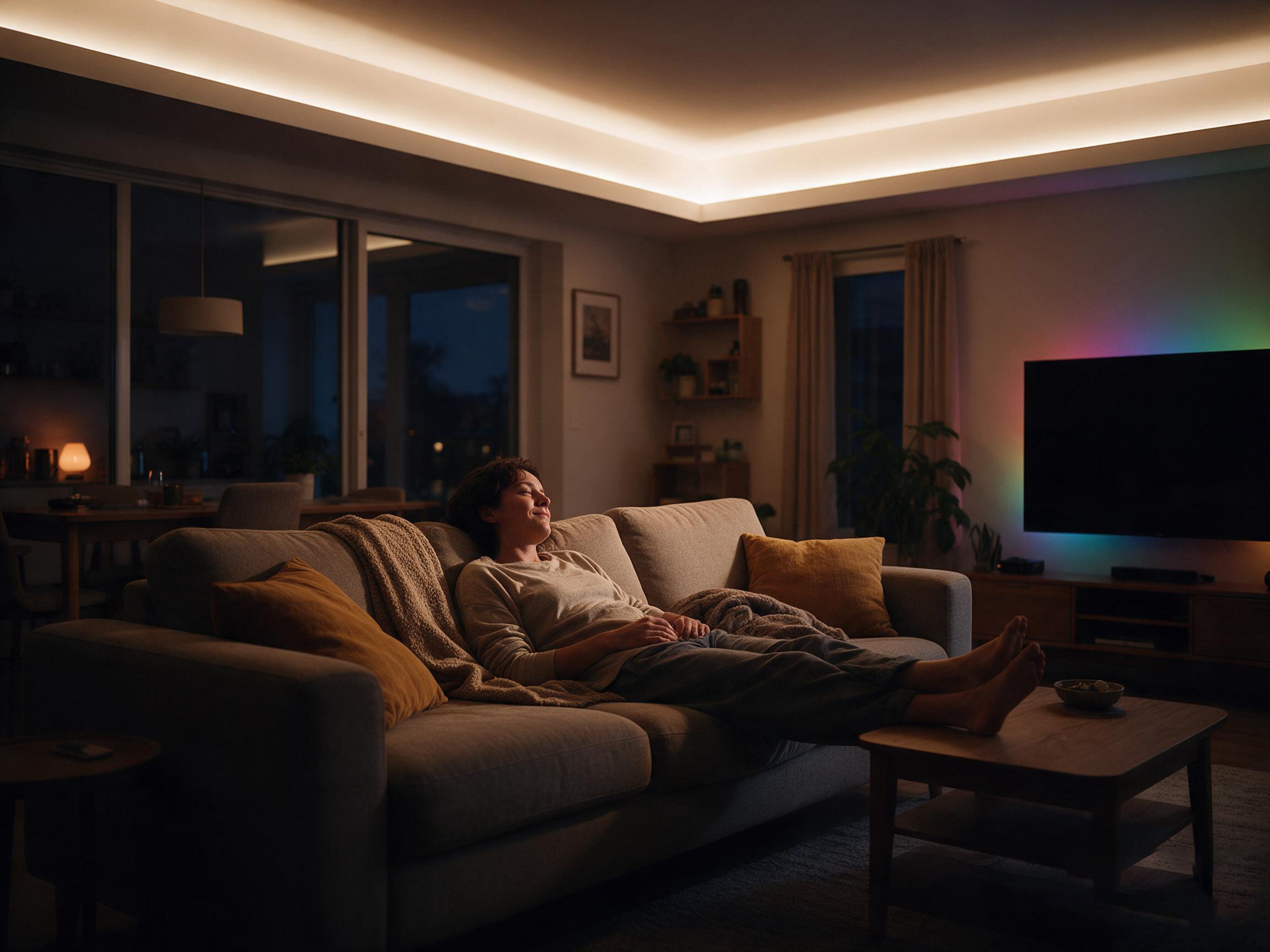
Here is why that matters. RGB LED strip and addressable color rolls are the fun part — TV background walls, game-room ambience, holiday decor. They produce instant atmosphere, and that is exactly why they spread so fast online. But the scenes that actually carry a day are almost all white: the ceiling cove in a shadowless lighting design, the under-cabinet fill light, the baseboard line down a hallway, the roll tucked under a monitor. A linear light washed into an aluminum channel, and commercial lighting aimed at shelves and display cases, all depend on clean, honestly rendered white light — not on color tricks.
Color LED strip earns attention. White LED strip light earns the daily experience. Keep that distinction in mind and choosing an LED strip gets a lot simpler.
 1、RGB LED strip looks great — white LED strip light does the work
Color LED strip — RGB, addressable, RGBW — sells itself because it moves and changes. For a TV background wall, a game room, or a seasonal display, color is genuinely the right tool, and that is why it earns so much organic attention. The visuals do the marketing on their own.
Look at where LED strip lights actually spend their working hours, and the picture flips. A shadowless lighting design fills ceiling coves with white LED strip light. Under-cabinet and wardrobe rolls are white. Baseboard and stair-nosing lines are white. The LED strip under a desk is white. Linear lighting pressed into an aluminum channel for wall-washing runs white, and commercial lighting over shelving and product displays runs white too. These are the high-frequency jobs, and almost none of them need color.
One distinction is worth spelling out, because people confuse it constantly: a linear light is not the same thing as a bare LED strip. A linear light is a LED strip mounted into an aluminum channel with a diffuser and a driver — even output, cleaner look, built to be seen as a ceiling line or a wall wash. A bare LED strip is more flexible and cheaper, built to hide inside a cove or a cabinet. The decision comes down to whether the light itself is meant to be visible.
Color LED strip starts the conversation. White LED strip light decides whether you are still happy six months later.
2、Three specs decide whether a white LED strip light is good
Two rolls can both read “white LED strip light” on the label and look nothing alike. Three specs do most of the deciding.
Color temperature. 3000K runs warm and suits bedrooms and dining rooms where you want to wind down. 4000K is neutral and works in kitchens, offices, and makeup areas where you need to see detail. Push to 4500K–5000K and you get the cool white that keeps a study or a workbench feeling sharp. The part that surprises buyers is this: the same “3000K” can look warm and natural on one LED strip and dull and gray on another. Same number, different phosphor, different result. When someone asks what color temperature for LED strip lights is right, the honest answer is “depends on the room” — but rendering quality is what separates a good warm white from a muddy one.
CRI, the color rendering index. This decides whether colors look real under your LED strip light. High CRI makes food look appetizing, wood veneer look warm, and skin look healthy; low CRI flattens everything into gray. Mingxue Optoelectronics pushes its white LED strip lights to CRI>97 because “still looks good in white” is the whole point of the product. If you have been asking what CRI is good enough for LED strip lights, start at 90 and prefer 97 for anything you will look at every day.
SDCM, color difference. A LED strip runs for several meters or more, and the real enemy is one section reading slightly different from the next, or brightness sagging along the run. Binning inside a 3-step MacAdam ellipse (SDCM<3) keeps color difference small enough that your eye cannot separate it.
|
Parameter |
How to choose |
What a poor LED strip light looks like |
| Color temperature | 3000K warm / 4000K neutral / 4500K–5000K cool | Dull, gray, or harsh and cold |
| CRI | Higher is more accurate — prefer CRI>97 | Flat colors, weak skin tones |
| SDCM | Binned to SDCM<3 | Visible color or brightness steps along one run |
3、COB LED strip vs SMD LED strip — where the dots come from
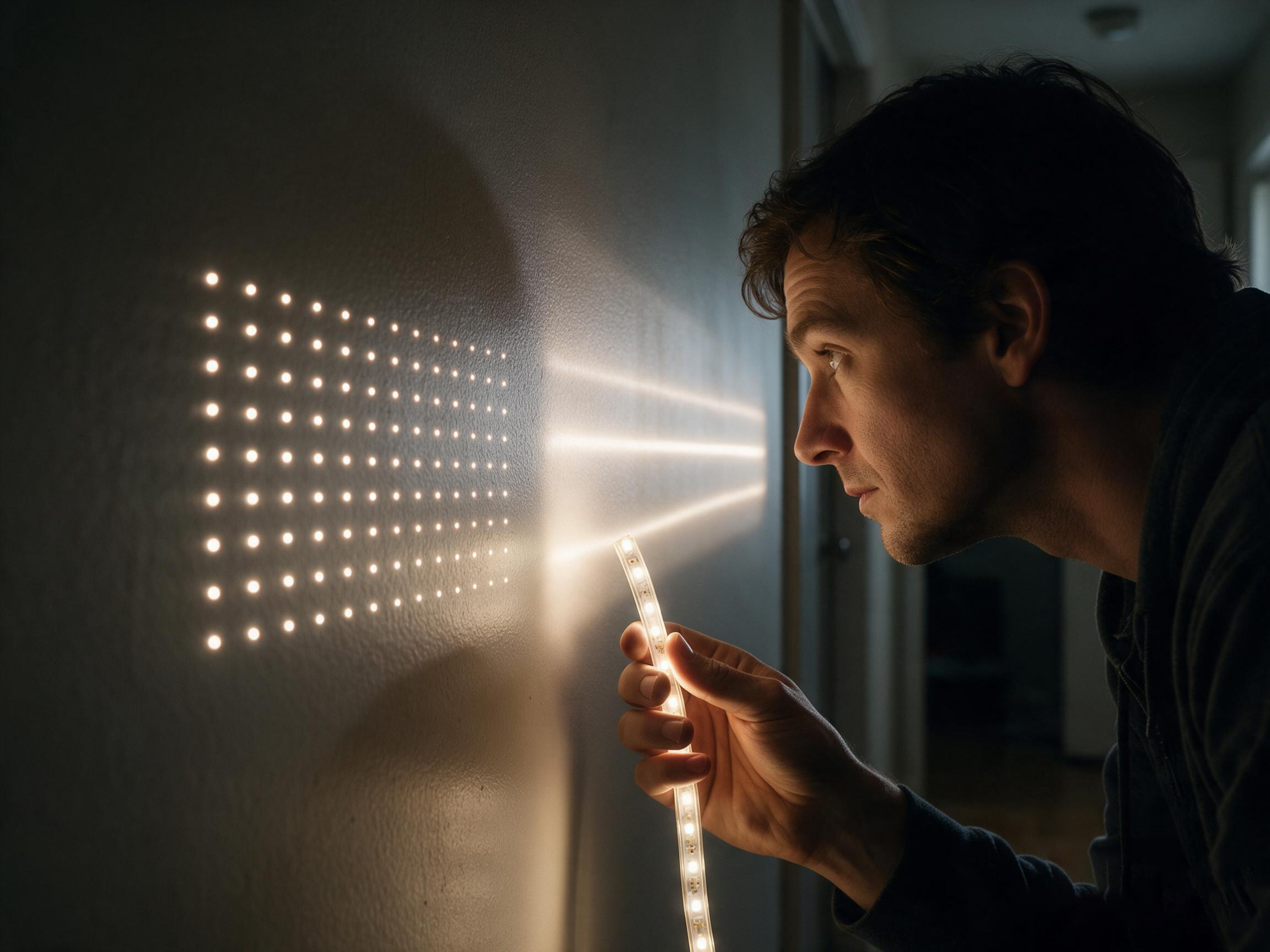
Plenty of people install a roll and only then notice the “dots.” A standard SMD LED strip lines its diodes up one by one, and when the light hits a reflective surface straight on, each chip shows as a small bright point. This is most obvious in a shadowless lighting design and when a linear light washes a wall through an aluminum channel — the exact places you least want it.
A COB LED strip exists to fix that. The chips sit so densely that the emitting surface is continuous, and the light comes out as one even line with no visible dots. That is why COB LED strip or CSP LED strip is the usual recommendation for shadowless lighting, decorative lines, and wall-washing — every case where the smoothness of the light surface is the whole job. If you are weighing COB LED strip vs SMD LED strip, the answer usually hangs on whether the light will reflect off a surface people can see.
A CSP LED strip pushes the idea further: higher density in a smaller footprint, which suits thin lines where there is no room for a wide board. What is CSP LED strip, in one line? A chip-scale package that crams the diodes tighter than COB LED strip for the narrowest, most continuous light line.
|
Type |
Dot appearance |
Best for |
| SMD LED strip | Visible dots | Hidden installs, value-driven jobs |
| COB LED strip | No dots, even line | Shadowless lighting design, wall-washing, decorative lines |
| CSP LED strip | No dots, thin profile | Fine lines, narrow channels |
4、Matching LED strip light to the room
The right LED strip depends on the room more than the budget.
Shadowless lighting design. For a living room or bedroom that skips a main fixture, you tuck LED strip lights into the ceiling cove for base light and add downlights or spotlights for accent. This is where COB LED strip or CSP LED strip earns its keep, at 3000K–4000K with the highest CRI you can afford. Cheap white LED strip light in a cove is exactly how ceilings end up looking greenish or gray. If you have searched what LED strip to use for shadowless lighting design, that is the answer: dot-free, high-CRI, 3000K–4000K.
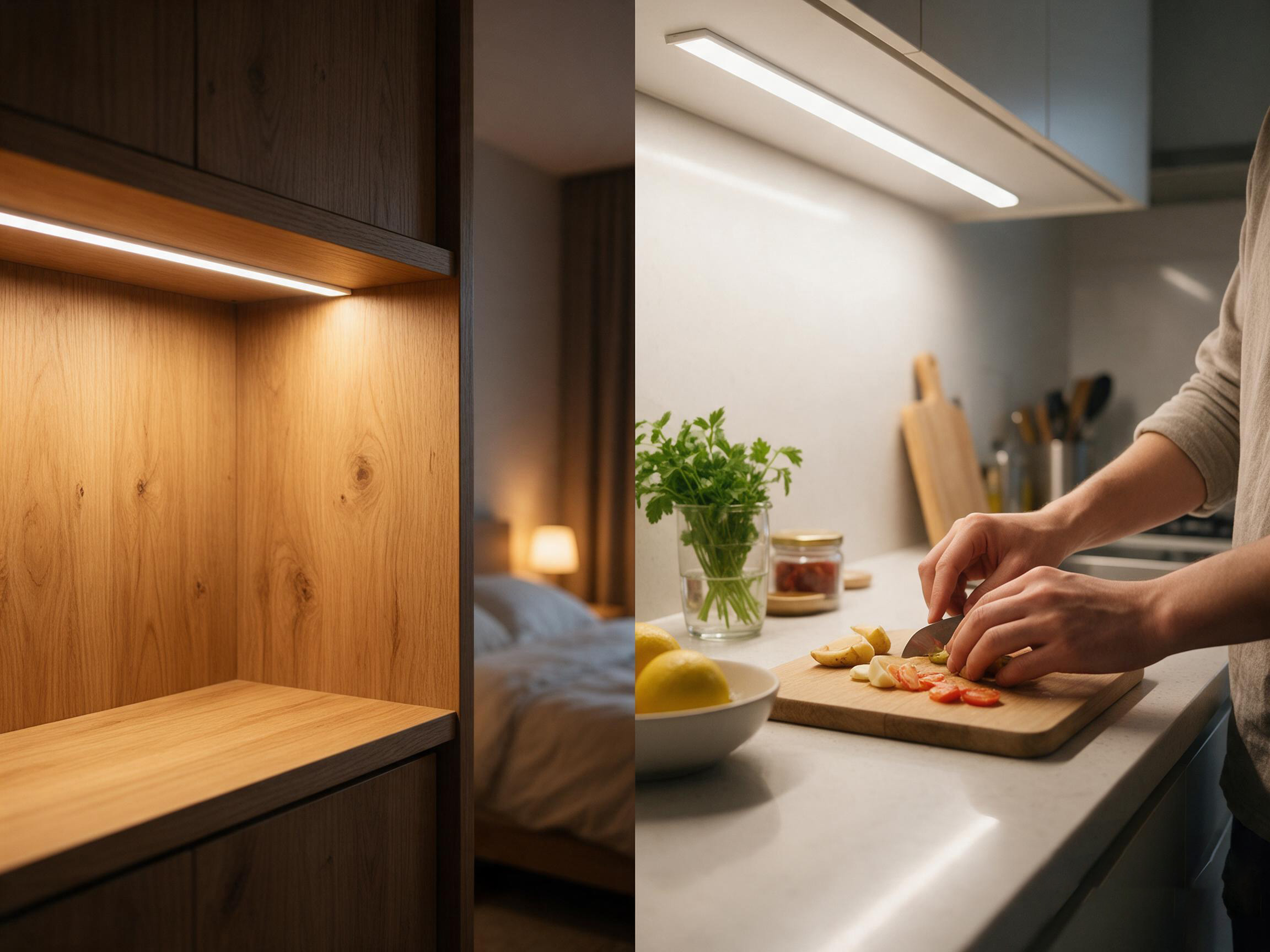
Cabinets and wardrobes. Under-cabinet and in-cabinet fill light wants a narrower LED strip, around 4000K to stay near daylight — bright enough to chop and find clothes, and cool enough not to add heat.
TV background walls and decorative lines. Trace the line with COB LED strip or flexible neon LED strip for the “see the light, not the lamp” effect, at 3000K for warmth.
Commercial lighting. Shelving, display cases, and storefronts want high-CRI white LED strip light so product colors read true. This is where CRI>97 pays for itself — a tomato that looks like a tomato sells. If you are choosing what LED strip for commercial lighting, lead with CRI and color consistency, not brightness.
5、The invisible specs that make an LED strip light last
Color gets the click, but the things that decide whether an LED strip light still looks right a year later are invisible: voltage drop, waterproofing, and light decay.
Voltage drop is why a long LED strip dims toward the far end. Good LED strip lights fight it with thicker 2oz or 3oz copper on the PCB. Waterproofing is the difference between a roll that works in a bathroom and one that dies in a month — IP20 for dry indoor coves, IP65 for splash zones, IP67 where it could get wet, which is also the baseline for any serious outdoor lighting project. And light decay decides whether the LED strip stays bright or quietly fades; a roll built to a 50,000-hour standard and driven properly fades far slower than a cheap one pushed to its limit. For a facade or a landscape job, that gap is the whole difference between an outdoor lighting project that reads crisp for years and one that needs redoing in two. The same logic applies to a lighting engineering project, where a spec written on paper has to survive on the wall.
None of this shows up in a color demo. It shows up in how long the LED strip light keeps looking right.
6、Frequently Asked Questions About LED Strip Lights
Q1: Should I choose white or RGB LED strip lights?
A: Match it to the job. RGB LED strip suits background walls, ambience, and entertainment; white LED strip light suits daily lighting, shadowless lighting design, and commercial lighting. For both, a multi-channel tunable white LED strip gives you color options plus a clean white when you need it.
Q2: What LED strip light works best for shadowless lighting design?
A: COB LED strip or CSP LED strip. Both are dot-free and high-CRI, and paired with an aluminum channel and the right color temperature they deliver the “see the light, not the lamp” effect a shadowless ceiling depends on.
Q3: How do I tell a good LED strip light from a bad one?
A: Do not stop at brightness. Check CRI (prefer CRI>97), color consistency (SDCM<3), light decay and lifespan (a 50,000-hour standard), and whether the waterproof rating matches where the LED strip will be installed.
Q4: Why do LED strip light prices vary so much?
A: Per meter, the gap comes from chip quality, diode density, CRI, waterproofing, and lifespan. Cheap LED strip lights cut corners on the chip and the copper, so they decay faster and drift in color. If you are comparing how much does LED strip light cost per meter, ask what is inside the roll, not just the number.
The pattern we have watched for two decades is simple: people pick a LED strip light on what is fun and judge it on what lasts. White-light quality, color rendering, color consistency, voltage drop, waterproofing — the unglamorous specs are the ones that decide whether the strip feels right and holds up.
That is the direction Mingxue Optoelectronics has committed to. The company has been making LED strip lights since 2005, and the group runs a Shenzhen R&D and sales center alongside a 24,000 sqm manufacturing base in Foshan, with a monthly capacity of 6 million meters and vertical integration from chip packaging through finished delivery. That setup is what lets us put CRI>97, SDCM<3, and a 50,000-hour lifespan into every meter of production LED strip instead of leaving them on a spec sheet. Foshan Mingxue Optoelectronics Co., Ltd. — the manufacturing arm — operates as a wholly-owned subsidiary of Mingxue Optoelectronics Holding Co., Ltd., and the facility is ISO 9001 certified, alongside IATF16949, UL, CE, SAA, and ErP.
Color is worth playing with. But the white LED strip light you turn on every single day is the one that has to be right. If you’d like to learn more about our LED strip lights or get a quote, feel free to leave your contact details on our official website, or call us at +86 137 1903 7641 (same number on WeChat).
MINGXUE is the brand name of Shenzhen Mingxue Optoelectronics Co., Ltd. For international markets, the company operates under the brand name MINGXUE Lighting.
Facebook:https://www.facebook.com/profile.php?id=100089993887545
Instagram:https://www.instagram.com/mingxuelighting.factory/
YouTube:https://www.youtube.com/channel/UCMGxjM8gU0IOchPdYJ9Qt_w
LinkedIn:https://www.linkedin.com/company/mingxue/
Post time: Oct-06-2026