
 Chinese
Most buyers start at the wrong end. They ring up asking how to choose LED strip lights, and a minute in, the real problem floats to the surface: the roll they already bought powers on fine, but the light it throws doesn’t match the room they had in their head. Nine times out of ten the fix isn’t a pricier product. It’s matching the color type to the job before the order goes in. We’ve been making these since 2005, and the five kinds below come up in nearly every conversation we have.
You’ll hear the same product called a LED tape light in plenty of catalogs. Same thing, different label — don’t let the naming throw you.
A lot of people skip straight to the LED strip light price per meter. Fair enough — a number feels safer than a color. But two rolls at the same price can look like different products once they’re on the wall, just because one is a fixed warm white and the other is an RGB LED strip faking white. So before you settle what color temperature for LED strip lights or chase down how much does LED strip light cost per meter, get the five types straight first. From one fixed color to per-pixel control, here’s what actually separates them.
|
Type |
What it does |
Where it fits |
| Single-color | One fixed color, cheap and stable | Cabinets, stairs, basic fill |
| Tunable white | Warm 2700K to cool 6500K on one roll | Smart homes, hotels, offices |
| RGB | Three chips, around 16 million colors | Bars, KTV rooms, game rooms |
| RGBW | RGB plus a true white chip | Living rooms, hotels, clothing stores |
| Addressable | Every pixel controlled on its own | Building facades, stages, exhibits |
1、Single-color LED strip light: one color, steady and hard to get wrong
This is the workhorse. One fixed color, no controller, very little to fail. Most of the footage we sell lands here — under kitchen cabinets, along stair edges, inside display cases, tucked into kickboards where nobody ever sees the strip itself. The palette splits into two camps: the whites (warm, natural, cool) and the pure hues like red, green, and blue for accent runs.
The question that keeps coming back is warm white against cool white. A warm white LED strip sits around 2700K to 3000K and reads yellowish and easy, which bedrooms and living rooms like. Cool white lands near 6000K to 6500K, crisper and cleaner, which is why kitchens, offices, and anywhere you judge a surface lean toward it. Stuck on what color temperature for LED strip lights? A single-color roll makes you commit to one number — and honestly, that’s a feature, not a flaw. One job, nothing to drift. If this is a first install and you want the cheapest answer to how much does LED strip light cost per meter, start here.
The pure hues earn their keep in accent work — a red run behind a backlit sign, a green strip tracing a shelf edge, blue washing a home-theater wall. They’re cheap, they don’t flicker, and they last. The one thing they won’t do is change color later, so pick the shade right the first time.
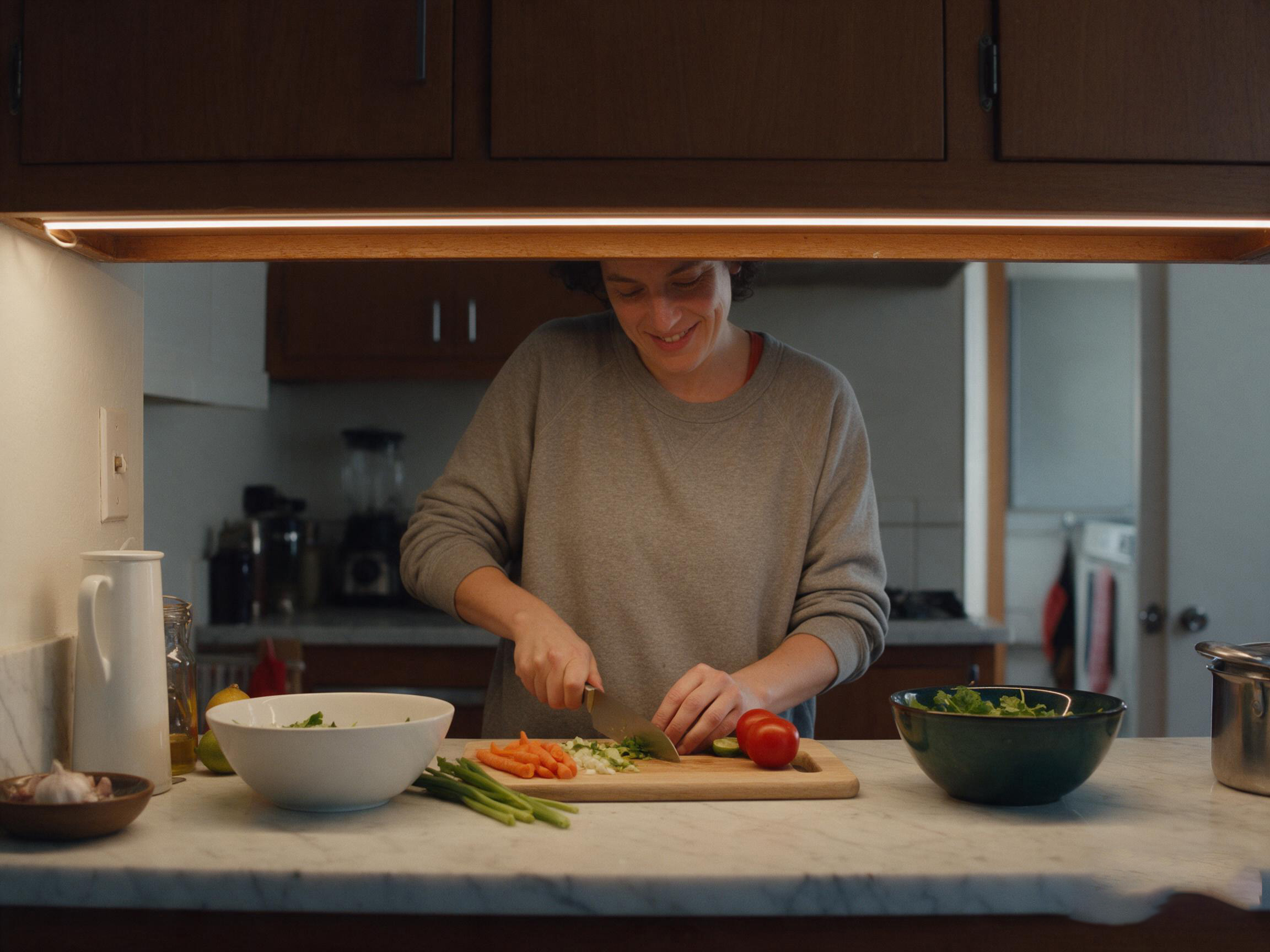
2、Tunable white LED strip light: 2700K to 6500K on one roll
Tunable white — a lot of people call it a CCT LED strip — is for anyone who hates locking in a color temperature. Two groups of white chips share one board, one warm and one cool, and blending them gets you anything from 2700K to 6500K. You decide after it’s mounted, and you can change your mind the same evening.
That flexibility is why hotels, offices, and smart-home setups reach for it. Dim and warm at night, bright and cool in the morning, off the same roll. If the 3000K-versus-4000K debate has been gnawing at you, a tunable run just erases it. Warm white LED strip color temperature turns into a dial rather than a decision. Families doing shadowless lighting design in a living room or bedroom tend to land here too — warm while winding down, bright white when it’s time to cook or work. Physically, the two chip groups sit in alternating rows, so as you dial one down the other comes up and the shift feels continuous — no jumpy steps, no sudden flicker. One caveat: it needs a compatible controller. A plain switch turns it on and off but won’t shift the color.
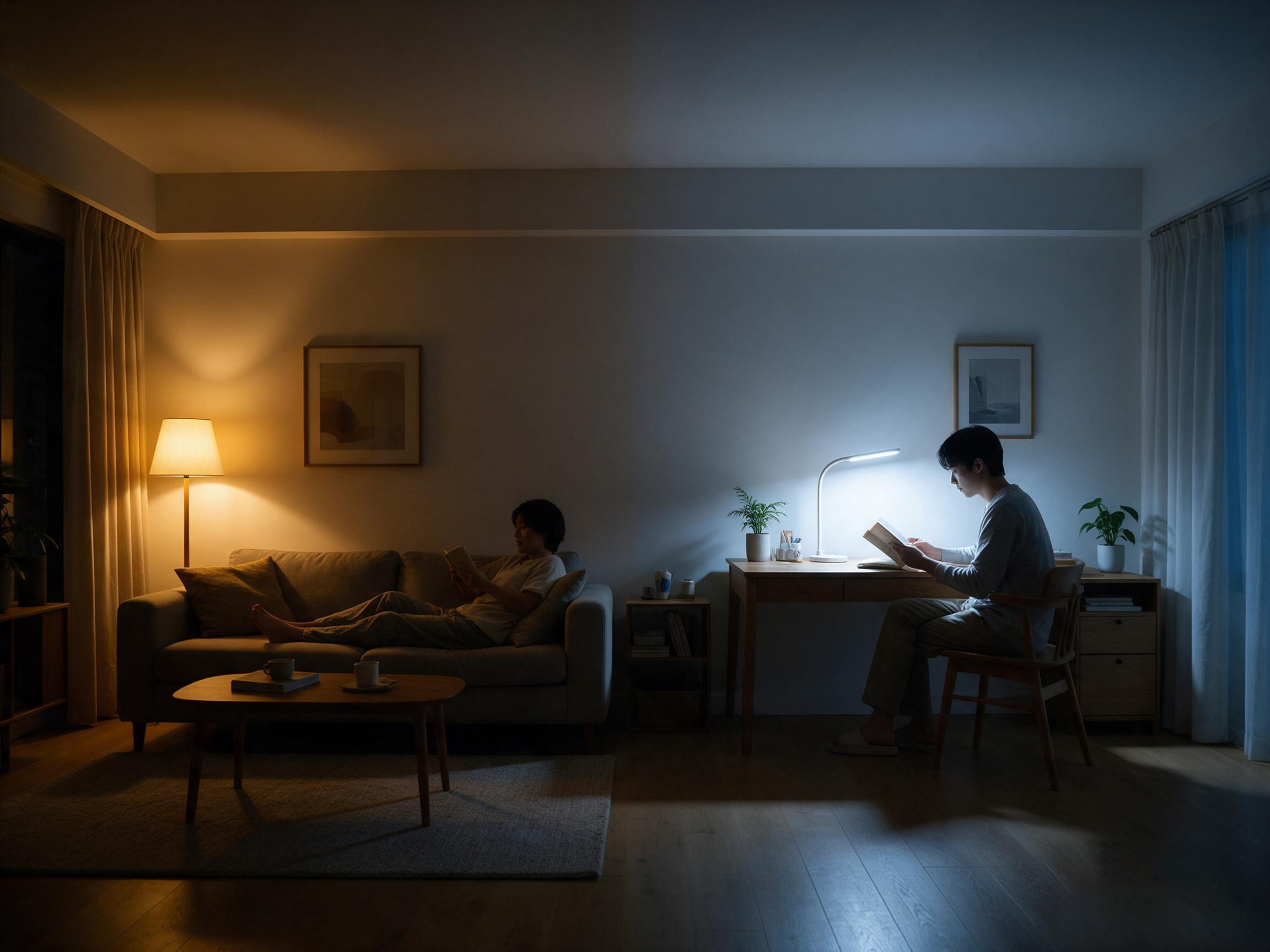
3、RGB LED strip: 16 million colors, but a weak white
RGB packs red, green, and blue chips into every diode and mixes them at different levels to reach something like 16 million colors. That number prints great on a box, and it’s roughly true. Bars, KTV rooms, game rooms, and accent walls are its home turf — places that want color for its own sake.
The catch shows up when someone asks it to make white. The “white” it blends is dim and slightly off; skin tones and fabric colors go muddy fast. So if you’re wondering what CRI is good enough for LED strip lights, RGB is the wrong tool for that job. Keep it as mood light, not the light you cook or read under. And that 16-million figure? Most people settle into a few dozen favorites and never scroll past them. You buy RGB because a room needs to feel like a stage or a bar, not because you’ll actually touch all 16 million.
One more thing: most RGB runs want a controller, and anything longer than a few meters usually needs an amplifier too, since the color signal has to be boosted down the line. That’s an extra box to budget for that single-color buyers never think about.

4、RGBW LED strip light: the color and the white in one
RGBW takes RGB and bolts on a fourth chip that makes a real white — brighter, cleaner, able to render color properly. One roll handles both the party lights and the honest white, so you don’t run two strips side by side.
That’s why it’s the compromise pick in commercial lighting. A hotel lobby, a clothing store, a living room — you want color and warmth at night, then a clean white when someone reads a menu or checks a hem. RGBW covers both without touching the hardware. If you’ve been asking what LED strip for commercial lighting and can’t pick a side, this is the one that ends the argument. It also shows up as the ambient layer in shadowless lighting jobs, backing up the main lights instead of competing with them.
Some versions pack the white and color into one chip, while others lay four separate emitters in a row; the all-in-one tends to throw a more even line with less color shadow. Worth asking which you’re getting if the run will be visible up close.
5、Addressable LED strip light: every pixel does its own thing
Add a control chip to the RGB design and every diode starts acting on its own — light up, change color, go dark, each on its own schedule. That’s what makes chases, waves, and running-light effects possible. A normal RGB roll changes as one block; an addressable roll can make a single point of light sprint down the strip.
That per-pixel control is why it owns outdoor lighting project work — facades, stage rigs, tech exhibits that want motion and shape rather than a steady glow. If you’re asking what LED strip for outdoor lighting projects and you need something dynamic, this is usually the answer. It rides alongside linear light and linear lighting fixtures in the same lighting engineering project, handling the moving color while the linear light holds the base even. The cost is a controller and software to map every pixel before anything useful happens, which is why a typical home job skips it.
Outdoors, these also get spec’d for IP65 and up, since a facade run lives in rain and sun. Indoor versions skip the heavy sealing and cost a bit less, but the control gear stays roughly the same.
|
Scenario |
Recommended type |
Why |
| Basic home lighting | Single-color or tunable white | Steady color temperature, low cost |
| Bedroom mood light | Tunable white | Warm before bed, no glare |
| Entertainment space | RGB | Rich color, strong atmosphere |
| Commercial space | RGBW | Needs atmosphere and a true white |
| Outdoor facade | Addressable | Per-pixel control for motion |
6、FAQ: Common LED strip light questions
Q1: Can an RGB LED strip light be used as the main light?
A: It can, but we don’t recommend it. The white an RGB LED strip mixes is dim and off-color, so a room looks dull and slightly tinted. Keep RGB for mood and use a dedicated white LED strip light for real illumination.
Q2: Which is better, a single-color or an RGB LED strip light?
A: It depends on the job. For basic lighting, single-color wins — it’s cheaper and more stable. For color and atmosphere, go RGB, but accept that its white is only average.
Q3: How do you change the color on an LED strip light?
A: A tunable white or RGB LED strip light needs a controller, driven by a remote, an app, or a wall panel. A single-color LED strip can only switch on and off or dim — its color can’t change.
Q4: Do LED strip light colors fade over time?
A: On cheap rolls they can. Poor-quality chips suffer light decay and color drift, so the color turns dull or off after a while. Buying from a maker who controls chip and packaging quality makes a real difference.
Stepping back, the five types are really five levels of what a strip can express. Single-color states one color and holds it. Tunable white lets you shift the temperature. RGB adds a full palette. RGBW brings a true white back. Addressable turns the whole roll into a moving display. None of them is objectively better — the right one matches your space, your budget, and the effect you’re after. For a basic fill under a cabinet, spend on the simplest roll and pocket the rest. For a facade or a stage, the addressable LED strip light earns every extra dollar.
One more thing worth repeating: color is a choice about how a room feels, not just how it looks. Get the type right and even a modest budget reads as intentional. Get it wrong and the priciest roll on the market still lands flat.
Mingxue Optoelectronics has been making LED strip lights since 2005. We run a Shenzhen R&D and sales center alongside a 24,000 sqm manufacturing base in Foshan, and Foshan Mingxue Optoelectronics Co., Ltd. operates as a wholly-owned subsidiary of Mingxue Optoelectronics Holding Co., Ltd. The facility is ISO 9001 certified, along with IATF16949, UL, CE, SAA and ErP, and it ships to channels like IKEA, Walmart and BYD. Whether your job is a shadowless lighting design in an apartment or a large outdoor lighting project on a building, we make single-color, CCT, RGB, RGBW and addressable LED strip lights across the full range. If you’d like to learn more about our LED strip lights or get a quote, feel free to leave your contact details on our official website, or call us at +86 137 1903 7641 (same number on WeChat).
MINGXUE is the brand name of Shenzhen Mingxue Optoelectronics Co., Ltd. For international markets, the company operates under the brand name MINGXUE Lighting.
Facebook:https://www.facebook.com/profile.php?id=100089993887545
Instagram:https://www.instagram.com/mingxuelighting.factory/
YouTube:https://www.youtube.com/channel/UCMGxjM8gU0IOchPdYJ9Qt_w
LinkedIn:https://www.linkedin.com/company/mingxue/
Post time: Oct-12-2026