
 Chinese
LED strip lights have become the preferred flexible lighting solution for commercial projects, architectural decoration, industrial lighting, and retail display applications worldwide. Many B2B buyers, engineering contractors, and lighting designers search for how LED strip lights work and the core working principle of commercial LED strips to support product selection, project design, and bulk procurement. Unlike traditional rigid lighting fixtures, flexible LED strips deliver customizable, low-energy, long-lifespan illumination with easy installation and versatile adaptability. Understanding professional flexible LED strip technology is critical for system configuration and stable long-term commercial operation.
This guide breaks down the working principle of LED strip lights in simple terms, covering core components, power operation logic, mainstream commercial LED strip types, and practical application knowledge, fully optimized for commercial specification and engineering usage for B2B LED strip lighting solutions.
1. Core Working Principle of LED Strip Lights
The fundamental working mechanism of LED strip lights relies on the electroluminescence effect of semiconductor LED chips. Different from incandescent and fluorescent lamps that generate heat first to produce light, LED strips convert electrical energy directly into visible light with minimal thermal loss, achieving high energy efficiency.
The complete working process is straightforward and stable:
1. Power Conversion: A professional LED driver converts standard AC alternating current (mains power) into safe low-voltage DC direct current (12V or 24V, the mainstream voltage for commercial LED strips).
2. Circuit Transmission: Stable DC power flows through precision copper traces on the flexible PCB substrate of the LED strip.
3. Light Generation: Current passes through SMD or COB LED chips. Inside the semiconductor chips, electrons recombine with holes and release energy in the form of photons, producing continuous visible light.
4. Current Regulation & Protection: On-board resistors match each LED segment to stabilize current output, avoid chip burnout caused by voltage fluctuation, and ensure consistent luminous performance and long service life.
This low-voltage DC drive structure ensures safe operation, low heat generation, and anti-flicker performance, making LED strips suitable for long-time commercial and industrial operation.
2. Key Components That Support LED Strip Operation
A complete high-performance LED strip lighting system consists of 5 core components. Each part determines the lighting effect, stability, and service life of the whole set, which is a key reference for B2B bulk procurement and project customization.
| Core Component | Function & Working Role | B2B Selection Focus |
| Flexible PCB Substrate | Carries LED chips and circuit traces, supports bending, folding and cutting, adapts to irregular installation surfaces | Thickened copper foil, high thermal conductivity, anti-aging, suitable for long-term commercial use |
| LED Chip (SMD/COB) | Core light-emitting unit, converts electric energy into light energy; determines brightness, color rendering and light uniformity | High CRI, low light decay, consistent binning, stable luminous flux |
| Current Limiting Resistor | Stabilizes working current, prevents overcurrent damage to chips, ensures uniform brightness of the whole strip | Precision resistance matching, no local dimming or flickering |
| LED Driver Power Supply | Converts AC to DC low voltage, provides stable power input for the strip light system | Constant voltage design, overvoltage/overcurrent/short circuit protection |
| Light Controller (Optional) | Adjusts brightness, color temperature, RGB color and dynamic lighting effects | Smooth dimming, synchronous control, compatible with intelligent engineering systems |
3. Two Main Working Types of Commercial LED Strips
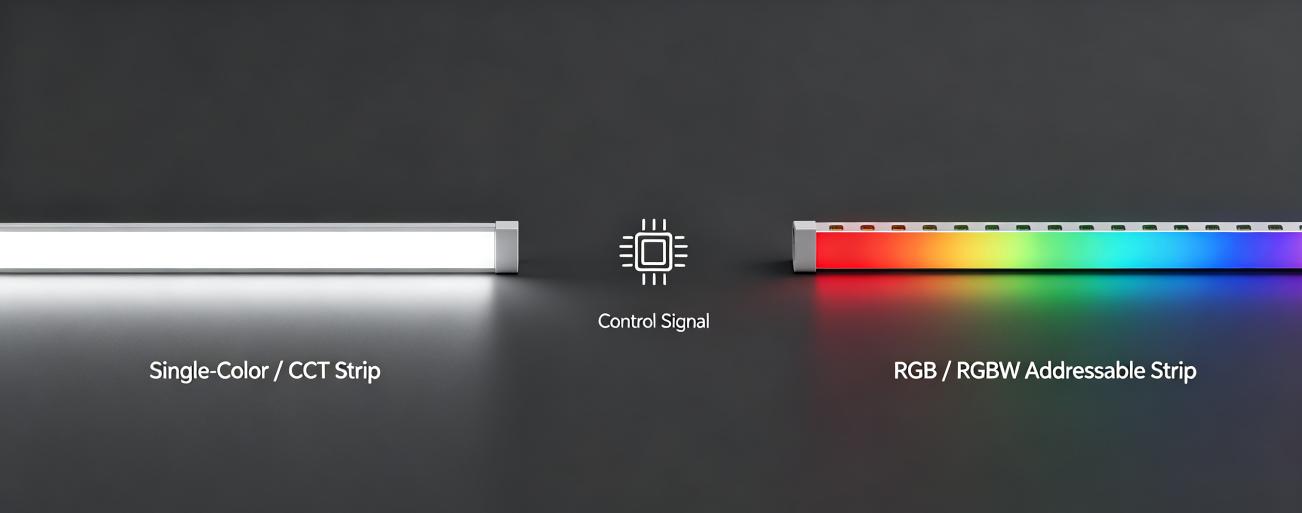
For B2B engineering and wholesale scenarios, LED strips are mainly divided into single-color analog strips and RGB digital addressable strips, with different working logics and application scenarios. Choosing the right type based on LED strip light working principle helps optimize commercial lighting project effects and costs.
3.1 Single-Color & CCT Tunable LED Strips
This is the most widely used commercial type. It adopts a parallel segment circuit design, with unified voltage and current output. It only supports brightness adjustment or color temperature switching (warm white, neutral white, cool white). The working mode is stable, with ultra-low failure rate, suitable for architectural lighting, cabinet lighting, hotel engineering and industrial auxiliary lighting.
3.2 RGB/RGBW Digital Addressable LED Strips
Equipped with independent IC control chips, each light segment can work independently. Through signal coding, it realizes single-point single-control, gradient color jumping, dynamic scanning and other programmable effects. It is widely used in stage lighting, mall decoration, brand display and creative commercial lighting projects.
4. Why LED Strips Outperform Traditional Lighting Solutions
Based on its unique working principle and structural design, LED strip lights have obvious advantages in commercial and industrial scenarios compared with traditional lighting:
- High Energy Saving: Direct photoelectric conversion, low power consumption, saving 60%-80% energy compared with traditional lamps, reducing long-term operation costs for commercial projects.
- Ultra-Long Service Life: Low-heat and low-current working state, effectively reducing light decay, with a service life of up to 50,000 hours, lowering replacement and maintenance costs for B2B customers.
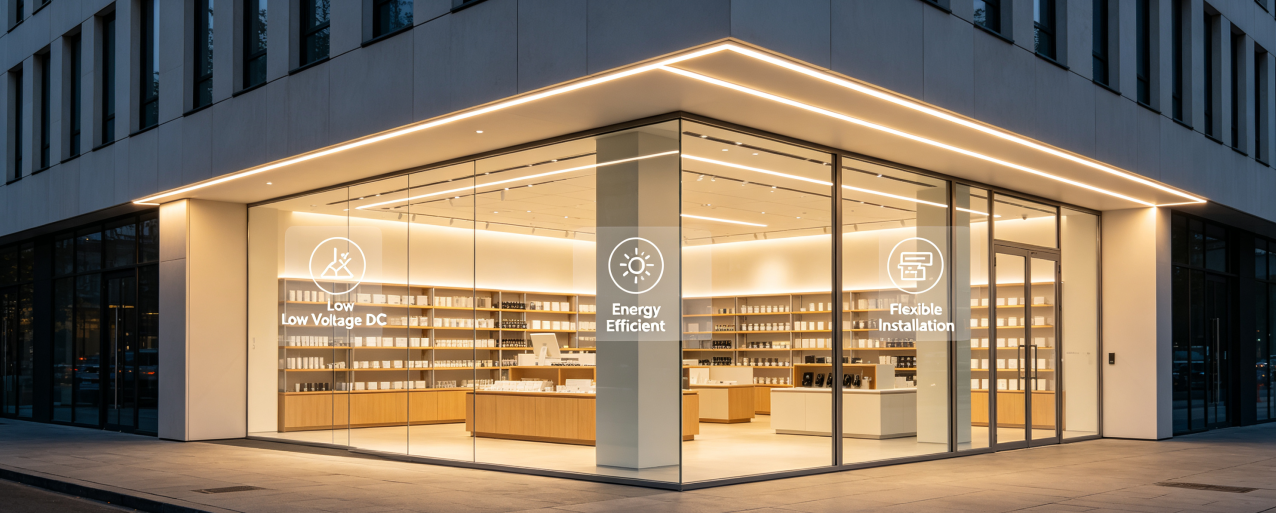
- High Safety: 12V/24V low-voltage operation, no electric leakage risk, low surface temperature, safe for long-time enclosed installation.
- Strong Customization: Support arbitrary cutting, bending and splicing, with customizable length, density, IP rating and lighting effects, meeting personalized engineering project needs.
- Eco-Friendly & Stable: No stroboscopic, no ultraviolet radiation, no harmful substances, compliant with international commercial lighting safety standards.
5. FAQ – Common Questions About LED Strip Working Principles
Q1: Why do LED strips need a dedicated driver power supply?
LED chips are sensitive to voltage and current and cannot directly support 110V/220V AC mains power. The dedicated driver converts high-voltage AC to stable low-voltage DC, and provides overcurrent, overvoltage and short-circuit protection, avoiding chip damage and ensuring the long-term stable operation of the strip light system.
Q2: Can LED strips work normally after cutting?
Yes. Regular commercial LED strips are designed with fixed cutting points (usually every 2.5cm, 5cm or 10cm). Each cutting segment is an independent parallel circuit unit. Cutting along the designated position will not affect the normal work of other segments, which is convenient for on-site engineering installation and size adaptation.
Q3: What causes flickering of LED strip lights?
Most flicker problems come from mismatched power supply, unstable voltage output, excessive load power, or poor circuit contact. Adopting a matched constant-voltage driver and standardized wiring construction can effectively solve flicker issues and ensure stable lighting output.
Q4: What is the difference between SMD and COB LED strips in working performance?
SMD strips adopt discrete chip light emission with clear light spots and high brightness, suitable for scenarios requiring high luminous flux. COB strips realize surface light emission with uniform light, no dark areas and softer light, more suitable for high-end architectural decoration and ambient lighting projects.
Q5: Are low-voltage LED strips safe for outdoor and wet environment use?
Yes. Matching with corresponding IP65/IP67/IP68 waterproof grades, low-voltage LED strips can work stably in outdoor, humid and dust-prone environments. The fully enclosed waterproof structure isolates water and dust, ensuring safe and continuous operation for outdoor commercial projects.
6. Custom B2B LED Strip Solutions for Commercial Projects
As a professional LED strip manufacturer, we provide one-stop OEM/ODM LED strip lighting solutions for global wholesalers, engineering contractors and brand customers. Our products cover single-color, CCT tunable, RGB/RGBW programmable, high-density, waterproof and ultra-long customized LED strips, which are widely used in architectural lighting, commercial display, hotel engineering, industrial equipment lighting and other scenarios.
We support customized voltage, luminous color, density, IP protection grade, length and packaging, with strict quality inspection and stable batch consistency, helping B2B customers reduce project costs and improve project competitiveness.
Final Words
In short, LED strip lights work through low-voltage DC power drive, semiconductor electroluminescence and precise circuit regulation, realizing efficient, stable and flexible intelligent lighting. Mastering the working principle of commercial LED strip lights helps B2B customers make scientific product selection and project configuration. Its simple working principle, reliable performance and strong scalability make it the mainstream flexible lighting solution in the global commercial market.
If you have product selection, project configuration and bulk procurement needs, feel free to contact our professional technical team for customized solutions and free technical guidance.
Facebook:https://www.facebook.com/profile.php?id=100089993887545
Instagram:https://www.instagram.com/mingxuelighting.factory/
YouTube:https://www.youtube.com/channel/UCMGxjM8gU0IOchPdYJ9Qt_w
LinkedIn:https://www.linkedin.com/company/mingxue/
Post time: Jul-08-2026