
 Chinese
In the field of lighting, energy conservation and refinement have long been the mainstream direction. LED light strips, with their advantages such as energy efficiency, flexible design, and wide application range, are gradually replacing traditional light bulbs and becoming the preferred choice for home decoration, commercial space layout, and industrial lighting. When many users replace their lighting equipment, they not only want to know why LED light strips are energy-efficient, but also are concerned about how much electricity they can save in a year. Here, we will explain the energy-saving logic and electricity-saving advantages of LED light strips from the technical principle to the actual calculation, making it clear and thorough.This article will comprehensively analyze the energy-saving logic and electricity-saving advantages of LED light strips from the technical core to the actual calculation.
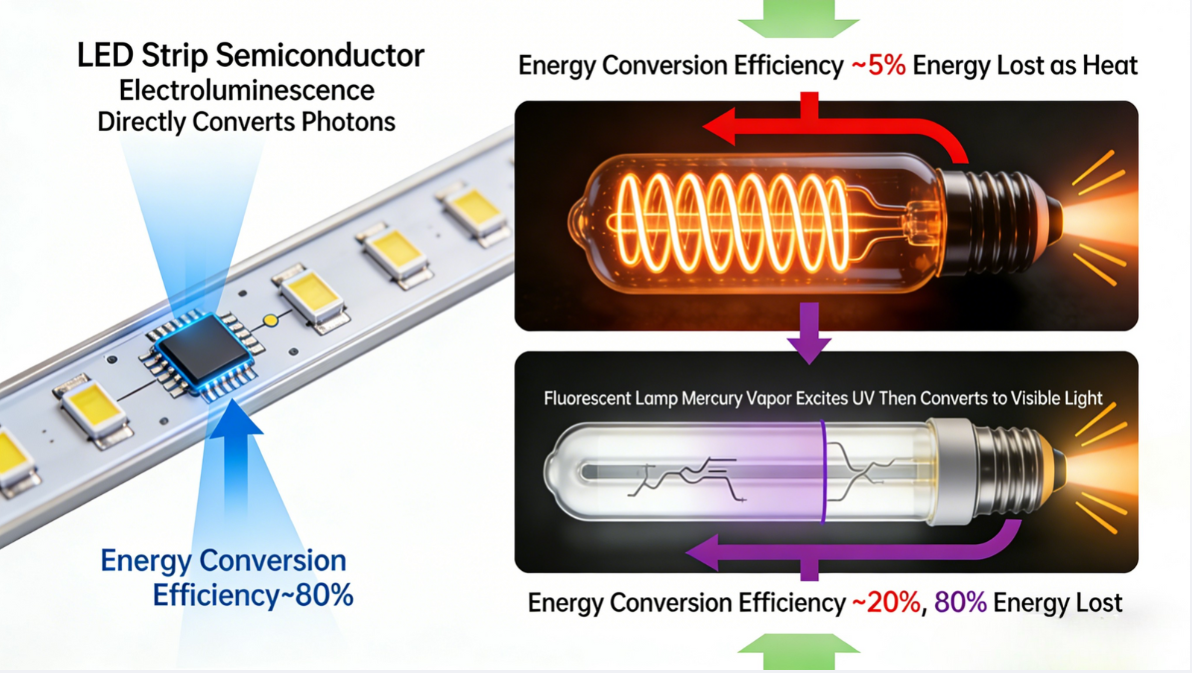
I. The energy-saving principle of LED light strips: Achieving efficient light utilization at the technical level
The energy-saving feature of LED light strips does not merely rely on optimization of a single aspect. Instead, it involves a complete chain of technological upgrades from the light-emitting principle, core components to circuit design. Compared to traditional light tubes, it has achieved a qualitative leap in the utilization rate of electrical energy.
2. Low-power driving power supply: The LED light strips are powered by 12V/24V low-voltage direct current. Combined with an efficient switching power supply, the efficiency of converting household alternating current to direct current is over 85%. Compared to the inductive ballast of traditional lamps (which increases power consumption by an additional 5-8W), the energy loss of the driving power supply can be negligible.
3. Precise heat dissipation design: When LEDs are operating, they generate a small amount of heat. If this heat cannot be dissipated, it will not only cause the brightness to gradually decrease but also increase energy consumption. High-quality LED light strips will use heat dissipation structures such as flexible PCB boards and graphene coatings to control the temperature of the chip within an appropriate range. This not only avoids excessive heat and power consumption but also extends the service life to over 50,000 hours, reducing the additional costs associated with frequent replacements.
4. Intelligent Control Adaptation: Reduce Unnecessary Consumption by Adjusting Light Intensity as Needed
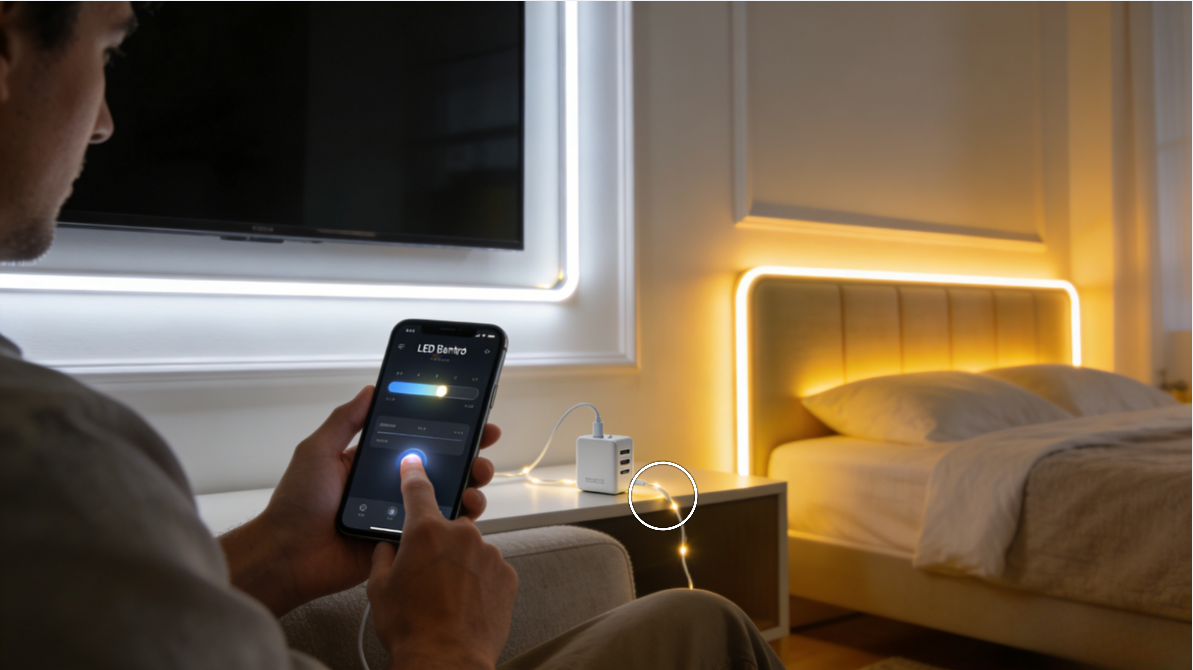
LED light strips can be combined with dimming, color temperature control units and intelligent Internet of Things systems to achieve functions such as adaptive brightness and time-based switching. For example, commercial spaces can adjust the brightness at different times through sensors, and in home scenarios, warm light/cold light can be switched according to needs (warm light has slightly lower energy consumption than cold light), avoiding the fixed mode of traditional lamps where they “become fully bright as soon as turned on”, and further reducing the time of ineffective electricity consumption and power loss.
II. Key Factors Affecting the Energy Consumption of LED Light Strips
The actual power consumption of LED light strips is not fixed. It can be affected by factors such as product specifications and usage scenarios. Choosing the right type and using it properly can fully maximize the energy-saving effect.
(1) Specifications and parameters of the product itself
1.Length of the light strip and density of the light bulbs: The power consumption is directly proportional to the length of the light strip. For the same length of fluorescent lamps, the power consumption is higher, reaching 20-30W. Although the denser the light bulbs, the higher the power consumption per meter, overall it is still much more energy-efficient than traditional lamps.
2.Brightness and Color Temperature: The higher the brightness, the greater the power consumption naturally. However, even when set to the maximum brightness, the power consumption of LED light strips is only 1/5 to 1/8 that of incandescent lamps. Color temperature has little effect on power consumption. Warm white (2700K – 3000K) light strips consume slightly less power than cold white (4000K – 6500K) light strips.
(II)Usage scenarios and costs
The duration of electricity usage is the key factor affecting the total electricity consumption. In commercial settings such as shopping malls and hotels, if lights are left on for more than 10 hours every day, the energy-saving effect will be more significant. In households, leaving lights on for 3 to 5 hours per day can also effectively reduce electricity bills. Additionally, by combining with a dimming system, instead of keeping the lights at full brightness all day long, another amount of electricity can be saved.
III. Comparison of electricity costs between LED light strips and traditional light tubes: How much money can be saved in a year?
Based on common lighting scenarios and using the domestic residential electricity price (0.538 yuan per kilowatt-hour, 1 kilowatt-hour = 1 kilowatt of electricity), let’s calculate the difference in annual electricity costs between LED light strips and traditional light bulbs (incandescent lamps, fluorescent lamps). All calculations are based on the same brightness and the same usage duration, which makes the results more objective.
(1) Comparison of Core Parameters Base
| Lighting type | Power (per meter/hour) | Alternative | Daily power consumption of 10 hours |
| Incandescent lamp | 60W | 1 meter of LED light strip (10W) ≈ 60W incandescent bulb | 0.6 kilowatt-hours |
| Fluorescent lamp (incandescent lamp) | 20W | 1 meter of LED light strip (10W) ≈ 20W fluorescent lamp | 0.2 kilowatt-hours |
| 5050 LED light strip (60 beads/meter) | 10W | Brightness is superior to that of 20W fluorescent lamps | 0.1 kilowatt-hours |
IV.Usage Tips: Further reduce energy consumption
1.Integrating intelligent control system: Through dimmers and human sensors, “the lights turn on when someone arrives and off when they leave”, avoiding continuous lighting when no one is present; at night, the brightness can be adjusted to 30%-50%, and energy consumption is also reduced simultaneously.
2. Reasonably plan the installation length: Cut the light strips according to the lighting requirements to avoid long-term power consumption of redundant lengths and reduce unnecessary power consumption.
3.Regular cleaning and maintenance: Regularly wipe off the dust on the surface of the light strips. Dust blocking the light will cause the brightness to decrease. Many people will unconsciously increase the brightness, which actually consumes more electricity.
V. Summary: The Energy-saving Value and Long-term Returns of LED Light Strips
The core of energy saving of LED light strips lies in achieving efficient conversion of electrical energy through electroluminescence principles and optimizing the core components. Compared to traditional lamps, it can save 50% to 85% of energy consumption. From the perspective of electricity cost calculation, in household scenarios, annual savings range from tens to hundreds of yuan, while in commercial scenarios, annual savings can reach thousands or even tens of thousands of yuan. Moreover, its service life is 5 to 10 times that of traditional lamps, significantly reducing replacement costs and labor expenses.
Whether it is for home decoration, commercial decoration or industrial lighting, choosing LED light strips not only reduces electricity costs but also cuts carbon emissions, aligning with the green environmental trend. In the current situation where electricity costs are constantly rising, replacing LED light strips is both an optimization of costs and a practice of sustainable development.
Contact us to obtain more energy-saving solutions!
Facebook:https://www.facebook.com/profile.php?id=100089993887545
Instagram:https://www.instagram.com/mx.lighting.factory/
YouTube:https://www.youtube.com/channel/UCMGxjM8gU0IOchPdYJ9Qt_w/featured
LinkedIn:https://www.linkedin.com/company/mingxue/
Post time: Jan-16-2026