
 Chinese
What Is the Difference Between High Voltage and Low Voltage LED Strips? This is one of the most common questions from B2B lighting buyers, project contractors, and architectural engineers worldwide. High voltage LED strips and low voltage LED strips are the two dominant types of flexible LED strip lights widely adopted in commercial decoration, building lighting, industrial engineering, and outdoor landscape illumination. Clarifying the high vs low voltage LED strip difference is essential for accurate B2B LED strip selection for all types of lighting projects.
Choosing between a low voltage and high voltage LED strip directly impacts installation difficulty, operational safety, lighting uniformity, project budget, and long-term maintenance. Many wholesale clients and engineering teams make improper choices due to unclear product characteristics, resulting in extra construction costs, unstable lighting performance, and potential safety hazards. This comprehensive guide professionally compares the two mainstream LED strip types, delivering reliable references for commercial LED strip lighting and industrial LED strip lights procurement and construction.
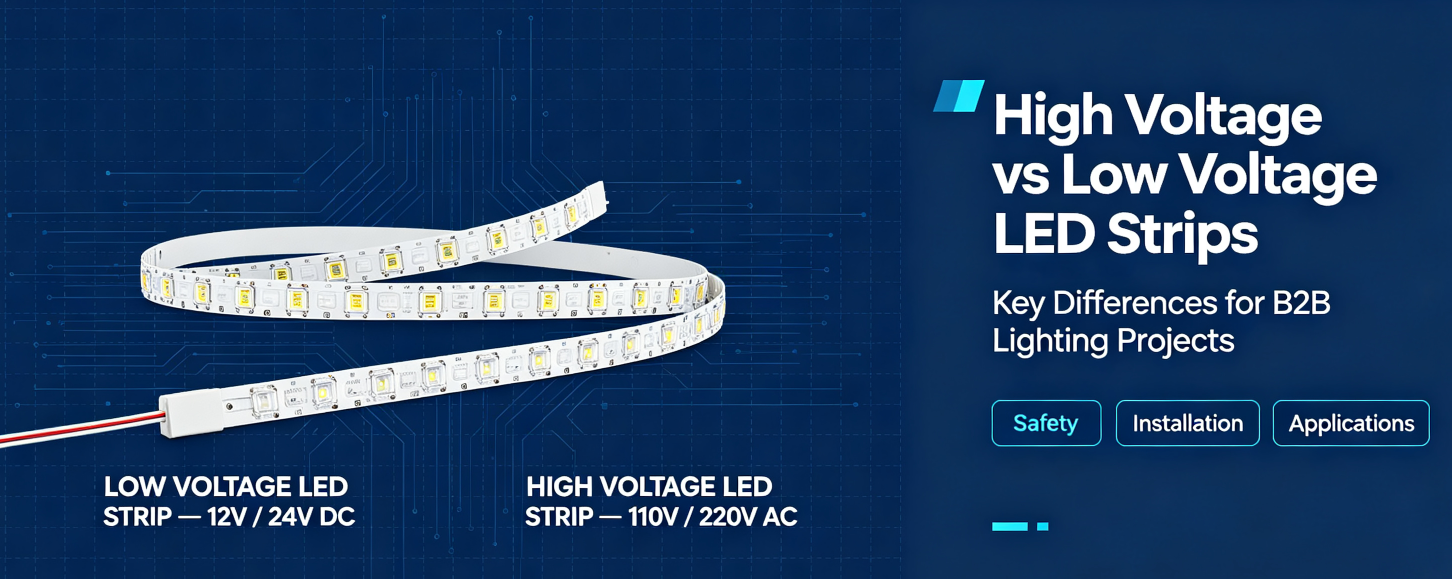
1. Basic Definition of High Voltage & Low Voltage LED Strips
1.1Low Voltage LED Strips (DC 12V / 24V)
Low voltage LED strips are DC constant-current flexible lighting products that operate at 12V or 24V safe voltage. Different from high voltage LED strips, this low voltage LED strip model cannot be directly connected to mains power and must be matched with an external LED driver or transformer to convert AC mains power into stable DC power. Featuring ultra-low heat generation, high operational safety, excellent flexibility, and precise cutting performance, low voltage LED strips are the mainstream choice for refined indoor commercial LED strip lighting and short-distance decorative lighting projects.
1.2 High Voltage LED Strips (AC 110V / 220V)
High voltage LED strips are AC-driven flexible lighting solutions compatible with global 110V and 220V mains grid voltage. Built-in rectifier circuits and multi-level protection modules enable high voltage LED strips to connect directly to mains power without additional drivers or transformers. Boasting ultra-long continuous lighting capability and simplified installation procedures, these LED strips are widely used in large-scale outdoor landscape lighting, building facade outlining, and various industrial LED strip lights engineering projects.

2. Core Differences Between High and Low Voltage LED Strips (Comparison Table)
The following detailed table intuitively sorts out the key high vs low voltage LED strip difference, covering safety, installation, performance, cost and application scenarios, which serves as a core basis for B2B LED strip selection and engineering construction design:
|
Comparison Dimension
|
Low Voltage LED Strips (12V/24V DC)
|
High Voltage LED Strips (110V/220V AC)
|
|
Power Supply Mode
|
Requires external LED transformer or driver; independent DC power distribution setup
|
Direct plug-and-play connection to AC mains power; no extra driver needed
|
|
Safety Performance
|
Safe extra-low voltage, no electric shock risk; touchable and human-friendly
|
Mains high voltage with electric shock risk; professional electrician installation required
|
|
Cutting Precision
|
High precision cutting every 2.5cm–10cm; fully customizable length
|
Fixed cutting unit of 0.5m–1m; limited length adjustment flexibility
|
|
Maximum Running Length
|
Short single run length; obvious voltage drop for long-distance laying
|
Ultra-long continuous run up to 50–100m; negligible voltage drop
|
|
Lighting Stability
|
Uniform brightness, flicker-free output, consistent color rendering
|
Slight brightness attenuation in ultra-long runs; average uniformity
|
|
Flexibility & Structure
|
Thin PCB and ultra-flexible design for curved, corner and narrow-space installation
|
Thicker structural design with low flexibility; unsuitable for complex modeling
|
|
Installation & Accessory Cost
|
Higher overall cost due to required transformers, wires and complex wiring labor
|
Minimal accessories needed; simple wiring reduces engineering and labor costs
|
|
Maintenance Difficulty
|
Support local partial replacement; convenient and low-cost post-project maintenance
|
Mainly requires overall replacement; partial repair is difficult and inefficient
|
|
Smart Control Compatibility
|
Fully compatible with dimmers, RGB controllers, DMX systems and smart home devices
|
Limited intelligent control functions; only basic dimming available
|
|
Typical Application Scenarios
|
Commercial indoor lighting, cabinet lighting, hotel decoration, retail display, residential ambient lighting
|
Building facade lighting, outdoor landscape lighting, large engineering outlining, long-distance decorative lighting
|

3. In-depth Analysis of Advantages & Limitations
3.1 Low Voltage LED Strip Lights
Core B2B Advantages
Low voltage LED strips are the top choice for high-end commercial LED strip lighting projects, thanks to their unparalleled safety and stable working performance. Operating at 12V/24V DC safe voltage, this type of low voltage LED strip completely avoids electric shock risks and complies with global commercial safety standards, making it ideal for indoor public spaces, hotel interiors and retail display scenarios. Its ultra-fine cutting accuracy and high flexibility support customized lighting for various irregular and curved structures. Meanwhile, low voltage LED strips are fully compatible with intelligent control systems, meeting the personalized lighting needs of modern refined projects. Low heat generation also extends the service life of the LED strip, reducing long-term lumen decay for stable indoor operation.
Key Limitations
The biggest drawback of low voltage LED strips is the need for supporting external drivers, which increases accessory procurement costs and on-site wiring workload for B2B projects. In addition, obvious voltage drop will occur when laying low voltage LED strips over ultra-long distances, leading to uneven brightness. This limitation makes it unsuitable for large-span industrial LED strip lights and long outdoor outline lighting projects.
3.2 High Voltage LED Strip Lights
Core B2B Advantages
High voltage LED strips have unique advantages in large-scale outdoor and industrial lighting engineering. Different from low voltage LED strips, high voltage LED strips can be directly connected to mains power without transformers, greatly simplifying installation steps and shortening project construction cycles for B2B contractors. Capable of 50–100 meters of continuous lighting with negligible voltage drop, high voltage LED strips perfectly adapt to building facade outlining, bridge lighting and urban landscape projects. Most high voltage LED strips are equipped with integrated waterproof and dustproof structures, with strong environmental adaptability to reduce overall project operation and maintenance costs.
Key Limitations
High voltage LED strips operate at dangerous mains voltage, requiring professional electrician installation to eliminate safety hazards, so they cannot be used in human-touchable indoor areas. Compared with low voltage LED strips, high voltage LED strips adopt fixed-length cutting design, unable to meet fine personalized customization needs. Their weak intelligent control expandability also limits their application in high-end refined decoration lighting projects.

4. B2B Project Selection Guidelines
Mastering the high vs low voltage LED strip difference is the core of accurate B2B LED strip selection. B2B buyers, wholesalers and engineering teams can select matching LED strip products according to actual project scenarios to balance safety, effect and cost.
Choose Low Voltage LED Strips If Your Project Is:
- Indoor refined commercial LED strip lighting, including hotel interiors, shopping mall displays, cabinet lighting and office ambient lighting
- Installed in human-accessible areas that require high safety standards
- Requiring customized lengths, curved modeling and precise lighting details
- Matching intelligent dimming, color adjustment and smart linkage systems
Choose High Voltage LED Strips If Your Project Is:
- Large outdoor industrial LED strip lights projects, such as building facade outlines, community landscape and bridge lighting
- Long-distance continuous laying over 30 meters with low demand for fine local adjustment
- Engineering projects prioritizing fast construction speed and low comprehensive cost
- Fixed large-area decorative lighting without frequent human contact
5. FAQ – B2B Frequently Asked Questions
Q1: Are low voltage LED strips safer than high voltage LED strips for commercial use?
A: Yes. 12V/24V low voltage LED strips work at safe extra-low voltage with zero electric shock risk, fully compliant with global commercial safety regulations. They are the safest option for indoor, touchable and high-traffic public areas. By contrast, high voltage LED strips rely on mains high voltage operation, requiring professional installation and isolation protection.
Q2: Which LED strip type offers a longer service life for engineering projects?
A: Both high voltage and low voltage LED strips support over 30,000 hours of lifespan under standardized installation. Low voltage LED strips generate less heat and run more stably, with lower lumen attenuation for long-term indoor use. High voltage LED strips are affected by higher heat generation and outdoor harsh environments, requiring regular maintenance for outdoor engineering projects.
Q3: Can high voltage LED strips be used for indoor lighting?
A: High voltage LED strips are only applicable for high-altitude, non-touchable indoor outline lighting. They are not recommended for conventional indoor decoration, as their safety risks and low cutting precision cannot match the refined lighting effect of low voltage LED strips.
Q4: How to fix the voltage drop issue of low voltage LED strips?
A: The voltage drop problem of low voltage LED strips can be solved by segmented power supply, increasing wire gauge, or selecting 24V low voltage LED strips with lower operating current. Multi-point power supply is strongly recommended for ultra-long laying projects to ensure uniform lighting brightness.
Q5: Which LED strip is more cost-effective for B2B bulk procurement?
A: For short-distance indoor commercial LED strip lighting, low voltage LED strips deliver better long-term cost performance with stable performance and low maintenance costs. For large-scale outdoor industrial LED strip lights projects, high voltage LED strips save transformer and wiring costs, with faster construction and lower overall project investment.
6. Conclusion
There is no absolute superior option between high voltage and low voltage LED strips — only the most suitable solution for specific B2B lighting projects. A clear understanding of the high vs low voltage LED strip difference helps global B2B buyers and engineering contractors avoid selection errors, reduce project risks, and improve overall engineering quality.
Low voltage LED strips occupy a dominant position in high-end indoor commercial LED strip lighting by virtue of outstanding safety, flexibility and smart compatibility. High voltage LED strips are the preferred solution for large outdoor architectural and industrial LED strip lights projects due to their ultra-long laying capability and low construction costs.
As a professional LED strip manufacturer, we provide customized high voltage and low voltage LED strip solutions, bulk wholesale services and one-stop engineering support for global B2B clients. All products meet international safety and quality standards, supporting project customization, bulk ordering and professional technical guidance to help clients optimize project budgets and lighting effects.
*Published by Shenzhen Mingxue Optoelectronics Co., Ltd. | Founded 2005 | Shenzhen R&D Center + Foshan Manufacturing Base | 24,000 sqm | ISO 9001 Certified*
Facebook:https://www.facebook.com/profile.php?id=100089993887545
Instagram:https://www.instagram.com/mingxuelighting.factory/
YouTube:https://www.youtube.com/channel/UCMGxjM8gU0IOchPdYJ9Qt_w
LinkedIn:https://www.linkedin.com/company/mingxue/
Post time: Sep-02-2026