
 Chinese
For B2B lighting contractors, project specifiers, commercial property managers, and wholesale buyers, selecting the optimal CRI rating for LED strip lights is a foundational step in delivering qualified, high-quality lighting projects. The Color Rendering Index (CRI) is an industry-standard metric that measures how accurately LED strip lights replicate the true color of physical objects compared to natural sunlight, directly impacting space aesthetics, project acceptance, and end-user satisfaction.
In modern industrial, architectural, hospitality, and retail lighting construction, CRI 80, CRI 90, and CRI 95 are the three mainstream standardized grades for LED strip lights. Improper CRI selection often results in distorted color presentation, subpar on-site lighting effects, client project rejection, and additional construction rework costs, which greatly affects the profitability of B2B lighting projects.
This professional B2B guide explains the differences between CRI 80, CRI 90, and CRI 95 LED strip lights, lists applicable scenarios, and provides actionable specification advice for your lighting projects.
1. What Is CRI in LED Strip Lighting?
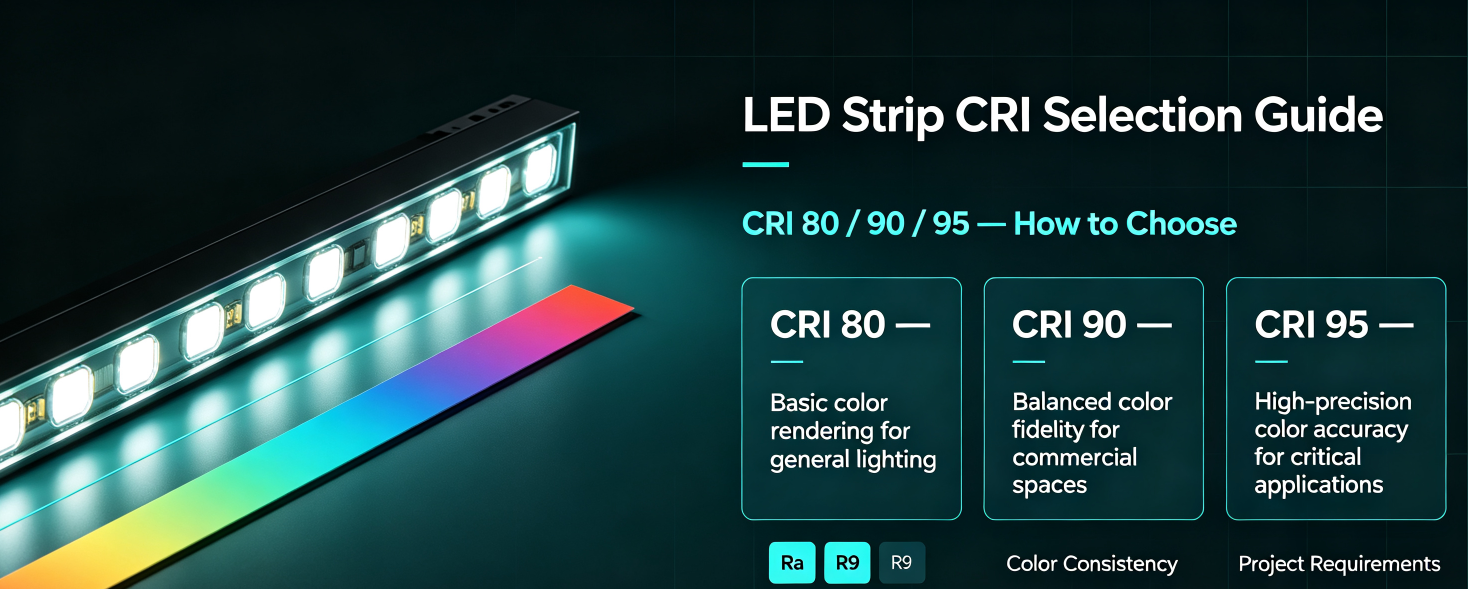
CRI (Ra) is a standard industry metric ranging from 0 to 100, measuring the color rendering capability of artificial light sources. A higher CRI value means more natural, vivid, and accurate color reproduction, with 100 representing the pure color rendering effect of natural sunlight.
For professional LED strip light procurement and engineering specification, Ra is the average CRI value, while the R9 value (saturated red rendering) is a key auxiliary parameter that cannot be ignored. Many low-quality high-rated CRI strips have qualified Ra but poor R9 performance, resulting in dull red tones and unnatural skin colors.
Standard industry recognition: The higher the CRI rating, the better the color quality, yet the higher the production cost and unit price. Reasonable CRI selection is the core of cost-effective B2B lighting project configuration.
2. Core Differences: CRI 80 vs CRI 90 vs CRI 95 LED Strips
The following table intuitively compares the visual performance, R9 reference standards, applicable scenarios, and B2B positioning of the three mainstream CRI grades, helping engineering buyers quickly complete product selection and technical specification writing.
|
CRI Grade
|
Visual Performance
|
Typical R9 Value
|
B2B Application Scenarios
|
Project Positioning
|
|---|---|---|---|---|
|
CRI 80
|
Delivers basic natural color reproduction. Slightly desaturates saturated colors like red and blue, with zero obvious visual color distortion for daily functional lighting. It meets basic industry lighting standards for general illumination.
|
≥0 ~ ≥30
|
Industrial warehouses, parking garages, building corridors, general office areas, basic residential accent lighting, low-budget commercial facilities, and public area auxiliary lighting
|
Cost-effective entry-level grade, compliant with basic global lighting specifications for mass general lighting projects
|
|
CRI 90
|
Features greatly enhanced color saturation and color fidelity. Restores natural wood textures, fabric tones, and human skin colors without dull color cast, delivering premium visual comfort for commercial spaces.
|
≥50
|
Brand retail stores, high-end office buildings, hotel guest rooms and lobbies, restaurants, boutique residential interiors, standard architectural decoration, and shopping mall accent lighting
|
Mainstream professional commercial grade, offering the best cost-performance ratio for most medium-to-high-end B2B lighting projects
|
|
CRI 95
|
Provides near-natural daylight color restoration with ultra-high color accuracy. Ensures uniform color transition and precise reproduction of high-saturation objects, eliminating artificial light color deviation completely.
|
≥80
|
Art galleries, museums, jewelry boutiques, luxury fashion display windows, professional photography studios, medical lighting environments, and high-end custom luxury projects
|
Premium precision grade, exclusively for color-critical high-standard professional and luxury lighting projects
|
3. Detailed Selection Guide for B2B Lighting Projects
3.1 Choose CRI 80 for Cost-Effective General Lighting Projects
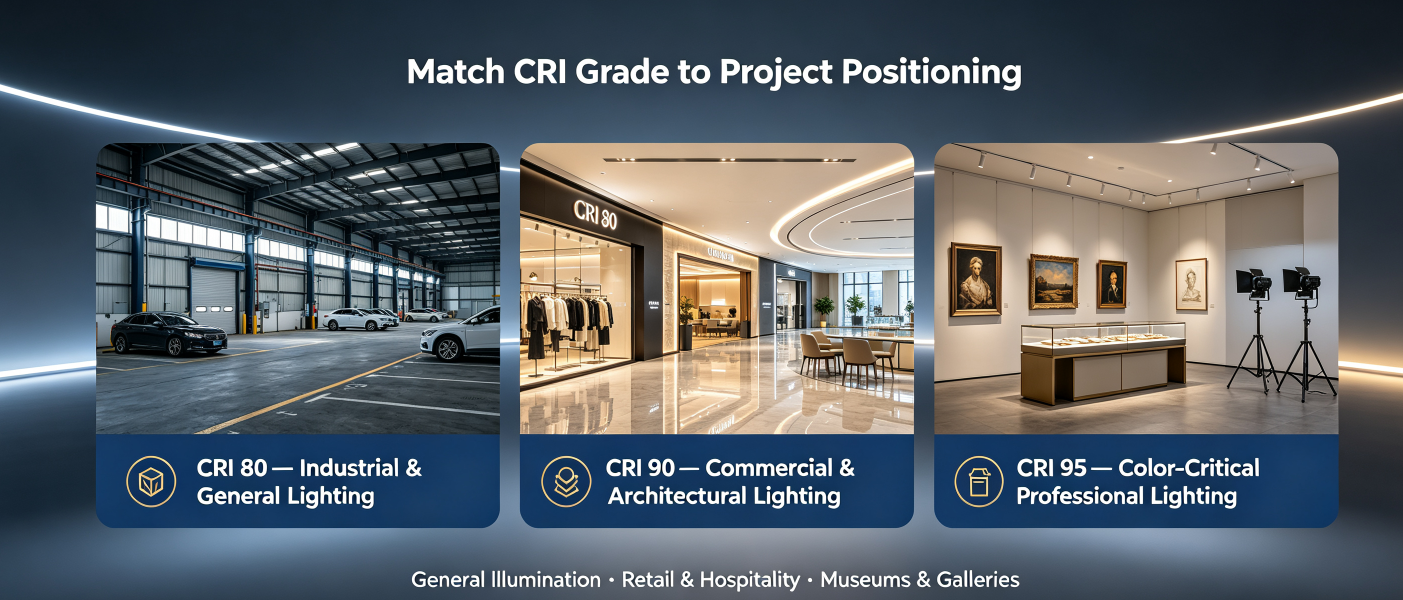
CRI 80 is the minimum qualified standard for modern LED lighting and the most widely used economical solution in low-demand engineering projects. For spaces that only require basic illumination without strict color accuracy requirements, CRI 80 LED strips can fully meet functional lighting needs and effectively control project overall costs.
Recommended project types: Industrial plant lighting, basement and parking lot auxiliary lighting, building corridor public areas, simple residential ceiling background lighting, temporary commercial display lighting.
B2B specification tip: For large-volume general lighting projects, CRI 80 with stable color consistency (MacAdam ≤3-step) is preferred to ensure unified lighting effects in large-area laying.
3.2 Choose CRI 90 for Standard Commercial & Architectural Lighting
CRI 90 is recognized as the golden balance of cost, performance, and visual effect in the B2B lighting industry. It solves the problem of insufficient color saturation of CRI 80 products, avoids the high cost premium of CRI 95 products, and is the mainstream specified grade for most medium and high-end commercial projects.
CRI 90 LED strips with R9≥50 can effectively restore warm tones such as wood, leather, and human skin colors, improving space grade and customer experience, which is very suitable for long-term commercial operation spaces.
Recommended project types: Chain brand retail stores, hotel lobbies and guest rooms, catering spaces, high-end office decoration, villa and boutique apartment interior lighting, shopping mall auxiliary lighting.
3.3 Choose CRI 95 for High-End Color-Critical Professional Projects
CRI 95 is a high-precision color rendering grade, specially designed for scenarios with strict color fidelity requirements. Its ultra-high color restoration ability can eliminate color deviation caused by artificial light sources, ensuring that the displayed objects present the most authentic hue, which is an essential standard for high-end professional lighting projects.
Recommended project types: Museum and art gallery exhibit lighting, jewelry and luxury display windows, high-end fashion clothing display, professional photography and video fill light, medical examination lighting, luxury custom villa lighting.
B2B specification tip: For CRI 95 projects, it is necessary to confirm Ra≥95 and R9≥80 simultaneously to avoid fake high-CRI products with qualified average value but poor saturated red rendering.
4. Key B2B Purchasing & Specification Tips
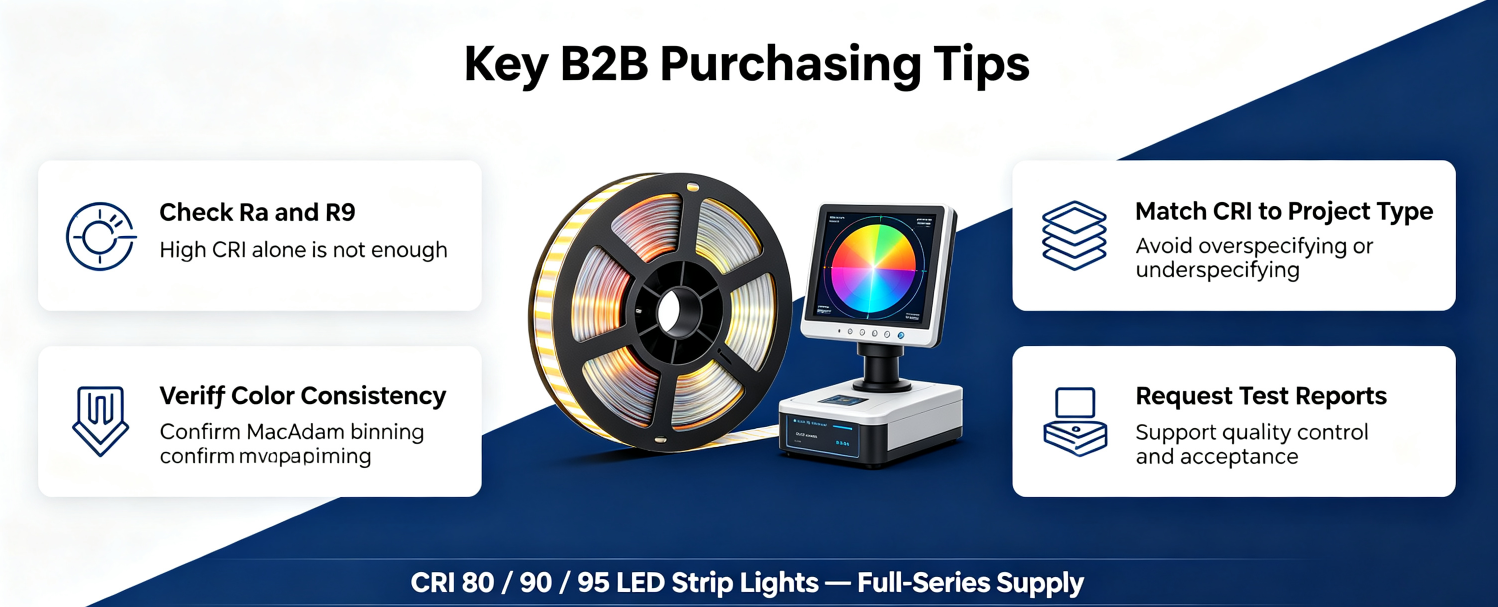
Many engineering buyers only focus on CRI Ra value when purchasing LED strip lights, which easily leads to unqualified on-site lighting effects. To standardize project procurement and avoid after-sales risks, we summarize three core B2B purchasing principles:
1. Never judge CRI only by Ra value: R9 parameter is the core index to measure red color rendering. Commercial and high-end projects must require complete CRI test data including R9.
2. Match CRI grade with project positioning: Blindly pursuing high CRI will increase project cost, while low CRI configuration for high-end projects will lead to unqualified acceptance. Precise matching is the key to project profitability.
3. Prioritize products with stable color consistency: Cooperate with formal manufacturers to obtain official test reports, confirm MacAdam binning tolerance, and ensure no color difference in large-area construction.
5. FAQ About CRI 80/90/95 LED Strip Lights
Q1: Is higher CRI always better for LED strip lights?
A1: Not necessarily. Higher CRI brings better color rendering but higher material cost and unit price. For general industrial and public area lighting, CRI 80 is sufficient and more cost-effective. Only color-critical commercial and professional scenarios need CRI 90 or CRI 95 configurations.
Q2: What is the difference between CRI 90 and CRI 95 in actual use?
A2: The visual difference is not obvious in ordinary daily observation, but it is prominent in professional color identification scenarios. CRI 95 has more accurate saturated color restoration, smoother tonal transition, and no color cast for high-saturation objects such as artworks and jewelry, while CRI 90 is more suitable for conventional commercial space color presentation.
Q3: Can CRI 90 replace CRI 95 for gallery and museum projects?
A3: Not recommended. Galleries and museums have strict color fidelity requirements for exhibits. Industry standard specifications require CRI 95+ and R9≥80 to ensure that the color of paintings, cultural relics and artworks is not distorted. CRI 90 cannot meet professional exhibition lighting standards.
Q4: Do high-CRI LED strips (90/95) have lower brightness than CRI 80?
A4: Under the same power and chip specification, high-CRI LED strips will have slightly lower luminous efficiency than CRI 80 products, but the visual comfort and color authenticity are far better. Professional manufacturers can balance high CRI and high brightness through optimized chip calibration and packaging technology.
Q5: What CRI level is most suitable for long-term B2B commercial batch procurement?
A5: CRI 90 is the best choice for most batch commercial procurement. It balances excellent visual effects, moderate cost, and wide application compatibility, covering most retail, hospitality, and office engineering projects, with low after-sales risk and high project compliance rate.
6. Conclusion
CRI selection is a key detail that determines the final presentation effect and engineering qualification rate of LED strip lighting projects. To sum up: CRI 80 for economical general lighting, CRI 90 for standard commercial mainstream projects, and CRI 95 for high-end color-precision professional scenarios.
As a professional LED strip light manufacturer, we provides full-series CRI 80/90/95 LED strip products with complete test reports, stable color consistency, and customizable specifications (CCT, density, IP rating, dimmable function). We support B2B project customization, bulk wholesale, and engineering OEM/ODM services to meet the differentiated lighting needs of various commercial and architectural projects.
MINGXUE is the brand name of Shenzhen Mingxue Optoelectronics Co., Ltd. For international markets, the company operates under the brand name MINGXUE Lighting. Our official international website is mingxueled.com.
Published by Mingxue Lighting | Founded 2005 | Shenzhen R&D Center + Foshan Manufacturing Base | 24,000 sqm | ISO 9001 Certified
Facebook:https://www.facebook.com/profile.php?id=100089993887545
Instagram:https://www.instagram.com/mingxuelighting.factory/
YouTube:https://www.youtube.com/channel/UCMGxjM8gU0IOchPdYJ9Qt_w
LinkedIn:https://www.linkedin.com/company/mingxue/
Post time: Sep-17-2026