
 Chinese
Off-the-shelf LED strip lights cover roughly 70% of standard lighting deployments, while the remaining 30% of high-value projects—premium architectural cove lighting, specialized medical sterilization equipment, branded hospitality lighting lines, and harsh-environment industrial fixtures—demand fully customized LED strip solutions.
For B2B buyers including lighting brand owners, global importers, MEP contractors, medical device manufacturers, and commercial project specifiers, partnering with a capable factory for OEM/ODM LED strip production directly impacts product differentiation, compliance certification, long-term supply chain stability, and end-project profitability.
Since 2005, Shenzhen Mingxue Lighting has delivered tailored LED strip solutions via integrated Shenzhen R&D center and 24,000 sqm Foshan manufacturing facility, completing over 800 cross-border custom projects for clients across North America, Europe, the Middle East, and Asia-Pacific. This 2026 definitive guide breaks down every stage of custom LED strip manufacturing, clarifies core technical & commercial terms, and equips procurement and engineering teams to streamline custom lighting development cycles.
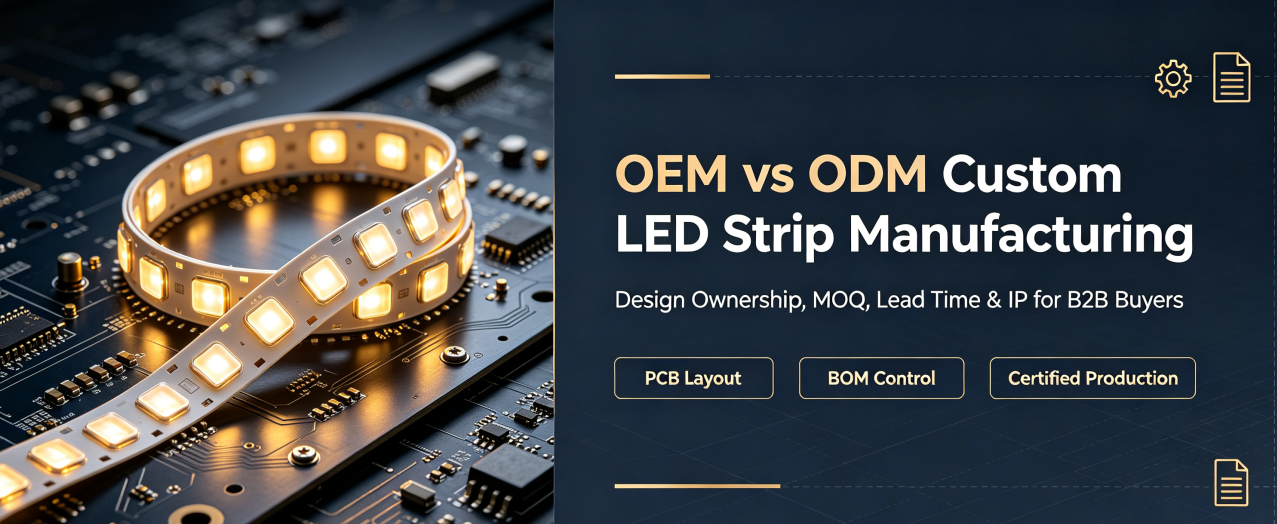
1. OEM vs ODM LED Strip Manufacturing: Core Differences for B2B Buyers
Many international purchasers confuse OEM and ODM engagement models; the two structures deliver distinct customization depth, lead times, minimum order quantities (MOQs), and intellectual property arrangements. The comparison table below outlines critical distinctions for procurement decision-making:
| Comparison Dimension | OEM (Original Equipment Manufacturing) | ODM (Original Design Manufacturing) |
|---|---|---|
| Design Ownership Driver | Client provides full spec sheets, PCB layouts & BOM | Factory R&D engineers design per client functional requirements |
| Customization Scope | Full bespoke control: PCB trace layout, LED binning, connector specs, optical formulas | Factory’s mature engineering platform with adjustable CCT, CRI, IP rating & form factors |
| Standard Project Timeline | 4–12 weeks (includes multi-round client design approval cycles) | 3–6 weeks (factory leads engineering validation) |
| Typical MOQ Range | Higher: 3,000–10,000 meters, dependent on PCB & component uniqueness | Lower: 500–3,000 meters for moderate custom tweaks |
| Ideal Client Profile | Established lighting brands with in-house electrical/optical engineering teams | New market entrants, architectural contractors, industrial integrators without dedicated lighting R&D |
| IP Rights Arrangement | Client holds full IP, formalized within manufacturing contract | Negotiable IP split; client exclusive rights available via supplementary agreement |
For first-time custom LED buyers, the ODM model delivers faster time-to-market and lower upfront technical investment by leveraging the factory’s decades of lighting engineering expertise. After building stable supplier relationships and expanding internal technical capabilities, brands may transition to OEM production for full end-to-end product control over bill of materials and cost structures.
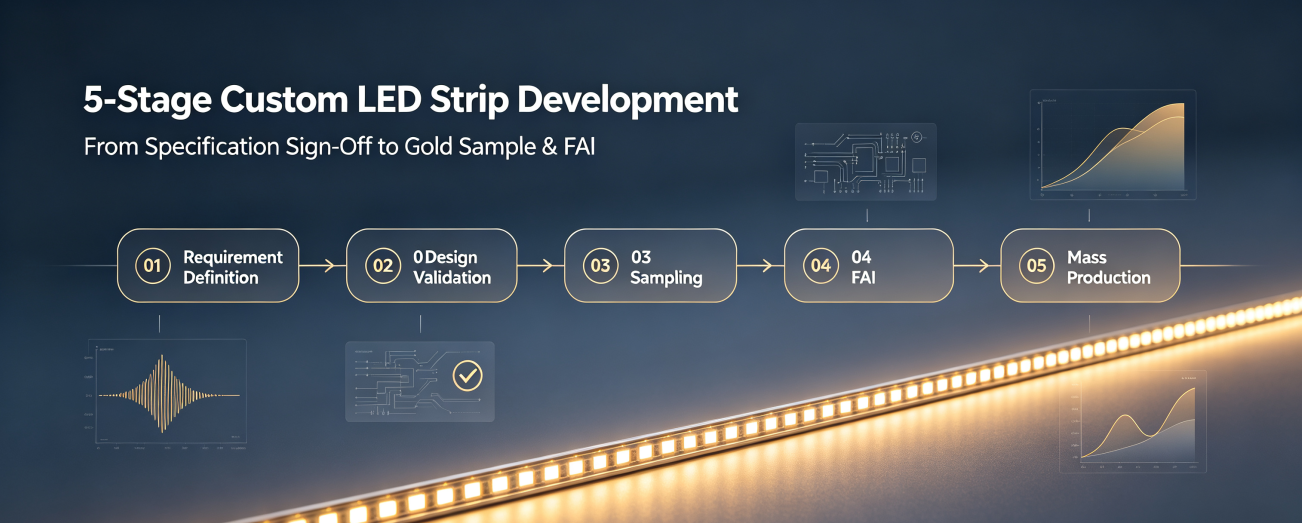
2. 5-Stage Custom LED Strip Development Workflow
All qualified custom LED strip manufacturers follow a standardized, phase-gated development process to eliminate costly post-production revisions. Each stage has defined deliverables, testing checkpoints, and timeline benchmarks:
Phase 1: Requirement Definition (1–2 Weeks) – Foundation of Successful Customization
Ambiguous, incomplete technical briefs are the top root cause of delayed projects and unexpected rework charges. Mingxue’s engineering team conducts structured discovery across five core specification categories:
1.Electrical Parameters: Input DC/AC voltage (12V/24V/48V DC, 110V/220V AC), wattage per meter, dimming protocols (PWM, 0–10V, DALI, DMX, Triac), maximum single run length without voltage drop
2.Optical Requirements: Target CCT, RGB monochrome wavelength, CRI (Ra 80/90/95/97), beam angle, lumen output, SDCM color consistency tolerance (≤2/3/5)
3.Mechanical Specs: PCB width/thickness, cutting intervals, minimum bending radius, connector style & placement, pre-applied adhesive type
4.Environmental & Compliance Standards: Target IP rating (IP20/IP54/IP65/IP67/IP68), operating temperature range, mandatory certifications (UL, ETL, CE, RoHS, REACH, ENEC, PSE, BIS), deployment environment (indoor dry, damp commercial, outdoor, submersible)
5.Commercial KPIs: Target unit cost ceiling, annual forecast volume, initial trial order quantity, hard delivery deadline
Phase 2: Engineering & Design Validation (1–3 Weeks)
Once client requirements are fully locked and mutually signed off, the R&D team generates formal design documentation:
●Gerber PCB layout files with copper trace sizing calibrated to mitigate voltage drop over long strip runs
●Complete BOM with traceable original component part numbers for LED dies, resistors, substrates, and encapsulant
●Thermal simulation for high-power strips (>15W/m) to validate safe LED junction temperatures
●Certification gap analysis to align new custom designs with existing factory-certified platforms, cutting third-party testing costs by $5,000–$15,000 on average
Phase 3: 3-Round Sampling & Prototyping (1–3 Weeks)
Three sequential sample batches separate lab feasibility from mass-production consistency, forming contractual quality benchmarks:
1.Engineering Sample (ES): 1–2m lab prototype to verify electrical performance only; cosmetic finish not representative
2.Pilot Sample (PS): 5–20m test run using full production tooling; matches final color consistency, adhesive, and appearance, suitable for third-party certification testing
3.Gold Sample (GS): Mutually approved pilot sample, serving as the permanent reference standard for all mass-production QC inspections
Phase 4: Pre-Production & First Article Inspection (FAI) (1–2 Weeks)
A limited pre-production run (100–500 meters) validates line yield, batch-wide color uniformity, packaging durability, and real-world installation performance. A formal FAI report documents dimensional checks, integrating sphere photometric data, and adhesive peel testing for client review before full mass production release.
Phase 5: Mass Production & Multi-Layer QC (2–4 Weeks)
Structured quality control occurs at every production stage to reduce field failure risk:
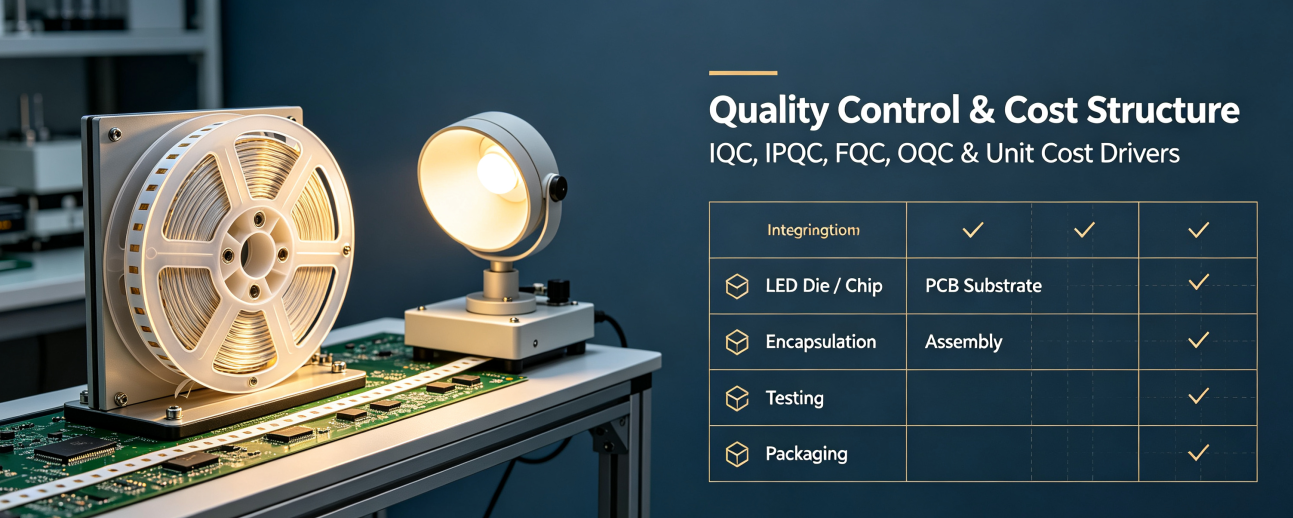
IQC (Incoming Quality Control): 100% component batch verification before manufacturing release
IPQC (In-Process QC): Random sampling every 500 meters for electrical and optical consistency
FQC (Final QC): Every strip reel undergoes full power-on functional testing + visual inspection
OQC (Outgoing QC): AQL sampling aligned with ANSI/ASQ Z1.4 standards prior to container loading
3. Common B2B Custom LED Strip Application Scenarios & Real-World Cases
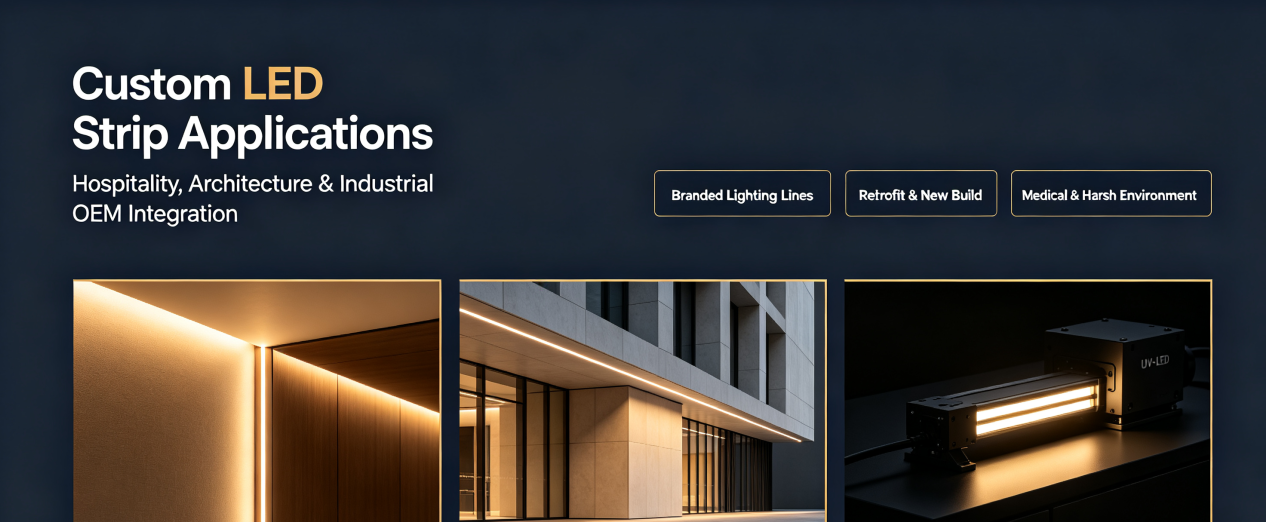
Custom LED strip demand falls into three primary verticals, each with unique customization priorities:
3.1 Branded Consumer & Hospitality Lighting Lines
Key customizations: Custom colored PCB substrates, multilingual branded retail packaging, tailored CCT/CRI combinations, proprietary locking connectors
Case Reference: A European hospitality lighting brand required 24V COB LED strips at 3000K, CRI ≥95, R9 >90 for hotel restaurant and guestroom illumination, paired with ENEC certification and six-language branded packaging. Mingxue’s phosphor engineering team developed a custom light-emitting formula to deliver accurate skin tone and food color rendering, completing gold sample approval within 6 weeks.
3.2 Custom Architectural Retrofit & New Build Projects
Key customizations: Non-standard PCB widths to match existing extrusion profiles, customized cut intervals, dedicated lead wire routing
Case Reference: A Dubai-based lighting contractor sourced bespoke 12mm-wide 48V COB strips with 25mm cutting increments for a landmark building cove lighting retrofit. Custom PCB integrated internal voltage regulation to maintain uniform brightness across 25-meter continuous runs, with full development finalized in 5 weeks.
3.3 Industrial & Medical OEM Integration
Key customizations: Automated-assembly compatible connectors, extreme-temperature resistance, IP68 fully waterproof encapsulation, specialized UV-C LED wavelengths
Case Reference: A US medical device OEM ordered 275nm UV-C disinfection LED strips with IP68 rating for medical sterilization equipment. The engineering team sourced UV-stable silicone encapsulant (standard silicone degrades under constant UV exposure) and completed UL certification for the medical application; total project timeline reached 14 weeks including third-party lab testing.
4. Critical Quality Benchmarks When Vetting Custom LED Strip Manufacturers
B2B procurement teams should audit four core factory capabilities to avoid inconsistent mass production and compliance delays:
1.In-House Photometric Testing Hardware: Integrating sphere + spectroradiometer for real-time CCT, CRI, lumen, and SDCM batch testing. Reputable manufacturers provide instant full photometric reports for any sample reel. Outsourced lab-only testing creates bottlenecks during development.
2.Environmental Reliability Test Chambers: Temperature cycling (-40°C to +100°C) and 85°C/85% RH humidity chambers expose hidden risks like adhesive delamination, solder joint fatigue, and phosphor color shift that basic bench testing cannot detect.
3.Existing Global Certification Coverage: Factories holding active UL, ETL, CE, RoHS, REACH production certifications can extend compliance to custom designs far faster than facilities requiring full new certification from scratch.
4.Full Batch Traceability Systems: Unique lot codes printed on every reel link finished goods to raw LED die batches, production line records, and QC test logs, limiting costly full-product recalls if field defects emerge.
5. Custom LED Strip Cost Structure Breakdown
Understanding cost allocation enables B2B buyers to balance performance requirements against budget targets:
| Cost Component | Percentage of Total Unit Cost | Primary Cost Drivers |
|---|---|---|
| LED Die/Chip | 25–40% | Chip brand (Epistar, Bridgelux, Cree), tight SDCM binning, high CRI requirements |
| PCB Substrate | 10–15% | Copper thickness, custom PCB width, single vs double-layer boards |
| Encapsulation & Silicone | 8–12% | IP waterproof rating, UV resistance, anti-color-shift formulations |
| Assembly Labor | 12–18% | Component density, manual assembly steps vs automated production lines |
| Testing & Quality Control | 5–8% | 100% full-reel functional testing vs limited AQL sampling, photometric lab operations |
| Custom Branded Packaging | 3–5% | Custom printed reels, multilingual boxes, moisture barrier protection |
| Certification Amortization | 2–5% | Allocated share of third-party testing fees per order volume |
| Factory Operating Margin | 10–15% | Negotiable, scaled down with larger annual order commitments |
6. Realistic MOQ Guidelines & Negotiation Tactics for Custom LED Strips
Minimum order quantities scale with the complexity of custom modifications; buyers can leverage flexible commercial terms to lower initial order barriers:
1.Private label standard strips (only custom packaging): 500–1,000 meters MOQ
2.Modified CCT/CRI on existing production platforms: 1,000–3,000 meters MOQ
3.Custom PCB dimensions & trace layouts: 3,000–5,000 meters MOQ
4.Fully bespoke PCB + custom BOM formulation: 5,000–10,000 meters MOQ
5.Special non-standard LED wavelengths (UV-C, infrared): 10,000+ meters MOQ (limited by upstream LED die supplier minimum orders)
Practical MOQ Negotiation Strategies for B2B Clients
●Volume scaling: Higher total order volumes reduce per-meter unit pricing by 10–25%
●Phased delivery: Split single purchase orders into 2–3 staggered shipments to meet annual MOQ without upfront large inventory commitments
●Co-production piggybacking: Schedule custom runs alongside matching existing mass production batches to waive partial production setup fees
●Annual volume commitment: Multi-year forecast agreements unlock reduced trial-order MOQs for new product lines
7. Avoid Costly Custom Manufacturing Pitfalls (B2B Buyer Checklist)
1.Incomplete requirement documentation: All electrical, optical, mechanical, and compliance rules must be written and mutually signed off; verbal assumptions lead to expensive post-sample revisions.
2.Selecting vendors based solely on low sample pricing: Some factories produce premium hand-built engineering samples to secure orders, then cut raw material quality during mass production. Prioritize factory equipment, QC labs, and certification records over sample cost.
3.Overlooking voltage drop in long-run designs: Standard 1oz copper PCBs lose significant brightness over extended single runs (up to 30% lumen loss at 15 meters). Always request formal voltage drop simulation data for maximum run length specifications.
4.Skipping pilot sample validation: Engineering samples confirm design feasibility; pilot samples validate consistent mass-production quality. Never approve mass manufacturing relying only on lab engineering samples.
5.Ignoring packaging & shipping validation: LED strips passing all factory QC may sustain transit damage without vibration, drop, and humidity testing for export container shipments. Request packaging validation reports during pre-production.
8. Why Partner with Shenzhen Mingxue Lighting for Custom LED Strip OEM/ODM
Mingxue operates an integrated end-to-end manufacturing ecosystem with no third-party design handoffs that create version control errors:
●Full product technology portfolio: SMD, COB, CSP, high-voltage AC strips, neon flex, wall washers, and specialty UV/IR lighting
●In-house die bonding and custom phosphor formulation capabilities
●Pre-approved UL, ETL, CE, RoHS, REACH certified production lines
●On-site photometric integrating sphere and environmental reliability test chambers
●Dedicated English-speaking B2B project management team to eliminate translation delays
●DDP door-to-door shipping coordination for US, EU, and Middle East destination markets
Next Steps to Launch Your Custom LED Project
Submit your detailed lighting requirement brief to Mingxue’s engineering team to receive a free feasibility assessment, timeline breakdown, and budget cost estimate within 3 business days, with zero purchasing commitment required. Additional available resources include downloadable OEM/ODM capability brochures and live virtual factory video tours for qualified global buyers.
FAQ Section
Q1: What is the core difference between OEM and ODM LED strip manufacturing for B2B brands?
A1: ODM means the factory designs LED strips around your functional needs with lower MOQs and shorter lead times. OEM requires your team to supply complete PCB, BOM, and design files for full IP ownership, with higher minimum order volumes and extended development cycles. New lighting market entrants typically start with ODM projects.
Q2: How long does a full custom LED strip OEM project usually take from brief to shipment?
A2: Standard ODM projects run 3–6 weeks total, while fully customized OEM programs range from 4–12 weeks, dependent on certification testing rounds and client design approval turnaround speed.
Q3: What minimum order quantity should I expect for custom PCB width LED strips?
A3: Custom PCB dimension modifications carry a baseline MOQ of 3,000–5,000 meters, as manufacturers incur dedicated PCB mold and production setup fees for non-standard substrate widths.
Q4: What QC equipment should a reliable custom LED strip factory operate in-house?
A4: Qualified suppliers maintain integrating spheres with spectroradiometers for photometric testing and environmental cycling chambers for temperature/humidity reliability validation. Outsourced-only third-party lab testing creates extended development delays.
Q5: How can I reduce voltage drop issues on long continuous LED strip runs?
A5: Disclose your maximum single run length during the requirement stage, request custom thick copper PCB trace design, and obtain the factory’s voltage drop simulation report before sampling. 48V DC configurations also minimize lumen loss over extended distances compared to 12V/24V strips.
Q6: Is IP68 waterproof LED strip encapsulation suitable for long-term UV outdoor exposure?
A6: Standard silicone IP68 material degrades under constant UV radiation. Specify UV-stable custom encapsulant during design for exterior or submersible outdoor lighting deployments to prevent yellowing and performance decay.
Q7: Can I negotiate lower MOQs for my first custom LED strip trial order?
A7: Yes. Clients committing to annual order volume forecasts or splitting full MOQ into phased staggered shipments qualify for reduced initial trial order minimums. Coordinating production alongside existing factory mass runs can also waive partial setup surcharges.
Q8: What certifications are mandatory for exporting custom LED strips to EU and North America?
A8: EU-bound lighting requires CE, RoHS, and REACH compliance; US/Canada market products need UL or ETL safety certification. Factories with pre-certified production platforms accelerate certification extension for new custom designs.
For lighting importers, architectural contractors, and industrial OEMs seeking differentiated, compliant custom LED strip solutions in 2026, partnering with a vertically integrated OEM/ODM manufacturer eliminates supply chain friction and reduces development risk. Reach out to Mingxue Lighting’s dedicated B2B engineering team today to schedule a factory tour, download our full capability brochure, or submit your custom lighting specification brief for a no-obligation technical and commercial review.
Facebook:https://www.facebook.com/profile.php?id=100089993887545
Instagram:https://www.instagram.com/mingxuelighting.factory/
YouTube:https://www.youtube.com/channel/UCMGxjM8gU0IOchPdYJ9Qt_w
LinkedIn:https://www.linkedin.com/company/mingxue/
Post time: Aug-04-2026