
 Chinese
The global LED strip lighting sector is undergoing its most disruptive upgrade since the industry transitioned from 3528 to 2835 SMD chips a decade ago. Driven by architectural aesthetic demands, international green regulatory mandates, smart building standard unification and high-margin vertical application segmentation, five interlocked trends are rewriting B2B product R&D, procurement, specification and project delivery rules for importers, lighting designers, OEM manufacturers and commercial construction stakeholders in 2026.
As core primary keywords like LED strip lights 2026, COB LED strip and tunable white LED strip dominate architectural tender documents and B2B search queries, cross-border merchants must prioritize these high-traffic product lines to capture organic leads from global buyers. Per aggregated cross-border customs shipment data and global specifier survey statistics, the worldwide LED strip light market will expand from $3.8 billion in 2023 to an estimated $5.6 billion by 2026, delivering roughly 47% compound growth within three years.
B2B players that fail to align product portfolios, supplier qualification standards and compliance documentation with these emerging LED strip light industry trends 2026 will face shrinking tender opportunities and compressed gross margins, while early adopters of COB LED strip, tunable-white and sustainability-certified linear lighting solutions will capture priority specification rights in commercial office, healthcare, education, hospitality and retail projects. This B2B-focused industry analysis unpacks each core trend with actionable procurement strategies, comparative market metrics, cross-regional compliance reminders and tailored recommendations for every supply chain participant, including dedicated guidance for LED lighting distributor procurement guide.
Top 5 Defining 2026 LED Strip Light Industry Trends for B2B Buyers & Specifiers
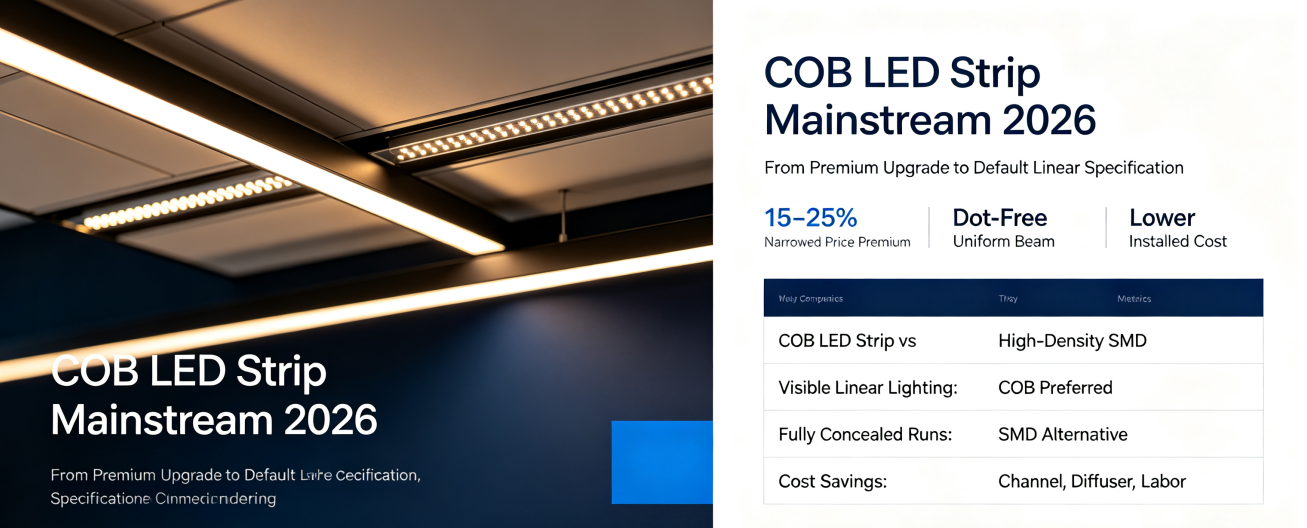
Trend 1: COB LED Strip Shifts from Premium Upgrade to Default Visible Linear Specification
Three years ago, COB (Chip-on-Board) LED strips were niche high-end architectural items with steep price tags, reserved only for luxury commercial fit-outs. In 2026, COB LED strip technology has become the mandatory baseline for any linear lighting installation where strips or light reflections remain visible to end users.
Core B2B Driving Factors
1.Narrowed Price Premium: The cost gap between COB LED strip and high-density SMD variants has fallen to just 15–25%. Extra strip procurement costs are fully offset by savings on thick aluminum profiles, heavy diffuser accessories and on-site installation labor. Ongoing die-bonding automation and mature phosphor coating workflows will further compress COB unit costs through 2027.
2.Minimalist Architectural Mandates: Modern design specifications widely adopt ultra-slim 10mm recessed trims, shadow-line detailing and flush-mounted linear channels. Traditional SMD strips create obvious dot light spots and require bulky masking hardware that violates clean design briefs, while COB’s 180° uniform beam angle delivers dot-free seamless illumination without extra structural components.
3.Mature Global Supply Chain Ecosystem: Only fewer than 10 factories globally delivered stable consistent COB strip outputs in 2023; today qualified manufacturing capacity has expanded massively. However, significant quality discrepancies persist between top-tier certified factories and commodity mass-production suppliers, requiring strict pre-order factory audits for B2B LED lighting supplier partners.
Practical B2B Implications
●Lighting specifiers: Standardize COB LED strip as the primary option for all exposed linear lighting; only select SMD strips for fully concealed installations or strict low-budget tender packages.
●Distributors & importers: Complete full portfolio coverage of COB strips across all mainstream voltages, color temperatures and CRI grades to avoid losing specification orders to competitors, following proven LED lighting distributor procurement guide frameworks.
●Project cost estimators: Rebuild cost calculation models — total installed COB lighting expenditure is often lower than the combined cost of SMD strips, deep mounting channels and heavy diffusers.
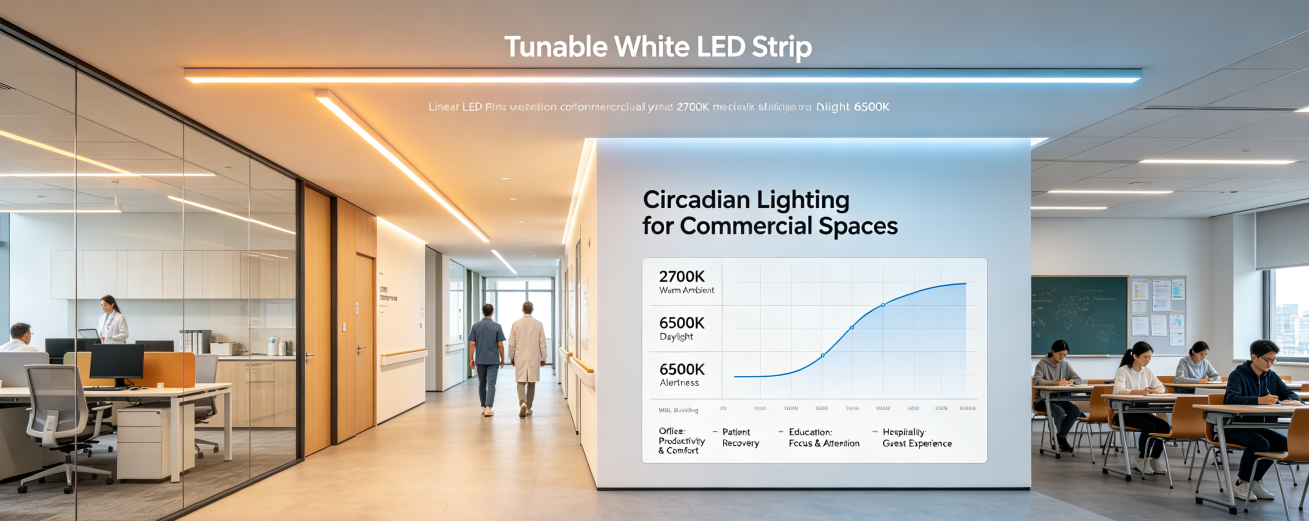
Trend 2: Tunable White LED Strip & Circadian Lighting Evolve from Wellness Niche to Commercial Standard
Tunable white LED strip supports independent adjustment of brightness and correlated color temperature (CCT) across the 2700K warm candle to 6500K cool daylight spectrum. In 2026, this product line transitions from a luxury add-on to a non-negotiable specification for Class A offices, medical facilities, educational campuses and high-end hospitality venues, widely recognized as commercial tunable white circadian lighting.
Key Market Catalysts
1.WELL Building Standard Global Penetration: Over 5 billion square feet of global real estate has obtained WELL certification or ongoing registration. The WELL Light module awards formal certification credits to projects deploying tunable circadian lighting that aligns with human natural biological rhythms, pushing commercial developers to prioritize compatible linear strips as core WELL building LED strip specification requirements.
2.COB + Tunable-White Product Synergy: Dual-die interleaving manufacturing technology resolves the uneven color mixing flaw that plagued pre-2023 COB tunable strips, creating a new high-value product category: seamless dot-free linear lighting with full CCT adjustability.
3.Massive Unit Price Reduction: Premium tunable white LED strip COB variants that cost $30–40 per meter in 2022 now retail at $18–25 per meter from ISO-certified manufacturers, matching the pricing tier of single fixed-CCT high-end strips from three years prior.
Industry Vertical Adoption Breakdown Table
| Vertical Sector | Market Adoption Level | Primary B2B Specification Driver |
|---|---|---|
| Class A Commercial Office | Mainstream Mandate | WELL certification compliance, staff wellness & productivity KPIs |
| Healthcare Facilities | Rapidly Expanding | Accelerated patient recovery, sustained medical staff alertness |
| K12 & Higher Education | Emerging Standard | Improved student focus, standardized exam performance metrics |
| Premium Hospitality Resorts | Steady Growth | Differentiated guest experience, positive online review scoring |
| Luxury Residential Developments | Niche to Emerging | Circadian health amenity, high-end property value uplift |
B2B Procurement Notes
The biggest bottleneck for tunable-white rollout is control system deployment complexity. While LED strip hardware technology is fully mature, DALI/DMX hardwired control packages carry high engineering and commissioning fees. Simplified wireless control ecosystems including Casambi and Zigbee are bridging this cost gap for mid-size projects. B2B buyers should prioritize suppliers offering matched driver-strip integrated systems instead of mixing third-party drivers and lighting strips separately.
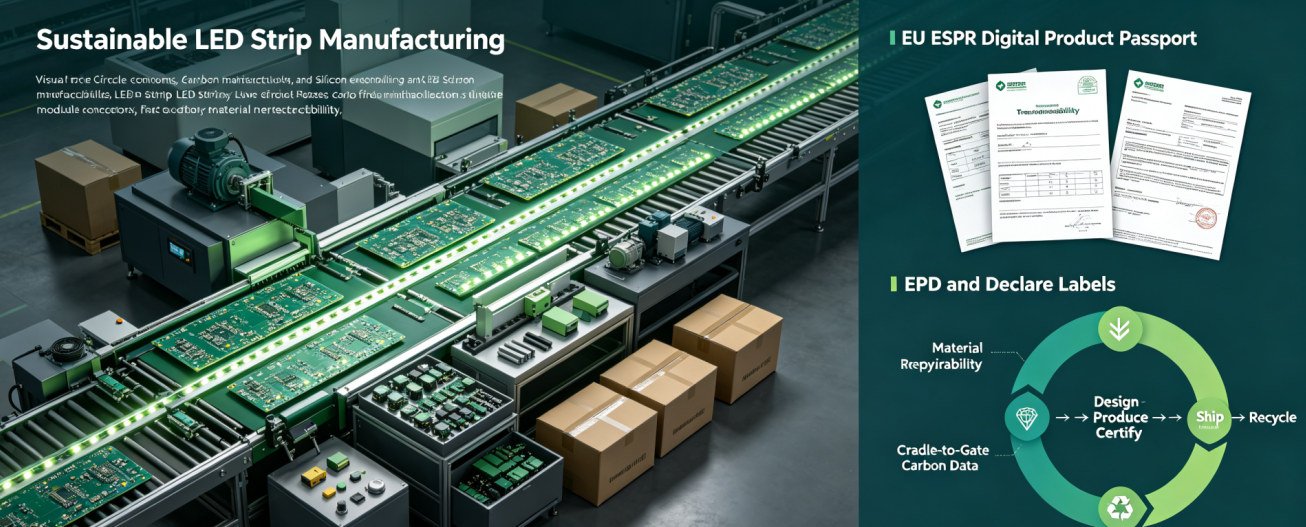
Trend 3: Global Sustainability Mandates Reshape Manufacturing & Cross-Border B2B Compliance
Environmental compliance requirements have moved past basic RoHS testing to comprehensive material traceability, full carbon footprint accounting and circular economy design rules, impacting every stage of LED strip production: flexible PCB substrate selection, silicone encapsulation, outer packaging and end-of-life disassembly recyclability. For any B2B LED lighting supplier exporting to Europe, mastering EU ESPR Digital Product Passport LED strips compliance rules becomes non-negotiable.
Cross-Regional Regulatory & Market Drivers
1.EU ESPR Digital Product Passport Rules: The EU Eco-design for Sustainable Products Regulation (ESPR) launched in 2024 with staged enforcement until 2027. All LED strips imported to EU territories must carry a complete Digital Product Passport documenting raw material composition, repairability, recyclability and cradle-to-gate carbon emissions.
2.North American LEED v5 & Institutional Tender Standards: U.S. federal GSA construction projects, university campuses and Fortune 500 corporate campuses now require mandatory Environmental Product Declarations (EPDs) and Declare material health labels, even without strict federal lighting legislation.
3.Global Brand ESG Scope 3 Emission Reporting: Large lighting distributors and international brands must collect full supply chain carbon data from manufacturing partners to meet investor ESG disclosure obligations, pushing factories to adopt low-carbon production workflows for sustainable LED strip manufacturing compliance.
Manufacturing Sustainability Upgrades for B2B Supplier Evaluation
●Low-carbon recycled-content flexible PCB substrates replacing high-emission traditional polyimide films
●Solvent-free silicone curing processes cutting factory VOC discharge; bio-based recyclable silicone coatings under R&D
●Disposable plastic reel packaging phased out for reusable, recyclable bulk packaging for B2B bulk shipments
●Modular mechanical connector designs enabling easy disassembly, solving the recyclability pain point of bonded metal-polymer strip composites
B2B Stakeholder Action Items
●EU-focused importers: Initiate Digital Product Passport documentation preparation immediately; suppliers with pre-built compliance files hold major tender advantages under EU ESPR Digital Product Passport LED strips policies.
●North America OEM buyers: Add EPD and material traceability document checks to standard supplier audit checklists ahead of tighter specifier requirements.
●Lighting manufacturers: Prioritize sustainability-focused product design and compliance certification to win exclusive commercial project specifications unavailable to non-compliant competitors.
Trend 4: Smart LED Strip Integration Moves Beyond Standalone Bluetooth/Wi-Fi Controllers
LED strip control architecture is shifting from isolated proprietary mobile app controllers toward native compatibility with commercial Building Management Systems (BMS), universal lighting protocols and cross-brand smart home Matter ecosystems — a core upgrade for B2B commercial and residential bulk procurement of smart LED strip. Industry engineers widely deploy DALI-2 PoE LED linear light for new commercial construction fit-outs.
Core Industry Enablers
1.Matter Protocol Universal Compatibility: Backed by Apple, Google, Amazon and Samsung, the Matter standard delivers unified cross-platform lighting control. Matter-certified strip controllers operate seamlessly across Apple Home, Google Home, Alexa and SmartThings without brand-locked dedicated hubs or single-product mobile applications.
2.DALI-2 D4i Standardization for Circadian Lighting: DALI-2 with D4i extensions establishes uniform data communication for tunable and RGB color-changing strips, tracking real-time energy consumption, cumulative operating hours and fault diagnostics for centralized building management, making DALI-2 PoE LED linear light the top pick for large office developments.
3.PoE++ Linear Lighting for New Commercial Construction: Cat6/Cat6a Power-over-Ethernet (PoE++) infrastructure powers and controls LED strips simultaneously. A single 90W PoE port supports 5–8 meters of linear lighting with segment-level dimming, occupancy automation and energy monitoring, eliminating separate low-voltage electrician installation work for new builds.
B2B Specification Guidance
●Large commercial fit-outs: Specify DALI-2 compatible drivers for all LED strips regardless of initial basic dimming scope, future-proofing assets for later BMS circadian lighting upgrades.
●Residential & small commercial bulk orders: Prioritize Matter-certified controllers to eliminate the fragmented “multiple app” pain point for installers and end clients sourcing smart LED strip.
●New construction tenders: Flag PoE linear strips as a forward-looking optional upgrade, noting current infrastructure wiring costs limit mass retrofitting availability.
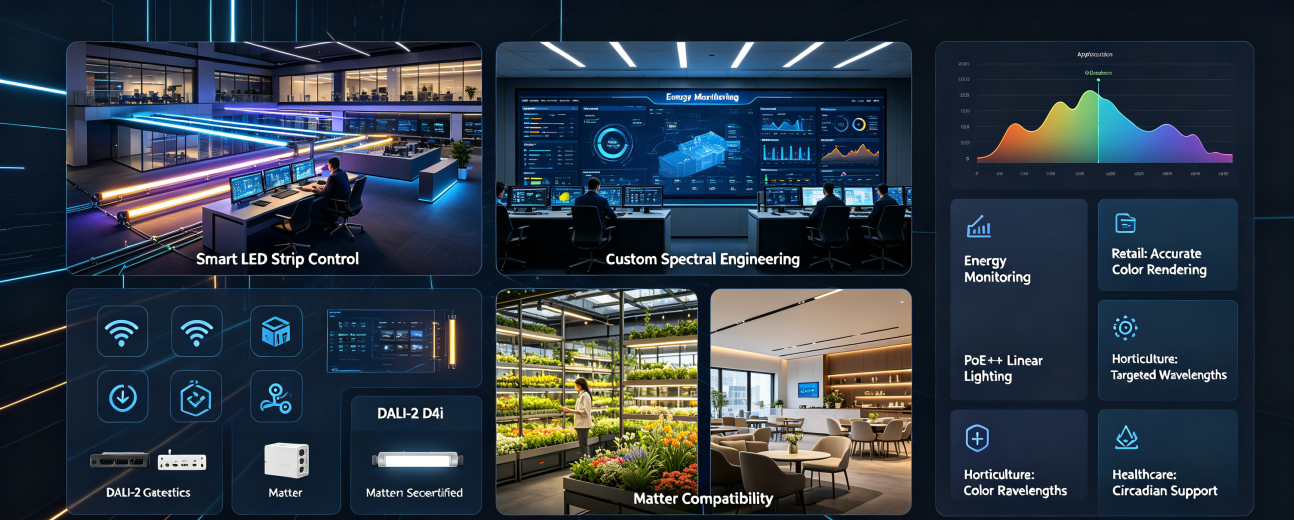
Trend 5: Application-Specific Spectral Engineering Creates High-Margin Vertical Product Lines
The LED strip market is splitting away from generic universal white lighting toward custom spectral power distribution products engineered to deliver targeted biological, retail visual and agricultural performance outcomes. Generic standard white strips are fast becoming low-margin commodity goods, while custom spectral LED strips for retail horticulture represent the highest B2B profit pool in 2026.
Mainstream Custom Spectral Product Categories
1.Circadian Optimized Spectra: Surpass basic CCT adjustment by tuning melanotic lux levels across every color temperature setting. Morning mode amplifies 480nm cyan-blue wavelengths to boost human alertness; evening mode suppresses blue light to stimulate natural melatonin secretion for restful sleep cycles.
2.Retail Vertical-Tailored Spectra:
●Fashion & Apparel: Boosted R9 deep red and R13 skin tone rendering for accurate fabric and human complexion reproduction
●Bakery & Fresh Food: Warm red-amber enhanced spectrum to amplify visual appeal of baked goods, fruits and vegetables
●Jewelry Boutiques: Elevated 450–470nm blue spectrum to maximize diamond sparkle and metallic luster
●Consumer Electronics Stores: High-CRI cool neutral light to render electronic product colorways without warm color distortion
3.Horticulture Grow Spectra: Single-color purple red-blue grow strips are obsolete for commercial farms. Balanced full-spectrum white strips with targeted wavelength supplementation are now standard for seedling propagation, vegetative growth and flowering crop cycles, core to custom spectral LED strips for retail horticulture vertical lines.
4.Health & Pest Control Specialized Spectra: Mosquito-repellent 590–610nm amber strips for outdoor hospitality public spaces; 265–280nm UV-C germicidal strips for HVAC air disinfection and surface sterilization; zero-blue low-amber night light strips for senior living and residential bedrooms.
B2B Business Value
Custom spectral formulations create strong competitive moats for OEM brands and distributors, as vertical-specific lighting solutions cannot be easily replicated by low-cost commodity manufacturers. Lighting supply chain participants must master technical spectral metrics including melanotic ratio, TM-30 Rf/Rg and PPF/W to qualify for high-value vertical project tenders outlined in the LED lighting distributor procurement guide.
2023 vs 2026 Global LED Strip Light B2B Market Benchmark Table
| Market Performance Metric | Actual 2023 Industry Data | Estimated 2026 Market Figure | Three-Year Growth Multiplier |
|---|---|---|---|
| Total Global LED Strip Market Value | $3.8 Billion | $5.6 Billion | ~47% Value Growth |
| COB Strips as Linear Lighting Sales Share | ~15% | 35–40% | 2.5x Market Penetration |
| Tunable White LED Strip Penetration (Commercial Only) | ~8% | ~22% | 2.75x Adoption Rate |
| Smart LED Strip Connected Product Share | ~18% | ~35% | 2x Market Share Expansion |
| Asia-Pacific Total Manufacturing Output Share | ~78% | ~74% | Minor Global Supply Diversification |
| Average Mandatory CRI Requirement (Commercial Tenders) | 80 Ra | 90 Ra | One Full Tier Upgrade |
Conclusion
2026 marks a pivotal inflection point for the global LED strip light B2B market, defined by COB LED strip mainstream adoption, mandatory tunable white LED strip circadian lighting specs, cross-border sustainability compliance enforcement under EU ESPR Digital Product Passport LED strips, unified smart LED strip control protocols and vertical custom spectral segmentation via custom spectral LED strips for retail horticulture. Supply chain participants that align product development, supplier qualification, compliance documentation and tender specification standards with these five core LED strip light industry trends 2026 will capture sustained growth amid rising global market demand (projected 47% value expansion by late 2026).
Looking forward to 2027–2030, emerging innovations including perovskite LED materials, embedded sensing hardware and biodegradable flexible substrates will open a new wave of high-value product categories for forward-thinking manufacturers, importers and specifiers. Continuous tracking of international green regulations and architectural WELL building LED strip specification standards will remain essential for long-term competitive positioning across all global B2B lighting markets, supported by consistent use of the LED lighting distributor procurement guide for bulk purchasing strategy.
Facebook:https://www.facebook.com/profile.php?id=100089993887545
Instagram:https://www.instagram.com/mingxuelighting.factory/
YouTube:https://www.youtube.com/channel/UCMGxjM8gU0IOchPdYJ9Qt_w
LinkedIn:https://www.linkedin.com/company/mingxue/
Post time: Aug-06-2026