
 Chinese
When sourcing 12V, 24V, and 48V LED strip lights for commercial, wholesale, or OEM projects, voltage is often the first specification buyers notice — but it is rarely the only factor that matters. For distributors, contractors, and lighting designers, a clear LED strip voltage comparison helps reduce installation errors, simplify driver selection, and improve long-term project reliability.
This guide explains what actually changes across low voltage LED strip platforms — including run length, current draw, voltage drop, power supply sizing, and total cost of ownership — so B2B teams can specify commercial LED strip lighting with confidence.
Why LED Strip Voltage Matters in B2B Projects
12V LED strip lights, 24V LED strip lights, and 48V LED strip lights are all widely used in professional applications such as retail displays, hospitality interiors, architectural cove lighting, signage, and private-label product lines.
Voltage affects how current flows through PCB traces and connectors, which in turn influences:
●LED strip run length before brightness falloff
●Voltage drop across long copper paths
●Driver and cable sizing
●Installation labor and power injection planning
For B2B LED strip wholesale and OEM partners, choosing the right voltage platform is a system decision — not just a number on a datasheet.
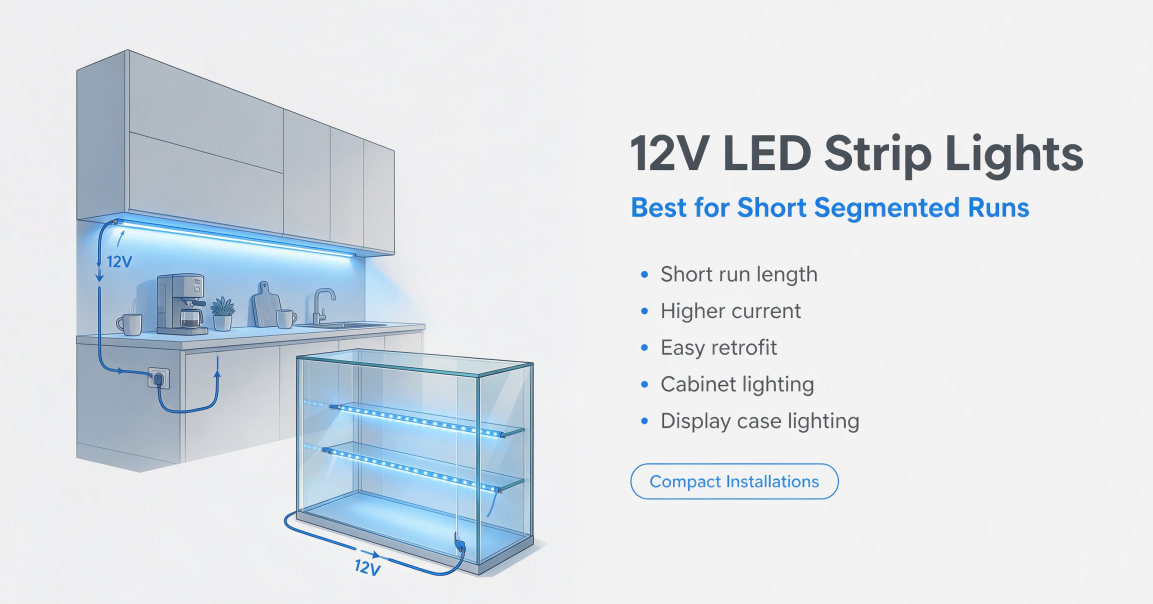
12V LED Strip Lights: Short Runs and Flexible Layouts
12V LED strip lights remain one of the most common options in residential and light commercial markets.
Typical characteristics
●Higher current at the same wattage (Power = Voltage × Current)
●May require more frequent power injection on longer runs
●Broad compatibility with existing 12V drivers and accessories
●Available in a wide range of CCT, CRI, density, and IP ratings
Best suited for
●Under-cabinet and display case lighting
●Short segmented runs
●OEM prototypes and compact product integrations
●Projects where 12V infrastructure already exists
12V LED strip lights can be a practical choice when runs are relatively short and layout flexibility is the priority. Always confirm maximum run length using the manufacturer’s official specification sheet.
24V LED Strip Lights: A Professional Standard for Commercial Use
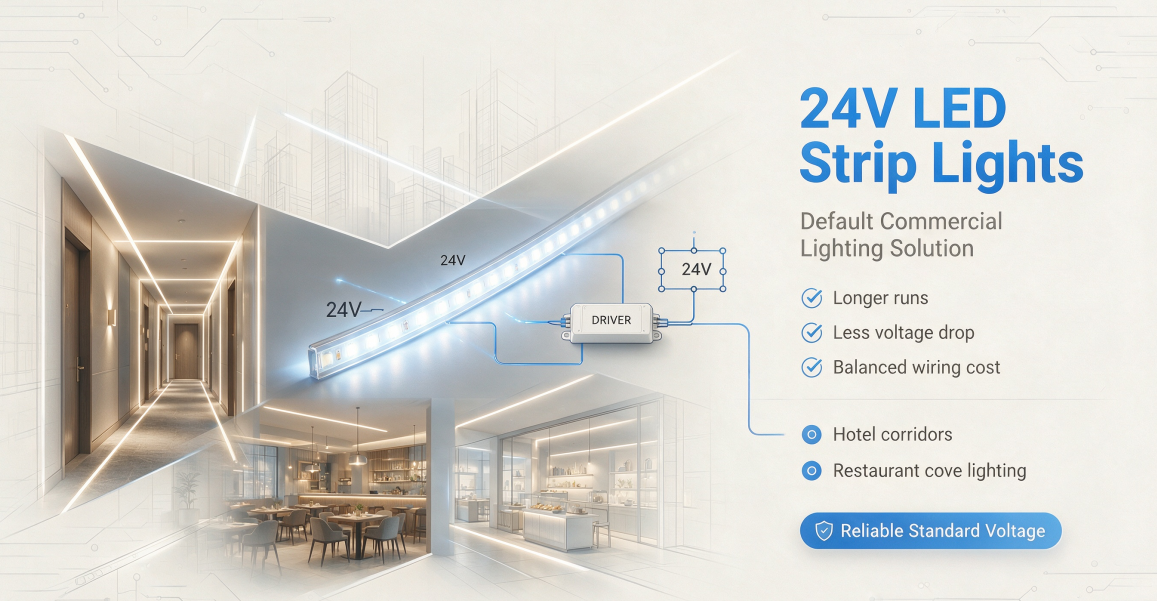
24V LED strip lights are frequently specified in commercial LED strip lighting projects because they offer a balanced combination of flexibility, driver availability, and installation efficiency.
Typical characteristics
●Lower current than 12V at equivalent wattage
●Generally supports longer runs before noticeable voltage drop
●Reduced stress on cables and connectors in higher-wattage layouts
●Popular in wholesale catalogs targeting contractors and integrators
B2B advantage
For fixed-price installations in hotels, restaurants, and retail chains, 24V LED strip lights may reduce the number of power feeds and callbacks related to uneven brightness — depending on product design and project layout.
Many professionals treat 24V as a practical default for medium-scale low voltage LED strip applications, not because 12V is unsuitable, but because 24V aligns well with common project scales and supply chains.
48V LED Strip Lights: Long Runs and Centralized Power Design
48V LED strip lights are less common in consumer retail but increasingly relevant for large-format linear installations and custom OEM LED strip lights programs.
Typical characteristics
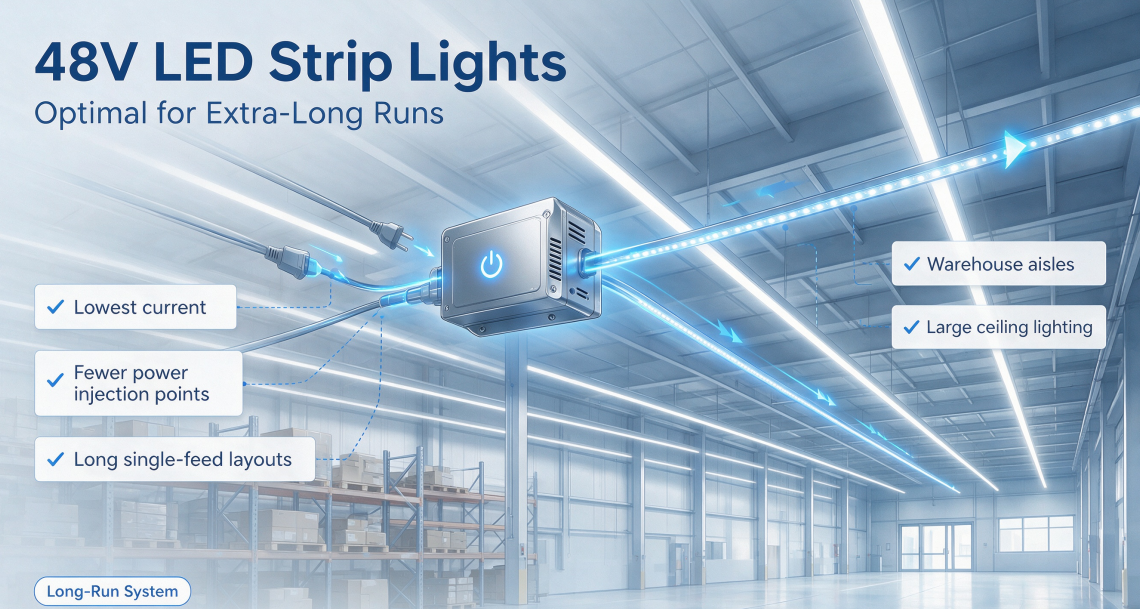
●Lowest current among the three voltages at the same wattage
●Potential for longer continuous LED strip run length (product-dependent)
●Often evaluated as part of a complete system architecture
●May require specialized drivers and compatible control protocols
When to consider 48V
48V LED strip lights may suit projects where minimizing injection points and simplifying cable routing across long distances is a priority — such as corridors, warehouse aisles, and large retail ceilings.Higher voltage does not automatically mean higher brightness or better value. 48V LED strip lights should be specified alongside matched drivers, dimming strategy, and compliance documentation.
LED Strip Voltage Comparison Table: 12V vs 24V vs 48V
| Factor | 12V LED Strip Lights | 24V LED Strip Lights | 48V LED Strip Lights |
| Typical use | Short runs, detail lighting | Commercial & professional installs | Long-run, centralized power |
| Current at same wattage | Higher | Medium | Lower |
| Run length trend | Shorter before injection | Longer than 12V | Often longest (model-dependent) |
| Voltage drop impact | More noticeable on long runs | Moderate | Generally lower per meter |
| Driver availability | Very wide | Very wide | More specialized |
| B2B applications | Retail detail, OEM prototypes | Hospitality, offices, wholesale | Large linear, industrial/commercial |
| System cost view | Strip + more injection points | Balanced TCO | Evaluate full system design |
Beyond Voltage: Specs That Affect LED Strip Performance
A complete LED strip voltage comparison should also include:
1.Wattage per meter — A 24V strip at 19W/m behaves differently from one at 8W/m.
2.PCB design — Copper thickness and thermal path affect current handling.
3.CRI and CCT — Light quality metrics matter for retail and hospitality.
4.IP rating — IP20, IP65, IP67 options define environmental suitability.
5.Dimming compatibility — Triac, 0–10V, DALI, DMX, or wireless control pairing.
6.Certifications — UL, CE, RoHS, and other marks relevant to your target market.
For B2B LED strip wholesale buyers, documentation quality is as important as voltage class.
How to Choose: 12V, 24V, or 48V LED Strip Lights
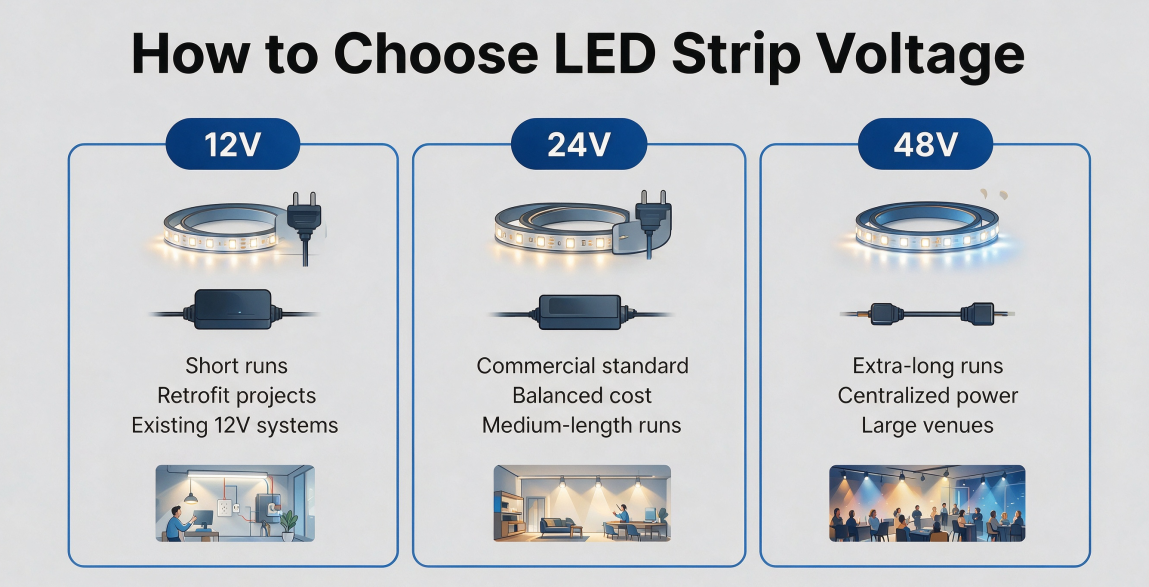
Choose 12V LED strip lights when:
●Runs are short and segmented
●Maximum accessory compatibility is required
●Existing systems already use 12V drivers
Choose 24V LED strip lights when:
●You need a widely supported professional platform
●Medium-to-long commercial runs are standard in your catalog
●You want balanced availability across drivers and accessories
Choose 48V LED strip lights when:
●Long single-feed runs are a design priority
●You are building a complete OEM system (strip + driver + controls)
●Wiring simplification may offset specialized component costs
Many distributors maintain two core voltage platforms — commonly 12V + 24V or 24V + 48V — to cover most commercial LED strip lighting projects without over-complicating inventory.
FAQ: 12V, 24V, and 48V LED Strip Lights
Q1:Is the difference between 12V, 24V, and 48V LED strips only the voltage?
No. While nominal voltage is the primary classification, it affects current draw, recommended LED strip run length, power supply sizing, wiring design, and installation method. Performance also depends on wattage, LED density, PCB quality, and driver compatibility.
Q2:Which voltage is best for long LED strip runs?
In general, 24V and 48V LED strip lights tend to support longer runs with fewer injection points than 12V LED strip lights, but exact limits vary by manufacturer. Always request run-length charts and voltage drop LED strip data before specification.
Q3:Can I use the same power supply for 12V and 24V strips?
No. Drivers must match the strip’s rated input voltage. Using the wrong voltage can cause poor performance or product damage. Verify rated voltage and maximum output current/wattage for every low voltage LED strip order.
Q4:Does higher voltage mean higher lumen output?
Not necessarily. Lumen output depends on LED chip design, drive level, and thermal management — not voltage class alone. Two strips at different voltages can deliver similar lumen ratings when engineered accordingly.
Q5:What do wholesale and OEM buyers request most often?
Many B2B LED strip wholesale customers specify 24V LED strip lights with stable CCT, high CRI options, flexible cut lengths, and consistent binning — plus compliance documentation for repeat orders. 12V LED strip lights remain strong in compact and retrofit applications; 48V LED strip lights demand is often project-specific.
Q6:How do I size the power supply for LED strip lights?
Total wattage = (Watts per meter × total meters) + safety margin. A common practice is adding 10–20% headroom, depending on installation conditions and manufacturer guidance. Confirm calculations with your supplier for large commercial LED strip lighting projects.
Q7:Are 48V LED strips suitable for indoor commercial use?
Low-voltage systems can be suitable for many indoor applications when installed according to local electrical codes and manufacturer instructions. Safety depends on correct driver selection, insulation, IP rating, and qualified installation.
Q8:Can I mix 12V, 24V, and 48V strips in one project?
It is possible with separate drivers and circuits, but it adds complexity. For scalable OEM LED strip lights programs, standardizing on one primary voltage per product family is usually more efficient for inventory, training, and after-sales support.
Conclusion: Voltage Is the Starting Point, Not the Full Answer
12V, 24V, and 48V LED strip lights represent different system architectures — not simply three interchangeable product labels. A thorough LED strip voltage comparison helps B2B buyers match voltage to run length, installation workflow, driver ecosystem, and regional compliance requirements.
Before placing a wholesale order or launching a private-label line, request:
●Official specification sheets and photometric reports
●Run-length and voltage drop LED strip recommendations
●Matched driver and dimming compatibility lists
●Certification documents for target markets
●Sample evaluation under real mounting conditions
That approach supports reliable installations today and repeat business tomorrow.
Need 12V, 24V, or 48V LED strip lights for your next project?
Contact our team for specification sheets, OEM/ODM support, and wholesale pricing tailored to your market.
Facebook:https://www.facebook.com/profile.php?id=100089993887545
Instagram:https://www.instagram.com/mingxuelighting.factory/
YouTube:https://www.youtube.com/channel/UCMGxjM8gU0IOchPdYJ9Qt_w
LinkedIn:https://www.linkedin.com/company/mingxue/
Post time: Jul-22-2026